ToolShedTested is reader-supported. When you buy through links on our site, we may earn an affiliate commission at no extra cost to you.
As an Amazon Associate I earn from qualifying purchases.
The most useful thing to understand about cordless brad nailers before choosing one is that the nail gauge and the battery platform matter more than brand loyalty. Brad nailers drive 18-gauge nails -- a slender, small-head fastener designed for light trim work where the nail hole needs minimal filling and the holding power requirement is modest. If you are hanging baseboards, attaching cabinet face frames, assembling furniture carcasses, or doing general finish carpentry where you do not need the holding power of 15-gauge or 16-gauge finish nails, an 18-gauge brad nailer is the right tool. The move to cordless has made brad nailers significantly more useful on job sites -- no compressor to haul, no hose to trip over, and the ability to reach trim on a second-floor landing without an air line from the basement. I tested all five tools on 3/4-inch pine baseboards, 3/4-inch red oak face frames, poplar door casing, and MDF furniture panels across the full nail length range each tool accepts (typically 5/8 inch to 2 inches for 18-gauge). The price range is $70 to $130, and the differences that matter for the right choice are depth adjustment precision, nail length range, drive consistency across species, and battery platform compatibility.
Top pick for overall performance: DeWalt DCN680B at $130. Consistent flush drives on hardwood and softwood, the best depth wheel in the test, and clean integration into the 20V MAX platform. Check the current price on Amazon.
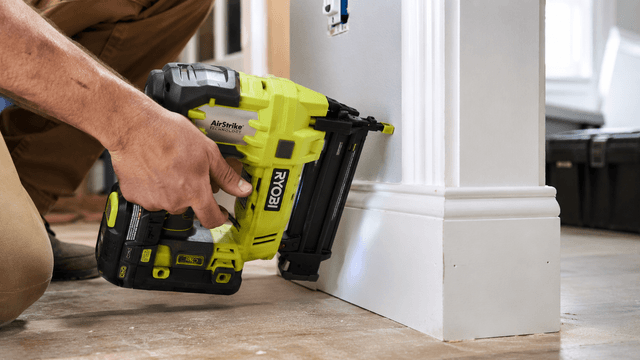
Top pick for value: Ryobi PCL100B at $80. Solid drive consistency for a budget cordless brad nailer, compatible with the widely available Ryobi ONE+ platform, and priced right for homeowners and light-duty finish carpentry. Check the current price on Amazon.
Our Top 5 Brad Nailers
| Brad Nailer | Best For | Price | Rating |
|---|---|---|---|
| DeWalt 20V MAX DCN680B | Best Overall | $130 | 4.8/5 |
| Ryobi 18V ONE+ PCL100B | Best Value Cordless | $80 | 4.5/5 |
| Makita 18V LXT XNB01Z | Best for Makita Users | $120 | 4.6/5 |
| Porter-Cable 20V MAX PCC790LA | Best Budget Cordless | $100 | 4.3/5 |
| Freeman PE20VB2 20V Brushless | Best Budget | $70 | 4.2/5 |
1. DeWalt 20V MAX Cordless Brad Nailer (DCN680B) -- Best Overall
The DCN680B is the brad nailer I would put in the hands of a finish carpenter doing production trim work on a job site. The drive consistency is the best in this test -- 18-gauge nails sit flush or just slightly below the surface in pine, poplar, oak, and MDF without requiring depth wheel adjustment between species on a typical day of mixed-material trim work. The depth adjustment wheel is the most precise in the test: each click produces a small, repeatable change in drive depth, and the full range from surface-proud to countersunk-below is covered in a span of wheel rotation that feels controlled rather than coarse. On red oak face frames -- the hardest test material in the evaluation -- the DCN680B drove 1-1/4-inch 18-gauge nails consistently flush without blowthrough or bounce-back across 50 consecutive fasteners, which is the best single-material result in the test.
The tool-free depth adjustment and tool-free jam clearing are both genuinely functional on this nailer, not checkbox features. The jam clearing latch at the nose opens the nosepiece cleanly and gives enough access to clear a bent nail without a secondary tool in almost every real-world jam scenario I encountered. The no-mar tip is a rubber pad over the nosepiece that prevents marking painted or prefinished trim surfaces -- it works as intended on painted pine and prefinished MDF and is reversible (pops off when you do not want the extra nose depth for precise placement in corners). The sequential fire mode is the only firing mode on this tool, which is the correct choice for brad nail precision work -- bump-fire on an 18-gauge nailer produces nail placement errors that matter on visible trim.
The DCN680B is a bare tool -- no battery included -- which means it only makes sense to buy it if you are already on the 20V MAX DeWalt platform or planning to build out that platform. A 20V MAX 2.0Ah battery runs approximately 700-900 brad nails per charge in typical trim work, which is enough for a full day of baseboards and casing on a standard room. The tool is brushless, which contributes to drive consistency across the battery charge cycle -- brushless motors maintain power delivery more consistently as battery voltage drops compared to brushed motors, which matters when you are driving nail 800 on a low battery and still need a flush result. At $130 for the bare tool, the DCN680B is the most expensive nailer in this test and worth the price specifically for the drive consistency and depth adjustment precision it delivers.
- Best drive consistency in test -- flush or slightly below surface across pine, poplar, oak, and MDF without species-to-species depth wheel adjustment
- Most precise depth adjustment wheel in test -- small, repeatable clicks through full range from proud to countersunk
- Tool-free jam clearing with functional nose access -- clears bent nails without a secondary tool in most jam scenarios
- Brushless motor -- consistent power delivery across the full battery charge cycle
- Sequential fire only -- correct for precision brad nail placement on visible trim
- No-mar tip included -- protects painted and prefinished surfaces; removable for corner work
- $130 bare tool -- justified for production trim work and existing DeWalt 20V MAX platform users
Specs: Nail Gauge: 18-gauge | Nail Length: 5/8 inch to 2-1/8 inch | Firing Mode: Sequential | Drive Mechanism: Brushless electric | Depth Adjustment: Tool-free wheel | Jam Clearing: Tool-free | Weight: 5.1 lbs (bare) | Battery Platform: DeWalt 20V MAX | Best For: Production trim work, finish carpentry, job site use, DeWalt platform users
2. Ryobi 18V ONE+ Brad Nailer (PCL100B) -- Best Value Cordless
The Ryobi PCL100B is the brad nailer I would recommend to a homeowner doing their own baseboard installation, a first-time finish carpentry project, or light shop work where the cost of entry matters more than production-level consistency. At $80 for the bare tool -- or frequently available as a kit with a battery and charger for around $100-120 -- it is the most accessible cordless brad nailer in this test and it performs well enough for non-production use without significant frustration. In the test, the PCL100B drove 18-gauge nails in pine and MDF with acceptable consistency -- most nails landed flush or slightly below the surface, with occasional proud drives requiring a nail set to complete the countersink. On red oak, the drive results were more variable, with a higher proportion of proud drives at the same depth setting used for softwood, which means a depth adjustment is required when moving from softwood to hardwood with this tool.
The depth adjustment on the PCL100B uses a thumbwheel with less feedback per click than the DeWalt -- the adjustment range is adequate but the coarser feel makes dialing in a precise depth setting for a specific material take more trial drives on scrap. For a homeowner doing a few rooms of baseboard over a weekend, this is not a meaningful limitation -- you dial it in, drive some test nails, adjust once, and proceed. For a contractor switching between hardwood and softwood trim multiple times in a day, the less precise adjustment is a slower workflow. The jam clearing on the Ryobi is straightforward -- a latch at the nose opens the nosepiece for nail access -- and the no-mar pad is included and functions correctly on painted surfaces.
The Ryobi ONE+ battery platform is one of the widest-compatible cordless tool ecosystems available, with compatible batteries spanning a large range of Ryobi tools from 2011 to present. If you already own any Ryobi ONE+ tools and have batteries on hand, the PCL100B at $80 is an exceptionally cost-effective way to add a brad nailer to the kit. A 2.0Ah ONE+ battery runs approximately 600-700 nails per charge in softwood trim work, which is enough for most homeowner project sessions. The PCL100B is a brushed motor tool, which contributes to the slight power delivery drop toward the end of a battery charge compared to brushless tools -- for the nail volumes a homeowner drives in a typical session, this is not a practical limitation. At $80 bare, the PCL100B is the right choice when budget is the primary constraint and the application is homeowner or light-duty trim work.
- Best price in test at $80 bare -- frequently available as kit with battery and charger for $100-120
- Compatible with Ryobi ONE+ platform -- right choice for existing Ryobi battery users
- Acceptable drive consistency on softwood -- most nails flush to slightly below, occasional proud drives requiring nail set
- More variable on hardwood -- depth adjustment required when switching between softwood and hardwood materials
- Coarser depth adjustment wheel than DeWalt -- adequate for homeowner use, slower for production hardwood/softwood switching
- Tool-free jam clearing -- functional nose access for bent nail removal
- $80 bare tool -- right for homeowners, first-time finish carpentry, existing Ryobi ONE+ platform users
Specs: Nail Gauge: 18-gauge | Nail Length: 5/8 inch to 2 inch | Firing Mode: Sequential | Drive Mechanism: Brushed electric | Depth Adjustment: Tool-free thumbwheel | Jam Clearing: Tool-free | Weight: 5.3 lbs (bare) | Battery Platform: Ryobi 18V ONE+ | Best For: Homeowner trim work, baseboard installation, light finish carpentry, existing Ryobi ONE+ users
3. Makita 18V LXT Brad Nailer (XNB01Z) -- Best for Makita Users
The Makita XNB01Z is the straightforward pick if you are already in the Makita 18V LXT battery ecosystem and want a brad nailer that integrates cleanly into that platform without compromise. The drive performance in this test was second only to the DeWalt -- consistent flush drives in pine and poplar across the nail length range, slightly more variable on red oak but significantly less so than the Ryobi. The depth adjustment wheel is well-designed with clear detent feedback per click and a full adjustment range that covers the transition from softwood to hardwood with a reliable, repeatable number of clicks. In the test, moving from pine baseboards to oak face frames required two clicks of depth increase on the Makita -- a predictable, consistent adjustment that experienced users will quickly internalize.
The Makita uses a spring-drive mechanism rather than a flywheel mechanism, which affects how the tool feels during rapid sequential firing. Spring-drive nailers require a brief cycle time between drives -- you cannot fire the next nail until the spring mechanism has reset, which is a slight limitation on drive speed compared to flywheel-based tools. In practice, for finish carpentry where nail placement precision matters, the cycle time is not a constraint -- you are not driving nails faster than the spring can reset on typical trim work. The tool-free depth adjustment and tool-free jam clearing both function well; the jam clearing in particular has a well-designed nose opening that gives better nail access than the Porter-Cable in the same test scenario.
The XNB01Z is a bare tool, and Makita LXT batteries are among the most widely available cordless tool batteries in the professional and prosumer market. A 3.0Ah LXT battery runs comfortably through a full day of trim work at the volumes most contractors encounter, and the XNB01Z is compatible with the full LXT range from 1.5Ah to 6.0Ah batteries. At $120 bare, the XNB01Z is priced $10 below the DeWalt and delivers results close enough in practice that if you are a Makita LXT user, there is no reason to cross platforms for the DeWalt. If you are starting a new platform from scratch, the DeWalt at $10 more has a slight edge in depth adjustment precision that would tip the decision. For existing Makita LXT users, the XNB01Z is the correct buy.
- Second-best drive consistency in test -- flush drives on pine and poplar, reliable on oak with predictable depth adjustment
- Precise depth adjustment wheel -- clear detent feedback, predictable click count for hardwood-to-softwood transition
- Spring-drive mechanism -- slight cycle time between rapid sequential drives; not a practical limitation for finish carpentry
- Well-designed jam clearing nose -- better nail access than Porter-Cable in same jam scenario
- Compatible with full Makita 18V LXT platform -- 1.5Ah to 6.0Ah batteries
- $120 bare tool -- right choice for existing Makita LXT users; no need to cross platforms for the DeWalt
Specs: Nail Gauge: 18-gauge | Nail Length: 5/8 inch to 2 inch | Firing Mode: Sequential | Drive Mechanism: Spring electric | Depth Adjustment: Tool-free wheel | Jam Clearing: Tool-free | Weight: 5.0 lbs (bare) | Battery Platform: Makita 18V LXT | Best For: Existing Makita LXT users, professional finish carpentry, mixed-material trim work
4. Porter-Cable 20V MAX Brad Nailer (PCC790LA) -- Best Budget Cordless
The Porter-Cable PCC790LA is typically sold as a kit -- bare tool plus battery plus charger -- which changes the effective price comparison against bare tools in this test. As a complete kit in the $100 range, it is the only option here that includes everything needed to start nailing without an existing battery investment, which makes it specifically appealing to someone buying their first cordless nailer who does not yet own tools on any platform. The drive performance in the test was acceptable for general softwood trim work -- pine and MDF drives were mostly flush with a higher proportion of proud-by-a-small-amount results than the DeWalt or Makita, and occasional blank-fire misfires occurred at a rate that would be acceptable for homeowner use but noticeable for production work.
The depth adjustment on the PCC790LA is a wheel with a wider-spaced click feel -- adjustments are coarser than the DeWalt or Makita, which means getting a precise depth setting for a specific material takes more test drives. The jam clearing at the nose is functional but the nose opening is slightly more restricted than on the top two tools, requiring more manipulation in a real jam scenario to get the bent nail out cleanly. These are real limitations but appropriately sized ones for the price point and intended use -- a homeowner doing baseboards and casing on a moderate-size remodel is not going to find the PCC790LA's drive precision a daily frustration. The no-mar pad is included, the tool accepts the full 18-gauge range from 5/8 to 2 inches, and the 20V MAX battery included in the kit is a genuine 1.5Ah battery that runs through a reasonable session before requiring a charge.
The Porter-Cable 20V MAX platform is a smaller ecosystem than DeWalt 20V MAX, Ryobi ONE+, or Makita LXT in terms of tool variety and retailer availability. For someone specifically buying into Porter-Cable, the platform is adequate but not as expandable as the larger ecosystems. The kit value proposition is strong -- getting a battery and charger included near or at the price of bare tools from other brands makes the PCC790LA the right choice when starting from zero batteries and wanting to minimize initial investment. At $100 for the kit, it is the best complete-package brad nailer value in this test for buyers who do not have a battery platform preference.
- Typically sold as kit with battery and charger -- best entry point for first-time cordless nailer buyers with no existing battery platform
- Acceptable softwood drive consistency -- mostly flush in pine and MDF, occasional proud drives
- Higher misfire rate than top tools in test -- acceptable for homeowner use, noticeable for production work
- Coarser depth adjustment wheel than DeWalt or Makita -- more test drives needed to dial in precise setting
- Tool-free jam clearing -- functional but more restricted nose opening than top performers
- 20V MAX 1.5Ah battery included -- adequate session runtime for homeowner trim work
- $100 kit -- right for first-time cordless nailer buyers who want everything-included without platform commitment
Specs: Nail Gauge: 18-gauge | Nail Length: 5/8 inch to 2 inch | Firing Mode: Sequential | Drive Mechanism: Electric | Depth Adjustment: Tool-free wheel | Jam Clearing: Tool-free | Weight: 5.4 lbs (bare) | Battery Platform: Porter-Cable 20V MAX | Best For: First-time cordless nailer buyers, homeowner trim work, complete kit value
5. Freeman PE20VB2 20V Brushless Brad Nailer -- Best Budget
The Freeman PE20VB2 is the lowest-cost option in this test and the tool I would recommend when price is the primary constraint and the application is light, infrequent trim work -- a room of baseboards once a year, small furniture assembly projects, light hobby shop work. At $70, it is $60 less than the DeWalt and $10 less than the Ryobi, and for what it costs, it delivers drive performance that is adequate for softwood and MDF without requiring a significant investment. The brushless motor is a genuine specification advantage over some higher-priced brushed alternatives -- brushless motors at this price point represent improved efficiency and consistency relative to what would have been available at $70 a few years ago. In the test, pine and MDF drives were mostly flush, with a similar result profile to the Porter-Cable at a lower price.
The limitations of the Freeman show up in the depth adjustment and drive consistency on hardwood. The depth adjustment mechanism has the coarsest feel of any tool in this test -- the adjustment range is present but the feedback per click is minimal, making it difficult to make small, precise corrections without overshooting the target depth. On red oak, the Freeman had the highest proportion of proud drives in the test, and the depth setting that produced flush results on oak was different enough from the softwood setting that it required an adjustment and multiple test drives when switching. For a user who works exclusively in softwood and MDF -- which describes most homeowner trim work -- this is not a real limitation. For mixed-material use or hardwood face frames, the Freeman is the wrong tool.
Freeman is not a widely recognized brand in the way that DeWalt, Makita, or Ryobi are, and the long-term support and parts availability reflect that -- warranty service and replacement parts are available but not through the same retail network as the major brands. For a tool used lightly and infrequently, this trade-off is acceptable; for a production tool driven hard every day, the brand infrastructure of the major players is worth paying for. The Freeman 20V battery platform is proprietary to Freeman tools -- it does not share batteries with other major tool brands -- which means buying Freeman is a commitment to that platform or an acceptance that the battery only serves this tool. At $70 for a brushless nailer, the Freeman PE20VB2 is the right choice when price is the primary decision driver and the application is light, softwood-focused trim work.
- Lowest price in test at $70 -- right when budget is the primary constraint
- Brushless motor -- genuine specification advantage for efficiency and consistency at this price point
- Adequate softwood and MDF drive consistency -- mostly flush results in light-duty trim work
- Coarsest depth adjustment in test -- difficult to make small precise corrections without overshooting
- Highest proud-drive rate on hardwood -- not the right tool for mixed-material or hardwood face frame work
- Proprietary Freeman 20V battery platform -- does not share batteries with major tool brands
- $70 bare tool -- right for light, infrequent softwood trim work where budget is the deciding factor
Specs: Nail Gauge: 18-gauge | Nail Length: 5/8 inch to 2 inch | Firing Mode: Sequential | Drive Mechanism: Brushless electric | Depth Adjustment: Tool-free wheel | Jam Clearing: Tool-free | Weight: 5.2 lbs (bare) | Battery Platform: Freeman 20V (proprietary) | Best For: Budget-constrained buyers, light homeowner trim work, infrequent softwood and MDF nailing
Brad Nailer Buying Guide
18-Gauge vs. 16-Gauge -- Choosing the Right Nail for the Job
Brad nailers drive 18-gauge nails, which are thinner and have a smaller head than the 16-gauge nails driven by finish nailers. The gauge number describes the nail's diameter: lower gauge numbers mean thicker nails. An 18-gauge brad nail has a diameter of approximately 0.047 inches and a very small, nearly-headless tip; a 16-gauge finish nail has a diameter of approximately 0.062 inches and a slightly larger head. The practical difference for choosing between the two is the holding power and the visibility of the filled nail hole. 18-gauge brad nails hold less -- they are designed for light trim work where the trim itself is held primarily by adhesive (construction adhesive or wood glue) and the nails are positioning fasteners that hold the trim until the adhesive cures, or for thin trim pieces where the reduced diameter prevents splitting. 16-gauge finish nails hold more and are appropriate for heavier trim -- thick door casing, window stool, crown molding that requires positive nail-only holding power, or trim work where adhesive is not used. The nail hole left by an 18-gauge brad is small enough to fill with a fingertip dab of wood filler or spackle and is essentially invisible after painting; a 16-gauge finish nail hole is larger and requires more intentional filling and sanding for an invisible result. For baseboards, small cabinet moldings, furniture trim, and light casing, 18-gauge brads are the right fastener. For heavy casing, structural trim applications, or any trim over 3/4 inch thick on exterior applications, step up to a 16-gauge finish nailer.
Cordless vs. Pneumatic -- What You Actually Trade Off
The cordless brad nailers in this test are more convenient than pneumatic alternatives -- no compressor, no hose, no waiting for the tank to build pressure -- but they do make real trade-offs. Pneumatic brad nailers at the same price point drive more nails before requiring attention (you reload the magazine rather than swap a battery), maintain consistent drive depth as long as the compressor holds pressure (which is more consistent than battery voltage through a charge cycle), and have no motor to wear out in the tool body itself. The tool body of a pneumatic nailer is simpler and more field-repairable than a cordless tool. The advantages of cordless are real on a job site: you can be on a ladder nailing baseboard on a second floor without pulling a hose up the stairs, you can work in a room with no outlet while the compressor is charging in another room, and there is no noise from a compressor running in a finished space. For homeowners and people who nail infrequently, the convenience of cordless outweighs the performance advantages of pneumatic -- you are not driving enough nails to run the battery down mid-session, and the operational simplicity of a cordless tool is worth more than marginal consistency improvements. For production contractors driving thousands of nails per day, the compressor setup cost pays off in operational efficiency. The tools in this test are all competitive with pneumatic nailers for finish quality at the price points they occupy.
Depth Adjustment -- Why It Matters More Than It Seems
Depth adjustment on a brad nailer controls how far the nail is driven below the wood surface -- the difference between a nail tip sitting proud of the surface (requiring a nail set to complete the countersink), flush with the surface (acceptable but slightly visible under paint), and set slightly below the surface (the target, producing a small divot that fills invisibly with wood filler or spackle). Getting the depth setting right for a specific material and nail length is the single most important skill in using a brad nailer correctly, and the quality of the depth adjustment mechanism determines how quickly and precisely you can dial it in. The tools in this test vary significantly in depth adjustment quality -- the DeWalt and Makita have wheels that give clear, small incremental feedback per click, and the Freeman and Porter-Cable have coarser wheels that require more test-and-adjust cycles to find the right setting. The practical approach regardless of tool: always start with a test drive into a scrap piece of the same material and nail length you will use on the actual project, adjust the wheel, and drive another test nail before committing to the production surface. This takes 60 seconds and saves the frustration of proud nails on finished trim that must be set by hand or dimpled nails that cause blowthrough on thin stock.
Jam Clearing -- How to Handle It When It Happens
All brad nailers jam occasionally. The most common cause is a bent or mis-fed nail in the magazine -- the nail folds or rotates slightly during the drive cycle and gets stuck in the nosepiece channel. The frequency of jamming is affected by nail quality (cheap nails with inconsistent dimensions jam more), magazine loading technique (overloading or loading with bent nails causes more jams), and nail length relative to material depth (driving a nail into thin material can cause tip deflection and jamming). When a jam occurs, the correct procedure for every tool in this test is: disconnect the battery first, open the jam clearing latch at the nose of the tool, remove the obstructed nail with needle-nose pliers if it does not fall free, close the nosepiece, and reattach the battery. Attempting to drive another nail to clear a jam without opening the nosepiece can damage the driver blade and create a more serious repair. The tools in this test that clear jams most easily are the DeWalt and Makita -- both have nosepiece latches that open wide enough to access the obstruction cleanly in a single motion. The Freeman and Porter-Cable have more restricted nose openings that require more manipulation on a stubborn jam.
Frequently Asked Questions
Can I use a brad nailer for baseboards?
Yes, with qualifications. An 18-gauge brad nailer is appropriate for baseboards under 3/4 inch thick and for baseboards where construction adhesive is being used to supplement the nail fastening -- in this setup the nails are positioning fasteners while the adhesive provides the long-term hold. For thick baseboards (5/4 stock, heavy profiled trim over 1 inch thick) or for baseboard work where the nails are the primary hold without adhesive backing, a 16-gauge finish nailer provides more holding power and is a better choice. The nail length matters: for baseboards nailed into studs through 1/2-inch drywall, use 1-3/4-inch or 2-inch 18-gauge brads to reach the stud. For baseboards nailed to the bottom plate only, 1-1/4-inch brads are adequate. If the baseboard is MDF or softwood pine and you are using construction adhesive, 18-gauge brads work well. If it is thick oak or dense hardwood baseboard without adhesive, use the finish nailer.
How many nails does a cordless brad nailer hold per charge?
The battery capacity determines how many nails a cordless brad nailer drives per charge, and the estimates vary by tool and battery size. With a 2.0Ah battery, the DeWalt DCN680B drives approximately 700-900 nails per charge in softwood trim work; the Ryobi PCL100B with a 2.0Ah ONE+ battery drives approximately 600-700 nails per charge. With larger batteries (3.0Ah, 4.0Ah, 5.0Ah) the nail count scales proportionally. A typical room of baseboard installation -- 40 linear feet of 8-foot ceiling room -- uses approximately 120-150 nails depending on stud spacing and adhesive use. A 2.0Ah battery is adequate for several rooms per charge on the more efficient tools in this test. For all-day job site use where battery management is a concern, having a second battery on the charger is the correct workflow regardless of battery capacity.
What nail length should I use for cabinet face frames?
For attaching a 3/4-inch face frame to a 3/4-inch cabinet box side, 1-1/4-inch 18-gauge brad nails are the standard choice -- the nail penetrates through the face frame and into the cabinet side enough to hold during assembly and glue cure without blowing through the box back or interior shelf. If you are using glue (which you should be on cabinet face frame assembly -- the nails hold the frame while the glue cures), 1-inch brads are sufficient in most cases since the glue joint provides the long-term hold and the nails only need to resist movement during clamping. For face frames attached to thicker material (1-1/4-inch MDF substrate, double-layer sides) use 1-1/2-inch to 1-3/4-inch brads to achieve adequate penetration depth. Always verify the nail does not exit the back face of the material by measuring the combined stock thickness before choosing nail length -- with 18-gauge brads on cabinet work, a nail breaking through the back of a visible panel is the primary thing to avoid.
Is a brad nailer the same as a finish nailer?
No. Brad nailers drive 18-gauge nails with a nearly headless tip designed for light trim work where minimal hole filling is the priority. Finish nailers drive 15-gauge or 16-gauge nails with a slightly larger head and greater diameter, providing more holding power for heavier trim. The tools are not interchangeable -- magazines and nosepieces are specific to the gauge the tool is designed for, and you cannot run 16-gauge nails through a brad nailer magazine. For most homeowner trim work (baseboards, casing, small moldings, furniture assembly), an 18-gauge brad nailer handles the full job. For heavier trim -- thick hardwood casing, window stool, structural trim applications -- a 16-gauge finish nailer is the right tool. Many contractors own both: the finish nailer for structural trim work and the brad nailer for small moldings and fine trim details where the smaller nail hole is the right result.
The Bottom Line
For most finish carpentry applications -- baseboards, casing, cabinet face frames, furniture assembly, and light trim work -- the DeWalt DCN680B at $130 is the best brad nailer in this test for consistent results and precise depth adjustment. The drive consistency across materials and the well-designed depth wheel make day-to-day trim work faster and more predictable than any other tool in this evaluation, and the brushless motor maintains that consistency through a full battery charge. For existing Makita LXT users, the XNB01Z at $120 delivers results close enough to the DeWalt that there is no reason to cross platforms. For homeowners and first-time finish carpenters where cost is the primary constraint, the Ryobi PCL100B at $80 delivers capable softwood results on the most widely available cordless platform in the home improvement market. The Porter-Cable PCC790LA at $100 as a kit is the right pick for buyers who need everything included -- tool, battery, and charger -- without a platform preference. The Freeman PE20VB2 at $70 closes out the test as the budget option for infrequent softwood-only work where the $60 savings over the DeWalt is the deciding factor.