Choose by the battery you own and the job: M18 for medium-duty tires, DEWALT for vehicle power and inflatables, or a compact platform match for top-offs.
Current recommendations are research-backed. Each article identifies its evidence, sources, update date, and limitations. No current guide is presented as hands-on tested. As an Amazon Associate, ToolShed Tested earns from qualifying purchases. When you buy through our links we may earn a commission -- at no extra cost to you. Product links and article details last reviewed September 6, 2026. Full disclosure.
Quick answer: Start with the battery you already own. The Milwaukee 2848-20 suits M18 owners maintaining passenger and light-truck tires. Choose the DEWALT DCC020IB if you need a vehicle-power fallback or a separate hose for large inflatables. Makita LXT, Milwaukee M12, and RYOBI ONE+ owners have smaller platform-specific alternatives below.
Research comparison, checked September 6, 2026: Recommendations use the manufacturer pages and manuals linked below. They are editorial judgments about documented features, without measured fill-speed or endurance results. Listed configurations are bare tools; Amazon sellers, bundles, condition, price, and availability can change.
Compare the Power Source and First-Use Requirements
Total cost: compare the exact tool price plus any missing battery, compatible charger, and required adapter. If you own none of these platforms, the DEWALT's included vehicle cable may meet your immediate car-tire need without a battery purchase. That is a power-source choice, not evidence that it is the cheapest offer today.
1. Milwaukee 2848-20: M18 Tire Maintenance
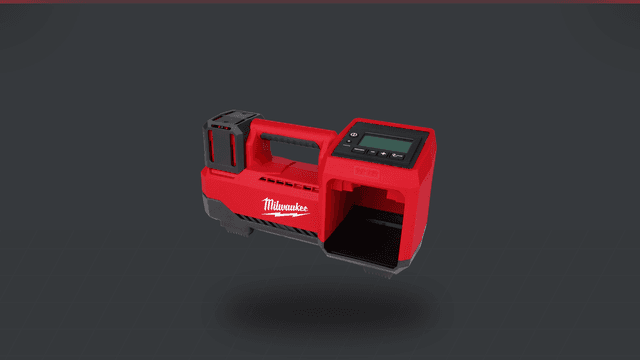
The M18 model is rated to 150 PSI and intended for passenger, light-truck, and medium-duty tires. Four pressure memories and a 36-inch hose are useful when returning to the same vehicles. Its pressure-check sequence pauses, reassesses, and resumes if needed.
Important limit: the 2848-20 manual requires 40 minutes of cooling after 20 minutes of continuous operation. Automatic mode starts at 10 PSI; below that, the manual specifies manual inflation. This is not an unattended shop compressor. Choose it for the documented tire application, not because its maximum PSI proves faster filling.
2. DEWALT DCC020IB: Vehicle Power and Large Inflatables
The DCC020IB manual documents 20V MAX battery operation, a 12V vehicle connection, and the optional N557514 AC power supply. The AC supply is a separate accessory, so do not assume a wall plug is included.
A dedicated high-volume hose handles inflation and deflation of large inflatables; the high-pressure hose serves tires. For items rated above 100 PSI, the manual limits runtime to 10 minutes. Choose this model if those two modes or vehicle power eliminate another purchase. Confirm your vehicle outlet's requirements and follow the manual before use.
3. Makita DMP180ZX: Compact LXT Top-Offs
Makita specifies a 120 PSI maximum, 25.5-inch hose, and 2.3-pound weight without a battery. The standard adapters cover Presta valves, balls, and tapered openings. Auto-stop ends inflation at the set pressure.
This is the DMP180ZX, not the larger DMP181ZX. It makes sense when an existing compatible LXT pack and compact storage matter more than adding another battery system. Check the instructions for operating the trigger; auto-stop alone does not establish unattended operation. The documented application is tire top-offs and smaller inflatables, rather than a high-volume mattress pump.
4. Milwaukee 2475-20: Compact M12 Top-Offs
The 2475-20 has 120 PSI capability, a 26-inch hose, backlit gauge, and automatic shutoff. Milwaukee lists car, light-truck, and compact-equipment tires, with ball and valve accessories.
Choose it when you already have M12 batteries and compact storage is the priority. M12 and M18 are separate battery formats even though the tools share a brand. Repeated large-tire work warrants checking the model-specific runtime and cooling instructions before choosing the smaller unit.
5. RYOBI PCL001B: ONE+ Pressure Maintenance
RYOBI's PCL001B is the tool-only ONE+ model with a digital gauge, automatic shutoff, and a 160 PSI maximum. The manufacturer positions it for car, bike, other small tires, and sports balls.
Buy it for a compatible ONE+ collection and routine pressure maintenance. Its higher maximum than the M18 or Makita does not establish higher airflow or faster filling. It is a high-pressure model; buyers needing a separate high-volume inflation/deflation function should compare the DEWALT instead.
Match the Inflator to the Job
- Routine car top-offs: an existing compatible battery often matters more than the largest pressure number.
- Several large tires: check intended tire class, cooling intervals, and battery requirements. No universal fill-time comparison is established here.
- Emergency vehicle kit: confirm an available power source before relying on a bare tool. A drained battery or an incompatible vehicle outlet defeats the purchase.
- Mattresses and rafts: look for a separate high-volume mode. Tire-pressure capacity does not measure large-volume performance.
- Pneumatic tools: use the required compressor airflow and tank specification, not one of these tire inflators.
Frequently Asked Questions
Which choice works without buying a tool battery?
The DEWALT DCC020IB includes a vehicle-power cable. Its wall-power supply is optional and sold separately. The other compared bare tools require their compatible platform battery.
Does a 160 PSI rating beat 150 PSI?
It only describes the rated pressure ceiling. It does not compare inflation time, sustained airflow, gauge accuracy, or battery endurance. Match the required pressure and the size of the item first.
Can I use the same Milwaukee battery in both models?
No. The 2848-20 uses M18 and the 2475-20 uses M12. Confirm the battery label before ordering.
What pressure should I set for a car tire?
Use the vehicle maker's cold-tire specification. Follow the inflator and vehicle instructions, stay with the tool while it operates, and verify the result with a suitable gauge. A tire's sidewall maximum is not the vehicle's recommended pressure.
For air tools and sustained airflow, compare portable air compressors. For finishing wheel fasteners to their specified torque, compare torque-wrench ranges and accuracy limits. Read the site's research methodology for the distinction between source checking and measured performance.
Our Picks, Reviewed
#1 -- M18 Tire Maintenance
Best for
Best for M18 Medium-Duty Tires
Package
2848-20 tool with Schrader chuck, Presta adapter, inflation needle, and nozzle. M18 battery and charger sold separately.
Choose the M18 model for its intended tire class and saved pressure settings; allow the specified cooling time.
Key features
- 150 PSI maximum rating
- TrueFill auto pressure check and shutoff
- Four PSI memory slots
- 36-inch hose
Pros
- Optimized for passenger and light-truck tires
- Four saved pressure presets
- All-brass Schrader chuck
- Uses Milwaukee M18 batteries
Cons
- Battery and charger sold separately
- Manual requires 40 minutes cooling after 20 minutes continuous use
Who it's for: M18 owners maintaining passenger and light-truck tires within the manual limits.
Check Price on Amazon#2 -- Best for DEWALT
Best for
Most Versatile Power
Package
DCC020IB tool with 12V DC vehicle cable and high-volume hose. Battery, charger, and N557514 AC power supply sold separately.
The flexible-power choice if vehicle-outlet operation or a separate high-volume hose solves your job.
Key features
- 20V MAX battery, 12V DC, or optional N557514 AC power supply
- High-pressure mode with auto shutoff
- High-volume inflation and deflation
- Onboard LED light
Pros
- Can run without a charged tool battery from a vehicle's 12V outlet
- Handles tires and high-volume inflatables
- Threaded chuck and onboard accessory storage
- Uses DEWALT 20V MAX batteries
Cons
- Battery, charger, and AC adapter sold separately
- Larger than the handheld Makita and Ryobi options
Who it's for: DEWALT owners and drivers who value multiple power sources and high-volume inflation or deflation.
Check Price on Amazon#3 -- Best for Makita
Best for
Best for Makita Users
Package
DMP180ZX tool with Presta adapter, ball needle, and tapered adapter. Compatible Makita 18V LXT battery and charger sold separately.
A light, compact platform match with the core pressure preset, auto-stop, display, and lighting features.
Key features
- 120 PSI maximum rating
- Auto-stop at the preset pressure
- 25.5-inch hose
- Backlit display and LED light
Pros
- Published 2.3-pound tool-only weight
- Compact shape for vehicle or tool-bag storage
- Presta adapter, sports-ball needle, and tapered adapter included
- Uses Makita 18V LXT batteries
Cons
- Designed for topping off rather than high-volume inflation
- Battery and charger sold separately
Who it's for: Makita LXT owners who want a compact inflator for car and light-truck top-offs, bicycles, and sports equipment.
Check Price on Amazon#4 -- Best Compact for M12
Best for
Best Compact for M12
Package
2475-20 tool with Schrader chuck, Presta chuck, ball needle, and nozzle. M12 battery and charger sold separately.
The compact Milwaukee option for buyers who do not need the M18 model's medium-duty capacity.
Key features
- 120 PSI capability
- TrueFill auto shutoff
- 26-inch hose
- Backlit digital gauge
Pros
- Compact vehicle-friendly form
- All-brass Schrader chuck
- Anti-vibration feet and reinforced cage
- Uses Milwaukee M12 batteries
Cons
- Better suited to car-tire top-offs than repeated large-tire work
- Battery and charger sold separately
Who it's for: M12 owners who prioritize compact storage and routine passenger-tire maintenance.
Check Price on Amazon#5 -- ONE+ Top-Offs
Best for
Best for ONE+ Top-Offs
Package
PCL001B tool only. RYOBI 18V ONE+ battery and charger sold separately; confirm valve accessories in the exact seller package.
A straightforward platform match for routine pressure maintenance; compare complete package cost.
Key features
- 160 PSI maximum rating
- Digital pressure gauge
- Auto shutoff
- Onboard accessory storage
Pros
- Digital pressure display and auto shutoff
- Uses the existing RYOBI 18V ONE+ battery platform
Cons
- High-pressure only, with no high-volume hose
- Battery and charger sold separately
Who it's for: Ryobi ONE+ owners who want a small, straightforward inflator for routine pressure maintenance.
Check Price on Amazon