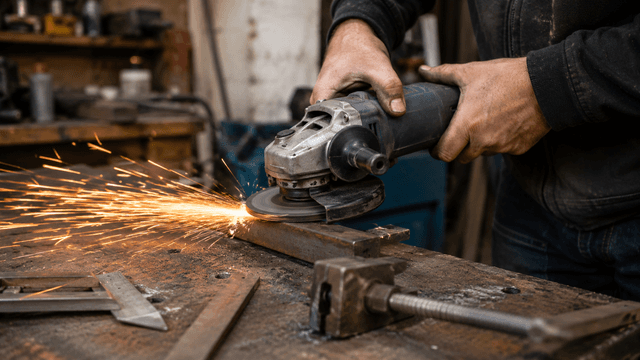
Three exact, currently purchasable angle grinders for different metalworking setups: Milwaukee cordless, Metabo HPT corded, and DEWALT cordless.
Current recommendations are research-backed. Each article identifies its evidence, sources, update date, and limitations. No current guide is presented as hands-on tested. As an Amazon Associate, ToolShed Tested earns from qualifying purchases. When you buy through our links we may earn a commission -- at no extra cost to you. Product links and article details last reviewed August 11, 2026. Full disclosure.
The best angle grinder for metalwork depends first on where the work happens. A corded grinder fits a fixed bench with reliable power. A cordless grinder fits fabrication, repair, and cleanup that moves around a shop, property, or job site.
This guide compares manufacturer specifications and exact Amazon configurations. ToolShedTested did not physically test these grinders or measure cutting speed, runtime, vibration, or wheel-stop time.
Quick answer
- Milwaukee 2880-20: best cordless metalwork pick for buyers already using M18 batteries.
- Metabo HPT G13SE3: best corded value for a fixed work area.
- DEWALT DCG405B: best platform fit for existing DEWALT 20V MAX owners.
Milwaukee specifies an 8,500-RPM M18 FUEL grinder that accepts 4-1/2-inch and 5-inch accessories. The 2880-20 includes a no-lock paddle switch, electronic clutch, RAPIDSTOP brake, overload protection, toolless guard adjustment, and an anti-vibration side handle.
The Amazon configuration is the tool only. It includes the grinder, Type 27 guard, Type 1 clip-on guard, side handle, wrench, back flange, and flange nut, but no battery or charger. That makes it most attractive when compatible M18 batteries are already available.
Check the Milwaukee 2880-20 on Amazon
Manufacturer reference: Milwaukee 2880-20 specifications
The G13SE3 is a 120-volt corded 5-inch grinder with a 10.5-amp motor and 11,500-RPM no-load speed. Metabo HPT lists a locking paddle switch, toolless adjustable guard, soft start, kickback reduction, and zero-voltage restart protection.
The current exact Amazon listing includes the grinder, side handle, spanner wrench, and depressed-center wheel. Choose the corded model when the work stays near an appropriate outlet and stopping to change batteries would add friction.
Check the Metabo HPT G13SE3 on Amazon
Manufacturer reference: Metabo HPT G13SE3 specifications
3. DEWALT DCG405B: best for DEWALT 20V MAX owners
The DCG405B is a brushless, 4-1/2-inch cordless grinder with a slide switch, kickback brake, and electronic brake. The exact Amazon configuration is the tool only and includes a side handle, hex key, flanges, and guard. Battery and charger are separate.
This is a platform decision more than an absolute ranking. A buyer with serviceable DEWALT 20V MAX batteries can avoid the cost and storage of another battery system. Buyers starting from zero should compare the complete battery, charger, and wheel cost of each cordless option before checkout.
Check the DEWALT DCG405B on Amazon
Side-by-side decision
Do not compare no-load RPM alone as a promise of cutting speed. Wheel type, wheel condition, material, pressure, battery state, guard setup, and the manufacturer's permitted application all affect the result.
Wheel and guard compatibility comes first
Match the wheel diameter, arbor, type, and maximum rated speed to the grinder manual. Use the guard type required for that wheel and operation. A grinding wheel, cut-off wheel, flap disc, wire accessory, and diamond wheel are not interchangeable simply because they fit the spindle.
Inspect every wheel before installation. Do not use a cracked, dropped, damaged, expired, or incorrectly rated bonded wheel. Disconnect the plug or remove the battery before changing accessories. Position the guard between the wheel and your body, use the side handle, secure the work, and keep the wheel clear before startup.
Wear the eye, face, hearing, hand, respiratory, and protective-clothing equipment specified by the tool, wheel, and material instructions. Control sparks and hot fragments. Remove combustibles, protect nearby people, and confirm that sparks cannot reach vehicles, finished surfaces, gas cylinders, dust, or hidden spaces.
Do not use a grinder in an explosive atmosphere. Evaluate coatings and the base metal before grinding because some materials create hazardous dust or fumes. Use appropriate extraction and ventilation. When the material is unknown, stop and identify it before cutting or grinding.
Allow the wheel to stop completely before setting the tool down. A brake reduces stopping time under specified conditions but does not replace that rule.