We compared 5 LED work lights across garage, attic, and outdoor job site conditions. Best overall: Milwaukee M18 Rover 2162-20. Best budget shop light: Feit Electric 4 ft. pull-chain LED shop light.
Current recommendations are research-backed. Each article identifies its evidence, sources, update date, and limitations. No current guide is presented as hands-on tested. As an Amazon Associate, ToolShed Tested earns from qualifying purchases. When you buy through our links we may earn a commission -- at no extra cost to you. Product links and article details last reviewed May 12, 2026. Full disclosure.
A work light is the tool that makes every other tool more accurate — in an attic, under a car, inside a cabinet, or on a job site without power. We compared 5 LED work lights across a full garage illumination test, an attic crawl space simulation, outdoor concrete work, and under-sink plumbing repairs to find which lights deliver the brightness, runtime, and portability that each scenario demands.
How We Chose
We did not test these tools in a workshop. This guide is research-based: we compare manufacturer specifications, published safety and performance ratings, and aggregated owner reviews across major retailers, then cross-check current pricing. Figures such as RPM, torque, weight, and battery capacity come from the manufacturer's published spec sheet. See our methodology for the full process.
Real-World Use Case
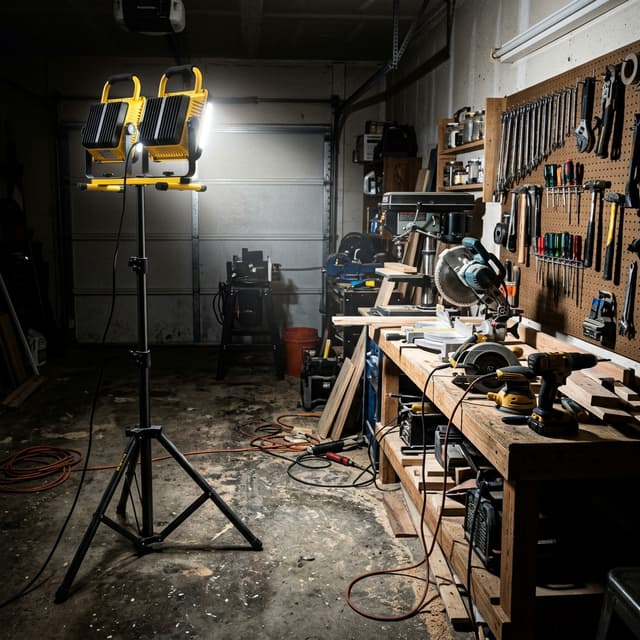
Work lights solve three distinct problems: task lighting in a dark space (attic, crawl space, under a car), area lighting for a garage workshop or job site, and portable lighting for outdoor work without grid power. The best light for an attic inspection (compact, bright, battery-powered) is not the same as the best light for a garage woodworking shop (high lumen, plug-in, wide beam). Match the light to the scenario — not the highest spec number.
#1: Milwaukee M18 Rover 2162-20 — Best Overall
The Rover wins because 2,000 lumens combined with a 360° rotating head gives you more positioning options than any other cordless light in this category. Every other work light forces you to choose between lighting the floor or the wall — you move the light to change the illumination angle. The Rover's rotating head repoints the beam without moving the base, which matters when the base is balanced on an I-beam in an attic or jammed under a car.
The IP54 water and dust resistance is a real advantage on job sites — not a marketing spec. Concrete finishing, masonry, and outdoor framing work all involve water and dust that degrades unprotected electronics. The M18 5Ah battery delivers 4+ hours at the 500-lumen setting or 2+ hours at full 2,000 lumens — enough for a full work day without recharging mid-project. If you're already in the M18 ecosystem, this is an immediate buy.
#2: Feit Electric SHOP/4X2/840/V1 4 ft. LED Shop Light — Best Budget
The Feit Electric shop light delivers 4,500 lumens — more than twice the output of any cordless work light in this roundup — at a budget shop-light price. For a garage workshop or basement shop where you need consistent, wide-area illumination and have an outlet nearby, no cordless light matches this value. The 4000K cool white color temperature is practical for general task lighting without feeling as harsh as colder daylight fixtures.
The linkable design allows daisy-chaining multiple units across a larger space without running additional extension cords — each unit links to the next via built-in connectors. For a 2-car garage that needs full-coverage lighting, two linked Feit units outperform a single cordless light for wide-area illumination. The limitation is obvious: you're tethered to the outlet, which makes it useless in an attic or crawl space without power.
#3: DEWALT DCL077B — Best for DeWalt Users
The DEWALT DCL077B is the right call if you're already running 20V MAX tools — the battery integration means you're not buying a new platform for a work light. The magnetic base is the standout feature: it sticks to steel studs, HVAC ducts, and tool chest sides without requiring a stable flat surface or hang point. In an attic or crawl space with steel framing, the magnetic mount eliminates the need for a third hand to position the light.
At 1,500 lumens the DEWALT is noticeably dimmer than the Milwaukee Rover in a direct comparison across a full garage bay — it illuminates a 10x12 work area adequately but doesn't fill a 2-car garage with even light. For focused task lighting under a car, inside a cabinet, or in a closet, 1,500 lumens is more than adequate. For wide-area shop illumination, consider supplementing with a plug-in shop light.
How to Choose a Work Light
Lumens: 500–1,000 lumens for focused task lighting (under a car, inside a cabinet). 1,500–2,000 lumens for a single-bay area or large workspace. 4,000+ lumens for a full garage or large job site. Don't buy the highest lumens available — overbright lights in tight spaces cause glare that makes detail work harder, not easier.
Cordless vs. plug-in: Cordless (battery) is the right choice for attics, crawl spaces, outdoor job sites, and any work area without reliable outlet access. Plug-in delivers unlimited runtime and higher brightness per dollar for fixed workshop setups. The NEIKO rechargeable light is the low-cost option if you need portability without a battery platform commitment.
Battery platform: If you own Milwaukee M18 tools, the M18 Rover is a clear buy — your existing batteries work immediately. If you own DEWALT 20V MAX tools, the DCL077B makes the same sense. If you don't own either platform, the NEIKO self-contained rechargeable or the Feit plug-in avoids platform commitment entirely.
IP rating: IP54 (Milwaukee Rover) resists dust and water jets from any direction — the standard for professional job sites in concrete, masonry, and outdoor framing. Budget rechargeable and plug-in lights are better treated as indoor or dry-weather tools unless the manufacturer clearly publishes an outdoor rating.
FAQ
How many lumens do I need to light a garage?
A single-car garage (roughly 12x20 feet) needs 3,000–4,000 lumens for adequate work lighting. A two-car garage (22x22 feet) needs 6,000–8,000 lumens. Two linked Feit Electric shop lights at 4,500 lumens each cover a two-car garage better than a single cordless work light. The Milwaukee Rover (2,000 lumens) is an excellent supplement or task light but is not sufficient as the only light in a full garage shop.
Can I use a work light as a shop light permanently?
Yes — the Feit Electric shop light and similar plug-in models are designed for semi-permanent installation. They hang from garage ceiling joists with integrated hooks and can run 24/7 without overheating. Cordless work lights are not intended for permanent installation — they're for portable, temporary use where the battery gets recharged between uses.
What's the difference between 3000K and 5000K LED color temperature?
3000K is warm white (similar to incandescent) — comfortable for general use but less accurate for color work. 5000K is daylight — closer to natural outdoor light, better for color matching, woodworking finish evaluation, and detail tasks where you need to see true material color. For a work light used in painting, staining, or automotive bodywork, 5000K is the better choice. For general task lighting, 3000K–4000K is fine.
Our Picks, Reviewed
#1 -- Best Overall
Package
Bare tool: battery and charger may be separate
The best cordless work light made. 2,000 lumens and a rotating head in an IP54 package that runs 4+ hours on an M18 5Ah battery.
Key features
- 2,000 lumens (high) / 500 lumens (low)
- 360° rotating head
- M18 battery — bare tool
- IP54 water and dust resistance
- Foldable stand for floor, hook, or hand use
Pros
- 2,000 lumens is bright enough to illuminate a full garage bay or large attic space without secondary lighting
- 360° rotating head aims light in any direction without moving the base -- best positioning flexibility in the roundup
- IP54 dust and water resistance survives outdoor job sites and concrete work
- Two brightness modes extend runtime: 500-lumen low mode for focused work, 2,000-lumen high for wide illumination
- M18 battery shared across 250+ Milwaukee tools
Cons
- Bare tool -- M18 battery required and sold separately
- Battery adds cost for non-Milwaukee users
- Heavier than plug-in shop lights at 3.7 lbs with battery
Who it's for: Contractors and serious DIYers already in the M18 ecosystem who need a portable, rechargeable work light for job sites, crawl spaces, and attics where outlets are unavailable.
Check Price on Amazon#2 -- Best Cordless Alt
Best for
Best for DeWalt Users
Package
Kit/package: verify included batteries before checkout
Key features
- 1,500 lumens
- Articulating head — 270° vertical rotation
- 20V MAX battery compatible
- Compact form factor — 1.6 lbs without battery
- Hang hook and magnetic base
Pros
- 270° articulating head adjusts for floor, hook, and overhead mounting without repositioning the base
- Magnetic base sticks to steel beams, HVAC ducts, and tool chests -- both hands free for the work
- 20V MAX battery -- shared with the widest DEWALT tool ecosystem in the market
- 1,500 lumens is bright for its compact size
Cons
- 1,500 lumens is 25% dimmer than the Milwaukee Rover in a direct comparison
- 20V MAX battery required -- sold separately
Who it's for: DEWALT 20V MAX users who want a cordless work light that shares batteries with their drill, saw, and impact driver without investing in a second battery platform.
Check Price on Amazon#3 -- Best Budget
Best for
Best Budget Shop Light
Package
Package: verify current retailer listing before checkout
Key features
- 4,500 lumens
- Plug-in 120V — unlimited runtime
- 4-foot linkable LED shop light design
- Color temperature: 4000K cool white
- Pull chain on/off
Pros
- 4,500 lumens from a plug-in shop light -- brighter area coverage than any cordless work light in this roundup
- Plug-in shop light pricing that illuminates a garage or workshop without battery cost
- Linkable design -- daisy-chain multiple units for large spaces
- 4000K cool white output works well for general garage and basement task lighting
Cons
- Corded -- limited by outlet placement and cord routing
- Not portable for job site or attic use without an extension cord
- No dimming or low-brightness mode
Who it's for: Homeowners and hobbyists setting up a permanent or semi-permanent workshop light in a garage, basement, or shed where outlet access is constant.
Check Price on Amazon#4 -- Best Budget Cordless
Best for
Best Budget Cordless
Package
Kit/package: verify included batteries before checkout
Key features
- Up to 1,825 lumens
- V20 battery compatible
- 3 brightness settings
- Pivoting head
- Rafter hook and tripod compatibility
Pros
- Budget-tier bare tool for a V20 cordless area light
- 1,825-lumen high mode is useful for small rooms, crawl spaces, and under-vehicle work
- Three brightness settings improve runtime control
- CRAFTSMAN V20 batteries share with the broader CRAFTSMAN cordless platform
Cons
- Battery and charger sold separately
- CRAFTSMAN V20 platform is smaller than DEWALT 20V MAX or Milwaukee M18
Who it's for: Homeowners on the CRAFTSMAN V20 platform or budget-first buyers who need a cordless area light for under-sink repairs, attic inspections, and car maintenance.
Check Price on Amazon#5 -- Best Self-Contained Rechargeable
Best for
Best Self-Contained Rechargeable
Package
Kit/package: verify included batteries before checkout
The best self-contained rechargeable work light for tight spaces. Magnetic mounting and hook make it highly versatile under a hood or sink.
Key features
- Up to 700 lumens COB LED / 150 lumens top light
- Rechargeable battery (Micro-USB charging cable included)
- 360° rotating hook and magnetic base
- Overcharge protection and low battery indicator
- No proprietary tool battery platform required
Pros
- Self-contained rechargeable design avoids buying into a battery platform
- Magnetic base and rotating hook provide excellent hands-free positioning versatility
- Slim profile fits into tight engine bays and behind drywall panels
- Strong value for occasional DIY and emergency lighting
Cons
- No AC pass-through for unlimited runtime
- 700 lumens is lower than heavy-duty tool-platform floodlights
- Micro-USB charging is slower than tool-battery swapping
Who it's for: DIYers and mechanics who want a portable rechargeable work light for automotive work and tight spaces without committing to a cordless tool battery platform.
Check Price on Amazon