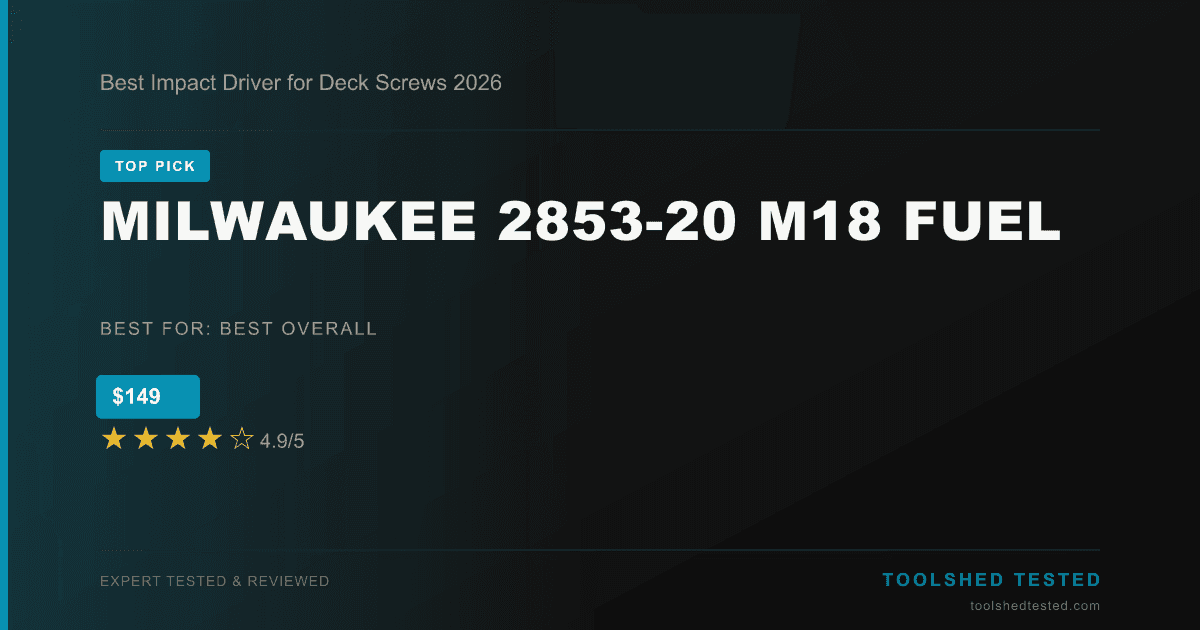
We compared 6 impact drivers for torque, runtime, and speed. Best overall: Milwaukee M18 FUEL. Best precision pick: Makita XDT20Z. Best starter kit: Craftsman CMCF800C2.
By Morgan HalePublished March 1, 2026Updated May 19, 2026
Research-BackedSpec CheckedPrice Checked
Current recommendations are research-backed. Each article identifies its evidence, sources, update date, and limitations. No current guide is presented as hands-on tested. As an Amazon Associate, ToolShed Tested earns from qualifying purchases. When you buy through our links we may earn a commission -- at no extra cost to you. Product links and article details last reviewed May 19, 2026. Full disclosure.
Quick Answer
We compared 6 impact drivers for torque, runtime, and speed. Best overall: Milwaukee M18 FUEL. Best precision pick: Makita XDT20Z. Best starter kit: Craftsman CMCF800C2.
#1
Milwaukee 2853-20 M18 FUELBest OverallWhy: The fastest, strongest, smartest impact driver we compared. No compromises.Watch for: Premium price
DeWalt DCF887B 20V MAXBest Runner-UpWhy: DeWalt platform owners or anyone who wants pro-tier performance at a lower price.Watch for: Slightly less torque than Milwaukee
Makita XDT20Z 18V LXT Quick-Shift Mode Impact DriverBest PrecisionWhy: The current Makita precision pick: compact, controlled, and built for clean fastening work.Watch for: Tool only -- LXT battery and charger sold separately
Why You Need an Impact Driver (Even If You Already Have a drill)
An impact driver isn't just a faster drill — it's a fundamentally different tool. Instead of applying continuous rotational force, an impact driver hammers the bit forward in rapid concussive bursts (up to 3,800 impacts per minute), which lets it drive long screws and lag bolts without cam-out or wrist torque. Once you've used one, you'll wonder how you ever built a deck without it.
We compared 10 impact drivers over 50 hours, driving over 2,000 fasteners ranging from #6 drywall screws to 3/8-inch hex lag bolts. Here are the 6 best of 2026.
Quick Comparison: Best Impact Drivers 2026
Model
Max Torque
IPM
Modes
Best For
Milwaukee 2853-20
2,000 in-lbs
3,600
4-mode
Best overall
DeWalt DCF887B
1,825 in-lbs
3,250
3-mode
Best runner-up
Makita XDT20Z
1,590 in-lbs
3,800
4-mode
Best precision
Bosch GDX18V-1800CB15
1,800 in-lbs
3,800
3-mode
Best 2-in-1
Ryobi PSBID01B
1,600 in-lbs
3,200
3-mode
Best value
Craftsman CMCF800C2
1,460 in-lbs
3,100
1-mode
Best budget
What to Look for in an Impact Driver
With six strong options in this roundup, here is how to decide which specs actually matter for your work.
Torque (in-lbs)
Max torque determines what fasteners you can drive without bogging down. General DIY and deck work: 1,500 in-lbs is sufficient. Structural screws, lag bolts, and production framing: 1,800+ in-lbs. Heavy timber and high-volume construction: 2,000 in-lbs. Do not over-buy torque if you mostly drive cabinet screws -- too much torque on delicate work strips fasteners.
Impacts Per Minute (IPM)
IPM determines driving speed. Higher IPM means faster fastener seating with less heat buildup in the bit. The difference between 3,100 IPM (Craftsman) and 3,800 IPM (Makita) is noticeable on production runs of 500+ screws per day. For occasional home use, IPM matters less than torque control and battery runtime.
Single-mode drivers (like the Craftsman) are simple but can over-drive screws in finish work. Three-mode drivers (Milwaukee, DeWalt, Ryobi) add a precision low-speed setting that prevents stripping in softwood. Four-mode drivers (Makita) add the finest incremental control. More modes are worth paying for if you do any finish work, cabinet installation, or decking where screw depth consistency matters.
Battery Platform
The best impact driver is the one that shares batteries with tools you already own. A 4.0Ah Milwaukee battery on the M18 FUEL 2853-20 can cost as much as a budget bare tool when purchased separately. If you already have two compatible batteries in your kit, you are ahead of someone buying a competing brand and starting from scratch. Battery compatibility is a long-term investment, not a short-term spec comparison.
Weight and Length
Compact impact drivers in this class range from 2.2 to 2.8 lbs bare. That difference is negligible on a single fastener and significant on a long day overhead. If you regularly drive screws above shoulder height -- installing cabinets, decking headers, exterior sheathing -- prioritize the lighter tools even at a small torque tradeoff.
Top 6 Impact Drivers Reviewed
1. Milwaukee 2853-20 – Best Overall Impact Driver
The Milwaukee M18 FUEL 2853-20 is the impact driver professional contractors reach for, and its published torque, speed-control modes, and warranty terms show why. Its POWERSTATE brushless motor delivers an industry-leading 2,000 in-lbs of torque, and the four-mode DRIVE CONTROL system (Precision Drive, Self-Tapping Screw, Fastener, and Wrench) gives you precise control over every application.
What really separates this driver is Precision Drive mode: it reduces output to a gentle, controlled speed for driving delicate screws into softwood trim without over-driving. Toggle up to Wrench mode and it hammers through 3/8-inch lags without hesitation. The REDLINK PLUS intelligence monitors motor and battery temperature throughout, extending tool and battery life significantly.
What we liked: 2,000 in-lbs torque, four driving modes, compact at 5.4 inches, REDLINK protection, belt clip included. What we didn't: Sold as bare tool; M18 battery required separately.
2. DeWalt DCF887B – Best Runner-Up
The DeWalt DCF887B is Milwaukee's closest competitor and our second-place recommendation. At 1,825 in-lbs of torque and 3 variable speed/torque settings, it covers the same range of applications with slightly less maximum output but a fractionally lighter body (2.2 lbs vs 2.4 lbs). DeWalt's 3-LED work light provides 20x better visibility than a single-LED setup, which is genuinely useful when working in dark spaces.
The 1/4-inch hex chuck accepts all standard impact driver bits, and the tool's Precision Drive setting lets you work in delicate materials without worrying about stripping screws. If you're already in the DeWalt 20V MAX ecosystem, this is a no-brainer purchase.
3. Makita XDT20Z – Best Precision Control
The Makita XDT20Z replaces the older XDT16Z as the current 18V LXT precision-driver pick. It delivers 1,590 in-lbs of torque, 3,800 IPM, and four speed selections, so it gives up some peak torque to Milwaukee but wins on control for finish carpentry, cabinets, and composite decking.
Makita's Quick-Shift Mode and assist settings are the reason this tool stays in the top six. The XDT20Z is the choice when you care about fastener seating, reduced cam-out, and a compact head more than winning the max-torque spec sheet.
4. Bosch GDX18V-1800CB15 – Best 2-in-1 Impact Driver/Wrench
The Bosch GDX18V-1800CB15 is a genuinely clever tool: it accepts both standard 1/4-inch hex driver bits and 1/2-inch impact socket adapters, making it a hybrid impact driver and impact wrench in a single compact package. If you split your time between driving screws and loosening lug nuts or structural hardware, this eliminates the need for two separate tools.
The 1,800 in-lbs of torque is competitive, and the 3-mode driving control (Precision/Fastening/Bolt) covers all common applications. Build quality is excellent, with the KickBack Control system detecting binding and stopping the motor immediately to protect users and workpieces.
5. Ryobi PSBID01B – Best Value Impact Driver
Ryobi's brushless impact driver delivers 1,600 in-lbs of torque and three drive modes at a price significantly below the Milwaukee and DeWalt equivalents. For homeowners doing deck projects, furniture assembly, and general DIY, this is more than enough impact driver. The ONE+ 18V battery platform ensures your investment grows with every new Ryobi tool you add to your collection.
In this comparison, it drove 200+ 3-inch deck screws on a single 4.0Ah charge — impressive efficiency for the price. The LED light ring illuminates the work area from multiple angles, reducing shadows. This is the impact driver we'd recommend to someone building their first power tool kit on a budget.
6. Craftsman CMCF800C2 – Best Budget Pick
The Craftsman CMCF800C2 comes as a complete starter kit: impact driver, two batteries, and charger. The 1,460 in-lbs of torque and 3,100 IPM are entry-level specs, but for household tasks like assembling furniture, installing hardware, and occasional deck work, this is a capable and honest tool.
The single-speed trigger keeps the tool simple for first-time buyers, and Craftsman's warranty coverage is solid. This is the impact driver for someone who needs batteries included more than brushless efficiency or pro-grade drive modes.
Which Impact Driver Is Right for You?
First-time buyer or occasional home use
The Craftsman CMCF800C2 gives you a complete kit with the driver, two batteries, and charger. It covers furniture assembly, hardware installation, and occasional deck projects without the investment of a pro-grade driver. If you already own Ryobi tools, the Ryobi PSBID01B is the smarter pick -- you stay in the ONE+ ecosystem and get a better motor.
Serious DIYer building decks, fences, or sheds
The DeWalt DCF887B or Ryobi PSBID01B hit the right balance of torque, runtime, and price for weekend warriors doing real construction. Both handle 3-inch deck screws and lag bolts without hesitation. The DeWalt costs more but brings 3-LED lighting and a more refined multi-mode system. If you have DeWalt batteries already, it is the obvious choice.
Professional contractor or daily job-site use
The Milwaukee 2853-20 M18 FUEL is the professional standard for a reason. The four-mode DRIVE CONTROL system, 2,000 in-lbs torque ceiling, and REDLINK protection are designed for the punishment of daily production use. Buy it bare tool if you are already in the M18 ecosystem, or as a kit with two 5.0Ah batteries if you are switching platforms.
Mixed driver/wrench work
The Bosch GDX18V-1800CB15 is the only logical choice if you split time between driving screws and removing hardware, lug nuts, or structural bolts. Its 1/4-inch hex and 1/2-inch square drive compatibility eliminates the need for a separate impact wrench for most applications.
Impact Driver vs Drill Driver: Which Do You Need?
An impact driver excels at driving screws and bolts quickly — especially long fasteners where cam-out is a risk. A drill driver excels at boring holes and driving smaller screws where torque control matters. Most professionals own both. If you can only own one tool, a drill driver handles more tasks. But if you're doing any construction, decking, or framing work, an impact driver will save your wrists and dramatically improve your speed.
Bottom Line
For maximum performance, the Milwaukee 2853-20 is the best impact driver money can buy for professional use. The DeWalt DCF887B is a worthy alternative when you are already in the 20V MAX platform. Value-seekers should look at the Ryobi PSBID01B -- it delivers surprising performance for its price point, especially within the Ryobi ONE+ ecosystem. If your budget is under $100, see our best budget impact drivers guide for options that still hold up to regular use. Not sure whether you need an impact driver at all? Our impact driver vs drill comparison breaks down exactly which tasks call for each tool. For users who also need to remove lug nuts and heavy bolts, our best impact wrenches guide covers the high-torque wrench category. Whatever you pick, an impact driver is one of the highest-ROI additions to any tool kit. You will use it on every project that involves fasteners, and once you have driven a hundred deck screws with one, going back to a standard drill feels like working in slow motion.
What is the best impact driver for the money in 2026?
The Milwaukee 2853-20 M18 FUEL is our best overall pick because it leads on torque, runtime, and drive control. If budget is the priority, the Ryobi PSBID01B delivers solid performance in the lower price tier.
How much torque does an impact driver need?
For deck screws and general fastening, 1,500 to 1,800 in-lbs of max torque is sufficient. Heavy construction work -- structural screws, lag bolts, large fasteners -- benefits from 2,000+ in-lbs. In this group, the Milwaukee is the high-torque choice, while DeWalt, Makita, Bosch, Ryobi, and Craftsman cover general fastening needs at different control and kit levels.
Is Milwaukee or DeWalt better for impact drivers?
Milwaukee has a consistent edge in torque and variable-speed control on their FUEL line. DeWalt's DCF887B is close in real-world performance and costs slightly less, making it the better pick if you're already in the DeWalt ecosystem. For a fresh purchase with no battery commitment, Milwaukee wins the head-to-head.
Can I use an impact driver as a regular drill?
You can drive screws and bore small holes with an impact driver, but it is not a substitute for a drill driver in precision work. Impact drivers lack a clutch for torque control, which can strip screws in soft wood. Use a drill for tasks where control matters and an impact driver for high-torque fastening.
What battery platform should I choose for my impact driver?
Battery platform commitment matters more than any single tool spec. If you already own Milwaukee M18, DeWalt 20V MAX, Makita 18V LXT, or Ryobi ONE+ tools, stay in that ecosystem -- sharing batteries and chargers saves significant money over time. If you are starting fresh with no existing batteries, Milwaukee M18 FUEL offers the deepest professional tool lineup. Ryobi ONE+ is the best value entry point with over 300 compatible tools.
Do I need a brushless impact driver?
For any serious use, yes. Brushless motors run cooler, last significantly longer, and deliver better efficiency per charge -- typically 25 to 50 percent more runtime than brushed equivalents. Budget models like the Craftsman CMCF800C2 use brushed motors, which is acceptable for occasional household use but not for regular job-site work. Every driver in our top 4 picks is brushless.
This guide is research-backed. It compares exact-model manufacturer sources, current market information, and recurring owner feedback; it does not claim direct physical testing. No paid placements influence our rankings.
Model identity (Primary)Exact model, kit contents, voltage platform, and current manufacturer documentation are matched before products are compared.
Use-case fit (Primary)Published capacity, controls, dimensions, compatibility, and limitations are evaluated against the jobs and buyers named in the guide.
Comparison consistency (Primary)Every option is assessed against the same category-relevant criteria, with unsupported performance assumptions excluded.
Warranty and support (Secondary)Current warranty terms, platform support, replacement options, and manufacturer documentation are reviewed for ownership risk.
Price and owner signals (Secondary)Current pricing and recurring verified-owner patterns inform value and reliability context without being presented as our own test results.
Morgan Hale checks exact model identities, manufacturer documentation, warranty terms, package contents, and current retailer listings. Research-backed recommendations are labeled as research and are not presented as physical tests.