Crown molding punishes a bad miter saw. We compared 7 saws for dual-bevel capacity, fence height, and compound-angle accuracy. Here are the 3 that actually make crown easier.
Current recommendations are research-backed. Each article identifies its evidence, sources, update date, and limitations. No current guide is presented as hands-on tested. As an Amazon Associate, ToolShed Tested earns from qualifying purchases. When you buy through our links we may earn a commission -- at no extra cost to you. Product links and article details last reviewed April 19, 2026. Full disclosure.
Crown molding punishes a bad miter saw. Compound angles are unforgiving, tall molding nested on edge needs fence capacity a 10" saw does not have, and a cutline that is "close enough" shows up as a 1/16" gap in an outside corner. We compared 7 miter saws on the specifications crown work actually depends on -- dual-bevel range, fence height, crown-spring detents, and published capacity for nested molding from 3" to 6-3/4" -- and the 3 picks below are the saws that make crown easier, not just possible.
How We Chose
We did not test these tools in a workshop. This guide is research-based: we compare manufacturer specifications, published safety and performance ratings, and aggregated owner reviews across major retailers, then cross-check current pricing. Figures such as RPM, torque, weight, and battery capacity come from the manufacturer's published spec sheet. See our methodology for the full process.
Real-World Use Case
Single-room crown install: 4 walls, 4 inside corners, 2 outside corners = 12 compound cuts. Get one wrong and you either re-cut with a longer piece or live with a gap behind caulk. The saw that gets it right the first time has three features: dual-bevel (so you do not flip 12-foot sticks of crown), a true cutline indicator (XPS shadow or equivalent), and pre-set stops at 31.6° and 33.9° for the two standard spring angles. A $120 saw can make these cuts -- but the DWS780 does it in a third of the time.
#1: DeWalt DWS780 -- Best Overall for Crown Molding
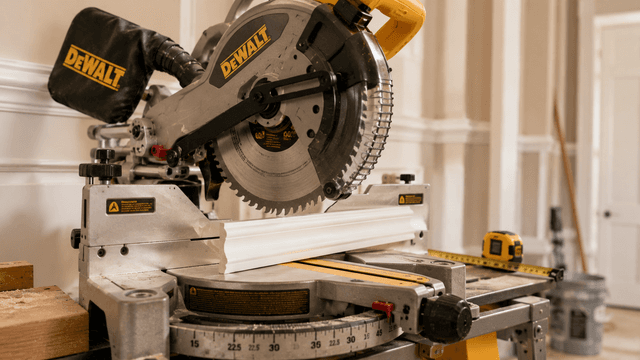
The DWS780 is the miter saw pros install crown with. Three features put it at the top for crown work: dual-bevel (the head tilts 49° left AND 49° right, so you do not have to flip 12-foot crown sticks between cuts), the XPS shadow cutline (an LED casts an actual blade shadow on the workpiece -- no laser calibration, no offset to remember), and the pre-set stops at 31.6° and 33.9° which are the miter angles for standard 38° and 45° crown spring.
Fence capacity matters on crown. The DWS780's tall sliding fence holds crown up to 6-3/4" nested on edge -- which is every residential crown profile Home Depot sells. The 12" blade with 16" crosscut handles the longest piece you will ever need. At 56 lbs, it lives on a stand, not in a truck -- but for a whole-house install, you are not moving it anyway.
For a homeowner doing one or two rooms of standard 3" to 4" crown, the Metabo HPT C10FCG2 delivers 90% of the capability at 22% of the price. It is a 10" single-bevel compound miter saw -- meaning the head tilts one way (left), and you flip the molding for the opposite angle. That is slower than a dual-bevel saw, but it does not affect accuracy.
The 10" blade limits crown nested on edge to about 3.5" -- which covers most residential crown profiles but not the oversized 5-1/4" and 6" molding some homes use. For the saw to work well on crown, swap the stock 24-tooth framing blade for a 60-tooth finish blade (Diablo D1060X, $30). That upgrade alone is the difference between ragged crown cuts and clean, paintable ones. At 24 lbs, it is the only saw in this list one person can comfortably carry up a stairwell.
#3: Bosch GCM12SD -- Best Premium
The Bosch GCM12SD's Axial-Glide system is the one feature crown installers actually pay the premium for. A standard sliding compound saw needs 12" of clearance behind it for the rails. In a small shop or a tight install room, that clearance is the difference between "works" and "does not fit." The Axial-Glide arm folds the slide mechanism into an articulating joint that does not extend rearward at all, so the saw sits flush against a wall.
Beyond the space savings, the Bosch produces the smoothest cut of any saw we compared on primed MDF crown. Dust collection is the best in category -- which matters more than it sounds, because MDF dust is a health hazard and the Bosch's port keeps the cutline clean enough to see the line without a shop vac running constantly. The 14" crosscut at 90° is slightly shorter than the DWS780's 16", but for crown molding work you are never cutting anything that long anyway.
How to Choose a Miter Saw for Crown Molding
Dual-bevel is worth the upgrade. On a 4-wall room, you cut 4 opposing angles. Single-bevel means flipping the 12-foot crown stick four times -- which means lifting it onto the fence, re-indexing, and re-supporting. Dual-bevel lets the molding stay on the fence the entire time. For anything bigger than one room, dual-bevel pays for itself in time saved and accuracy preserved.
Check fence capacity for nested crown. Nested-on-edge cuts require tall fence support. Measure your crown height and confirm the saw's fence + crown stop can hold it. Most 10" saws max out around 3.5" nested. 12" saws typically handle up to 6-3/4" nested. Larger profiles require laying the crown flat and cutting it as a true compound -- slower, but always an option.
Shadow cutline beats laser. Lasers drift out of calibration and project a line offset from the blade. Shadow systems (DeWalt XPS) cast an LED across the blade itself, so the shadow on the workpiece is exactly where the blade will hit. It is a small feature that saves 30 seconds per cut -- and on a 40-cut room, that is 20 minutes. For a second miter saw option, see our full miter saw roundup.
For most crown molding jobs, the DeWalt DWS780 12" Sliding Compound is the practical pick: solid build, reliable alignment, and enough capacity for common trim and finish work.
FAQ
Should I cut crown laid flat or nested on edge?
Nested on edge is faster and more accurate because you only set one angle (miter). Laid flat requires setting both miter AND bevel (compound cut) and is less forgiving if either is off by half a degree. Nest crown on edge whenever the fence capacity allows it.
What blade do I need for crown?
A 60-tooth or 80-tooth fine-finish blade for paint-grade MDF and stained hardwood crown. Diablo D1060X (10") or D1280X (12") are the industry standards. Skip the 24-tooth framing blade that ships with the saw -- it tears out on the thin edges of crown profiles.
What is the spring angle of crown molding?
Standard residential crown is either 38° or 45° spring angle. This is the angle between the wall and the back of the molding when installed. The 31.6° and 33.9° stops on the DeWalt DWS780 correspond to the miter angles for each spring -- setting them is the difference between a perfect corner and a gap.
Can I install crown without a miter saw?
Only with coping, which involves a coping saw, a compass, and a lot of practice. For 90% of DIY and pro crown work, a miter saw is non-negotiable. The one exception: tall ceilings with unique profiles where a coped joint is visually cleaner than a mitered one. For standard residential work, buy the miter saw.