ToolShedTestedWorkshop Spec & Field Reviews
Buying Guides

Best Oscillating Tool Blades for Cutting Metal

George Perkins, authorBy Updated October 23, 2026How we choose

Short answer

For cutting metal with an oscillating tool, the Dremel MM485BU carbide blade is the top pick for hardened fasteners, nails, and bolts, while the DeWalt DWA4250 bi-metal 3-pack is the value choice for general nail and pipe cutting. Match the blade mount to your tool: Bosch Starlock and Milwaukee OPEN-LOK blades fit those systems, so check compatibility before buying.

How we chose: We compared tooth material, mounting system, blade width, and the metal types each manufacturer lists. Research-based, not hands-on testing.

Check price on Amazon
Our Pick · Best Overall
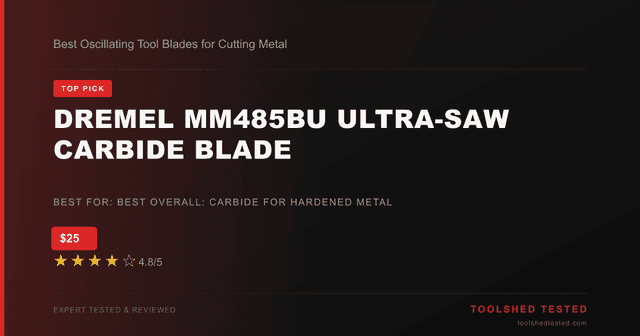
Dremel MM485BU Ultra-Saw Carbide Blade
Research rank #1Amazon paid link; price & availability change.
Research-BackedSpec CheckedPrice Checked

Current recommendations are research-backed. Each article identifies its evidence, sources, update date, and limitations. No current guide is presented as hands-on tested. As an Amazon Associate, ToolShed Tested earns from qualifying purchases. When you buy through our links we may earn a commission -- at no extra cost to you. Product links and article details last reviewed October 23, 2026. Full disclosure.

Quick Verdict -- Our Top Picks
Research-BackedSpec CheckedPrice Checked
Compare PicksRead Notes
★ Best Overall: Carbide for Hardened Metal#01

Tungsten carbide grit cuts hardened metal, tile, and fiberglass that bi-metal blades skip off

Best Value: General Nail and Pipe Cutting#02

3-pack covers most nail-cutting and pipe-cutting jobs in one purchase

Best for Embedded Nails#03

Starlock interface locks directly into Bosch and compatible tools without an adapter -- most secure attachment in this group

At-a-Glance Comparison
#Model & CategoryBuy If / Skip IfShop
#1
#1 Pick$$
Best Overall: Carbide for Hardened Metal
Verify package
✓ Buy if:Tungsten carbide grit cuts hardened metal, tile, and fiberglass that bi-metal blades skip off
✕ Skip if:Premium single-blade pricing -- highest per-unit cost in this group
#2
$
Best Value: General Nail and Pipe Cutting
Verify package
✓ Buy if:3-pack covers most nail-cutting and pipe-cutting jobs in one purchase
✕ Skip if:Bi-metal blades dull faster than carbide on hardened steel, cast iron, or stainless
#3
$$
Best for Embedded Nails
Verify package
✓ Buy if:Starlock interface locks directly into Bosch and compatible tools without an adapter -- most secure attachment in this group
✕ Skip if:Starlock interface is Bosch-proprietary -- requires an adapter for non-Starlock tools
#4
$$
Best for Demolition
Verify package
✓ Buy if:Milwaukee OPEN-LOK interface installs and removes without a wrench in 5 seconds -- the fastest blade change in this group
✕ Skip if:OPEN-LOK interface is Milwaukee-proprietary -- requires an adapter for non-Milwaukee tools
#5
$
Best Budget: High Volume Cutting
Verify package
✓ Buy if:Lowest price tier in this group -- the best value for high-volume nail and pipe cutting
✕ Skip if:Bi-metal dulls faster than carbide alternatives on hardened steel

Our Picks, Reviewed

SPEC SHEET // #01 -- Best Overall: Carbide for Hardened MetalREF: B00FBHFY3K

Dremel MM485BU Ultra-Saw Carbide Blade

Check Price on Amazon →
Best for
Best Overall: Carbide for Hardened Metal
Package
Package: verify current retailer listing before checkout
✓ What Stands Out (Pros)
  • Tungsten carbide grit cuts hardened metal, tile, and fiberglass that bi-metal blades skip off
  • Ultra-Saw carbide formula outlasts standard bi-metal blades 10:1 on hardened steel
  • Universal fitment with adapter fits Milwaukee, DeWalt, Makita, Bosch, and Dremel oscillating tools
  • 2-year warranty on manufacturing defects
✕ Watch Out For (Cons)
  • Premium single-blade pricing -- highest per-unit cost in this group
  • Carbide grit cuts slower than bi-metal on soft metals like copper and thin sheet steel
Check Price on Amazon
SPEC SHEET // #02 -- Best Value: General Nail and Pipe CuttingREF: B01GLGFTMK

DeWalt DWA4250 Bi-Metal Blade 3-Pack

Check Price on Amazon →
Best for
Best Value: General Nail and Pipe Cutting
Package
Package: verify current retailer listing before checkout
✓ What Stands Out (Pros)
  • 3-pack covers most nail-cutting and pipe-cutting jobs in one purchase
  • Bi-metal construction handles nails embedded in wood and light steel pipe without snapping
  • DeWalt IMPACT TOUGH design absorbs oscillating force for longer blade life than standard bi-metal
  • Compatible with all standard oscillating tool interfaces with included adapter
✕ Watch Out For (Cons)
  • Bi-metal blades dull faster than carbide on hardened steel, cast iron, or stainless
  • 3-pack depletes quickly on high-volume demo or plumbing work
Check Price on Amazon
SPEC SHEET // #03 -- Best for Embedded NailsREF: B01DDA7QZA

Bosch OSL114C Starlock Carbide Blade

Check Price on Amazon →
Best for
Best for Embedded Nails
Package
Package: verify current retailer listing before checkout
✓ What Stands Out (Pros)
  • Starlock interface locks directly into Bosch and compatible tools without an adapter -- most secure attachment in this group
  • Carbide construction cuts through nails in hardwood framing without the blade skating off
  • Narrow 1-1/4" width reaches into tight spaces between studs and joists
  • 2-year warranty
✕ Watch Out For (Cons)
  • Starlock interface is Bosch-proprietary -- requires an adapter for non-Starlock tools
  • Premium single-blade pricing for single-task use
Check Price on Amazon
SPEC SHEET // #04 -- Best for DemolitionREF: B094QFZQL6

Milwaukee 49-25-1263 OPEN-LOK Carbide Blade

Check Price on Amazon →
Best for
Best for Demolition
Package
Package: verify current retailer listing before checkout
✓ What Stands Out (Pros)
  • Milwaukee OPEN-LOK interface installs and removes without a wrench in 5 seconds -- the fastest blade change in this group
  • Carbide construction handles rebar, hardened steel bolts, and embedded nail clusters in demolition work
  • Wide 1-3/8" blade covers more surface area per oscillation for faster cut completion
  • 2-year warranty
✕ Watch Out For (Cons)
  • OPEN-LOK interface is Milwaukee-proprietary -- requires an adapter for non-Milwaukee tools
  • Premium per-blade cost is the highest price in this group
Check Price on Amazon
SPEC SHEET // #05 -- Best Budget: High Volume Cutting

Imperial Blades IBOA270 Bi-Metal Blade

Check Price on Amazon →
Best for
Best Budget: High Volume Cutting
Package
Package: verify current retailer listing before checkout
✓ What Stands Out (Pros)
  • Lowest price tier in this group -- the best value for high-volume nail and pipe cutting
  • Bi-metal construction handles standard embedded nails and thin-wall pipe without snapping
  • Universal fitment adapts to all major oscillating tool brands
  • 1-year warranty
✕ Watch Out For (Cons)
  • Bi-metal dulls faster than carbide alternatives on hardened steel
  • Single-blade pack depletes quickly on sustained demo work -- buy in bulk for production use
Check Price on Amazon
Standard bi-metal oscillating blades work fine for a few cuts through copper pipe or drywall nails. But if you are doing demolition, remodeling, or any job that involves cutting multiple fasteners or pieces of metal, those blades dull fast and start generating heat instead of cutting. Carbide and specialty metal-cutting blades cost more per blade but save time and frustration. Here are the five best oscillating tool blades for cutting metal in 2026.

Comparison Table

BladeTypeWidthTooth MaterialBest For
Dremel MM485BUFlush-cut1-1/4"CarbideHardened steel, nails, bolts
DeWalt DWA4250Flush-cut1-3/4"Bi-metalGeneral metal, pipes, nails
Bosch OSL114CPlunge-cut1-1/4"CarbideEmbedded nails, screws in wood
Milwaukee 49-25-1263Flush-cut1-3/4"Bi-metal/carbideDemolition, nail-embedded wood
Imperial Blades IBOA270Flush-cut1-1/4"Bi-metalBudget metal cutting

1. Dremel MM485BU Ultra-Saw Carbide — Best Overall

The MM485BU uses carbide teeth brazed onto the cutting edge, and the difference compared to bi-metal is dramatic. Where a bi-metal blade starts to dull after 5-10 cuts through 16d nails, the Dremel carbide blade maintains a clean cut through 50 or more. It handles hardened steel, stainless, and case-hardened fasteners that destroy bi-metal blades on contact. The 1-1/4" width is ideal for precision cuts in tight spaces — cutting flush with a surface to remove protruding bolts or trimming nail heads. The Starlock mounting system provides a rigid connection that reduces vibration and wobble at the arbor. If your oscillating tool uses a universal mount, Dremel includes an adapter. The cost per blade is higher than bi-metal. But the lifespan is so much longer that the cost per cut is actually lower if you are doing more than occasional metal work. Who this is for: Remodelers, plumbers, and anyone who cuts metal frequently with an oscillating tool. Who should skip it: If you only need to cut through a couple of nails once a year, a cheaper bi-metal blade is fine.

2. DeWalt DWA4250 Bi-Metal Blade (3-Pack) — Best Value

The DWA4250 is a workhorse bi-metal blade that handles copper pipe, galvanized nails, thin sheet metal, and conduit without drama. The 1-3/4" width gives you a wider cutting surface than the Dremel, which speeds up cuts through larger materials like copper DWV pipe. The bi-metal construction uses a high-speed steel tooth edge welded to a flexible spring-steel body. This combination lets the blade flex slightly without snapping — important in demolition work where you are cutting at odd angles. The universal fit works with DeWalt, Milwaukee, Makita, Bosch, and most other oscillating tools. These come in a 3-pack, and you should plan to use all three on any serious project. A single blade lasts about 20-30 cuts through standard nails before the teeth round off. That is normal for bi-metal — just swap in a fresh blade and keep moving. Who this is for: General contractors and DIYers who need reliable, affordable metal-cutting blades for occasional to moderate use. Who should skip it: Anyone cutting hardened steel or doing high-volume nail cutting — move up to carbide.

3. Bosch OSL114C Starlock Carbide — Best for Embedded Nails

The Bosch OSL114C is designed specifically for plunge cuts through nail-embedded wood. The carbide teeth cut through both the wood and the embedded fastener in a single pass — no need to switch between a wood blade and a metal blade. This is a massive time saver during remodeling work where every piece of old trim has three nails in it. The Starlock mount provides the most rigid blade connection of any oscillating tool system. Less wobble means cleaner cuts and longer blade life. If you have a Bosch Starlock tool, this blade feels like it is part of the machine. Universal-mount users can use an adapter, but you lose some of the rigidity advantage. The blade is 1-1/4" wide with an aggressive tooth geometry that grabs both wood and metal effectively. It does run hotter than pure metal-cutting blades, so take a pause every few cuts when working through thick hardened fasteners. Who this is for: Remodelers removing old trim, subfloor, or framing that is full of hidden nails and screws. Who should skip it: If you are cutting exposed metal (not embedded in wood), the Dremel MM485BU is a better pure metal-cutting blade.

4. Milwaukee 49-25-1263 OPEN-LOK Carbide — Best for Demolition

Milwaukee designed the 49-25-1263 for demolition contractors. The carbide-enhanced teeth chew through nails, screws, and staples embedded in wood without slowing down. The OPEN-LOK mounting system is Milwaukee's proprietary quick-change system — blade changes take about one second without tools. On a demo job where you are burning through blades, that speed adds up. The 1-3/4" width gives you a larger cutting surface for faster cuts through subfloor and sheathing. The blade body is thicker than most competitors, which reduces flex and gives more aggressive cutting action. The downside is that thicker blade means wider kerf and more material removal, which generates more heat. If you use Milwaukee M18 oscillating tools, the OPEN-LOK system is a compelling reason to stay in-family. But these blades also work with universal mounts via an included adapter, so Makita and DeWalt users can run them too. Who this is for: Demolition contractors and remodelers tearing out nail-filled subfloor, lath, and old framing. Who should skip it: Finish carpenters or anyone doing precision metal cuts where kerf width matters.

5. Imperial Blades IBOA270 — Best Budget Bi-Metal

Imperial Blades is a US-based blade manufacturer that often gets overlooked next to the big tool brands. The IBOA270 is a solid bi-metal blade that costs less per blade than DeWalt or Milwaukee equivalents while delivering comparable cut quality. The 1-1/4" width and universal fit make it compatible with virtually every oscillating tool on the market. The bi-metal construction handles copper pipe, galvanized nails, conduit, and thin sheet metal. Blade life is on par with the DeWalt DWA4250 — expect 20-30 cuts through standard nails before swapping. Imperial Blades sells these in bulk packs, which drops the per-blade cost even further. If you go through a lot of oscillating blades on remodeling or plumbing work, buying a 10-pack of these is the most economical approach. Who this is for: High-volume users who want decent bi-metal blades at the lowest cost per blade. Who should skip it: Anyone who needs carbide performance — no amount of bi-metal blades will match carbide on hardened steel.

Tips for Cutting Metal with an Oscillating Tool

Let the blade do the work. Apply light, steady pressure. Pushing hard overheats the blade, dulls the teeth, and can cause the tool to stall or kick. Use the right speed. Most oscillating tools have variable speed. For metal, run at medium to medium-high speed. Full speed generates too much heat on thick steel. Score first, then cut. On sheet metal, make a light scoring pass to establish the cut line before cutting through. This prevents the blade from wandering. Keep a spare blade handy. Bi-metal blades dull suddenly, not gradually. When cuts start taking twice as long, swap the blade — do not push harder. Wear gloves. Cut metal edges are razor sharp. Leather gloves protect your hands when handling cut pieces.

Bottom Line

The Dremel MM485BU carbide blade is the best oscillating blade for metal cutting, period. The upfront cost is higher, but the blade lasts so much longer that it pays for itself after a few dozen cuts. For occasional metal cutting on a budget, the DeWalt DWA4250 3-pack gives you reliable bi-metal performance at a fair price. And for demolition through nail-studded wood, the Milwaukee 49-25-1263 with OPEN-LOK mounting is the fastest blade-change system on the market.

Frequently Asked Questions

What type of oscillating tool blade cuts metal best? Bi-metal blades are the standard for cutting metal with an oscillating tool. They combine a flexible spring steel body with hardened high-speed steel teeth. For thicker metals or hardened fasteners, carbide-tipped blades last significantly longer but cost 3-4x more per blade.
Can an oscillating tool cut hardened steel bolts and nails? A standard bi-metal blade will cut mild steel nails and bolts, but hardened steel (like Grade 8 bolts or case-hardened screws) requires a carbide-tipped blade. Even with the right blade, oscillating tools cut slowly on hardened steel. For bolts thicker than 3/8 inch, a reciprocating saw or angle grinder is faster.
How long does an oscillating tool metal blade last? A bi-metal blade typically lasts through 10-20 cuts on nails or thin metal, or 3-5 cuts on thicker material like copper pipe. Blade life drops significantly on hardened metals. Carbide-tipped blades last 3-5x longer but eventually wear down too. Pressing too hard shortens blade life more than anything else.
Are universal fit oscillating tool blades compatible with all brands? Most oscillating tool blades now use the Starlock or universal open-back mount that fits Fein, Bosch, DeWalt, Milwaukee, Makita, and Ryobi. However, some older tools use proprietary mounts. Check your tool's blade interface before buying. Starlock blades snap in without a bolt, while universal fit blades use a center bolt.
Should I use a wide or narrow blade for cutting metal? Use a narrow blade (3/4 inch to 1 inch) for precision cuts, flush cuts, and tight spaces. Use a wider blade (1-3/8 inch or larger) for longer straight cuts where you need stability. Narrow blades flex more and can wander on long cuts, while wide blades are harder to control in confined areas.
Do oscillating tool blades make a good stocking stuffer?

Yes, for someone who already owns an oscillating multi-tool, because blades wear out and get replaced often. Check the mount first: many blades are universal fit, but Starlock and OPEN-LOK blades need a compatible tool. More ideas are in our tool stocking stuffers guide.

★ Bottom Line · Our Pick · Best Overall
Dremel MM485BU Ultra-Saw Carbide Blade
Check Price on Amazon
MethodologyHow we evaluate these tools

This guide is research-backed. It compares exact-model manufacturer sources, current market information, and recurring owner feedback; it does not claim direct physical testing. No paid placements influence our rankings.

  • Model identity (Primary)Exact model, kit contents, voltage platform, and current manufacturer documentation are matched before products are compared.
  • Use-case fit (Primary)Published capacity, controls, dimensions, compatibility, and limitations are evaluated against the jobs and buyers named in the guide.
  • Comparison consistency (Primary)Every option is assessed against the same category-relevant criteria, with unsupported performance assumptions excluded.
  • Warranty and support (Secondary)Current warranty terms, platform support, replacement options, and manufacturer documentation are reviewed for ownership risk.
  • Price and owner signals (Secondary)Current pricing and recurring verified-owner patterns inform value and reliability context without being presented as our own test results.

Read our full evaluation methodology for what each evidence label means.

Related

You Might Also Like

Best Band Saws 2026: 5 Models Compared for Wood, Metal, and Portability
Buying Guide

Best Band Saws 2026: 5 Models Compared for Wood, Metal, and Portability

We compared 5 band saws across benchtop cuts, resawing, and job site use. Here are the ones worth buying -- with real specs, accurate prices, and no filler.

Read Guide →
Best Chainsaw for Firewood 2026
Buying Guide

Best Chainsaw for Firewood 2026

We compared the best chainsaws for cutting and splitting firewood: top picks for homeowners stacking a cord or two each season in 2026.

Read Guide →
Best Chainsaws 2026: 4 Exact Gas and Battery Picks
Buying Guide

Best Chainsaws 2026: 4 Exact Gas and Battery Picks

Four exact chainsaw configurations for cordless property cleanup, battery-platform owners, firewood cutting, and demanding gas-powered work.

Read Guide →
George Perkins
George PerkinsTool Tester & Author

George Perkins writes ToolShed Tested from his home shop in North Carolina, where he buys and uses the tools he covers. Articles say plainly which tools he has used himself and which picks rest on research. This guide is research-based: the picks come from manufacturer specs, manuals, warranty terms and owner feedback, not from George using each model.

Tool buyingTool reviewsWorkshop perspective
From Our Shop

Keep your tools, maintenance, warranties, and loans in one place

Workshop OS is our Excel and Google Sheets-compatible tool tracker. It includes a filled sample, a clean blank copy, and a buyer guide.

See Workshop OS

This is our own product, not an affiliate recommendation.

Workshop Dispatch

Get the Workshop Dispatch

Reader questions, testing notes, and current tool-buying calls from ToolShed Tested. Use the email link to request updates.

Join by EmailSend a Tool Question

Your mail app opens so you can send your request.