For most beginners, a circular saw is the right first saw. Here's exactly why -- and when a table saw makes more sense.
Current recommendations are research-backed. Each article identifies its evidence, sources, update date, and limitations. No current guide is presented as hands-on tested. As an Amazon Associate, ToolShed Tested earns from qualifying purchases. When you buy through our links we may earn a commission -- at no extra cost to you. Product links and article details last reviewed April 19, 2026. Full disclosure.
For most beginners, the answer is straightforward: buy the circular saw first. It costs less, handles more types of cuts, goes wherever you go, and gives you a safer foundation for learning how a saw actually behaves. A table saw is a production tool -- it excels at one thing (repeatable rip cuts) and demands a dedicated workspace, a real technique foundation, and a higher upfront investment.
That logic flips in one scenario: you already know before you buy a single tool that your projects will be furniture, cabinets, or built-ins that require consistent rip cuts on sheet goods. In that case, a table saw belongs on the list early. But even then, a circular saw is usually still the better first purchase -- it covers more ground while you build skills.
Here's how the two tools actually compare.
Circular Saw: The Beginner's Workhorse
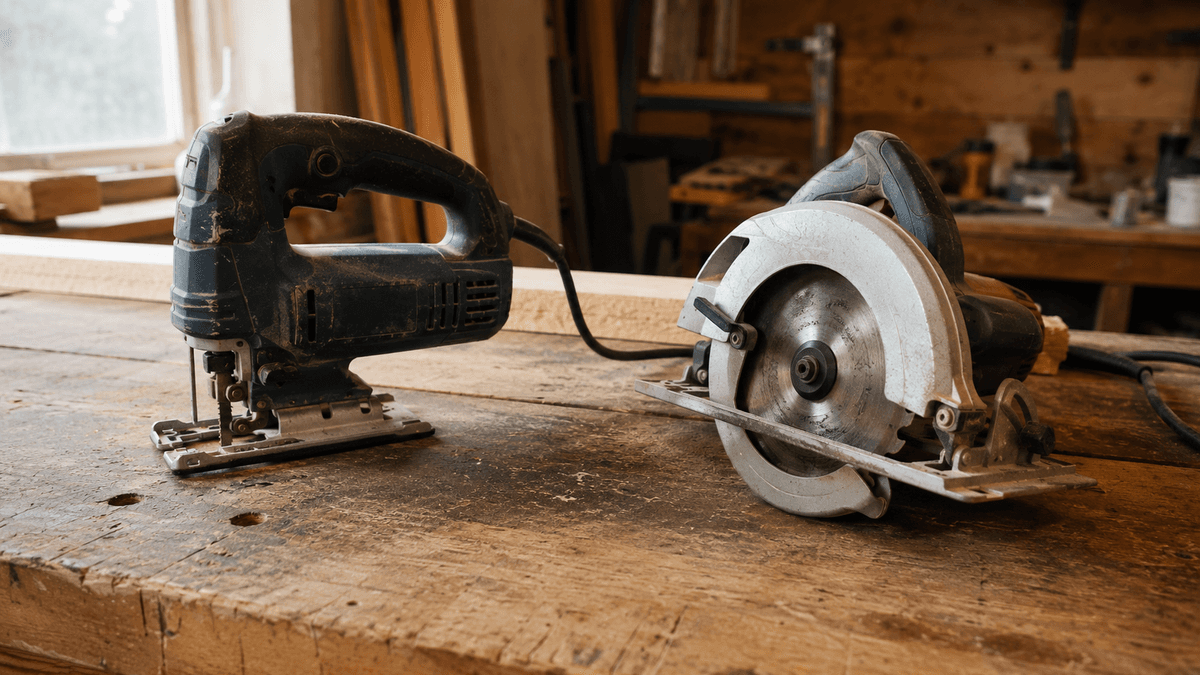
A circular saw is a handheld saw with a round spinning blade. You bring the saw to the material, not the other way around. That single fact explains most of why it's the better starting point.
What a circular saw handles:
- Cross cuts -- cutting across the grain of a board
- Rip cuts -- cutting along the grain, especially with a straight edge clamped as a guide
- Bevel cuts -- the shoe tilts up to 50+ degrees on most models
- Sheet goods -- 4x8 plywood sheets on sawhorses, no outfeed table needed
The portability matters more than people expect when they're starting out. You can work in a driveway, a backyard, or a half-finished garage. You don't need a permanent setup.
The honest limitation: freehand cuts are only as straight as your hand is steady. For accurate rip cuts, you need a straight edge clamped to the workpiece as a fence guide. It takes a few extra minutes to set up, but it works. Any beginner doing regular rip cuts on plywood should own a cheap aluminum straight edge and learn this technique early -- it closes most of the gap between a circular saw and a table saw for that type of cut.
Table Saw: Precision Ripping Machine
A table saw mounts the blade below a flat work surface. Material slides across the table and through the blade. The fence -- a metal guide that locks parallel to the blade -- lets you set a width and repeat it dozens of times without remeasuring.
That consistency is the table saw's real value. If you're building a set of cabinet doors or a bookcase with multiple identical pieces, the table saw saves real time and produces tighter results than a circular saw with a clamped guide.
What a table saw does well:
- Precise rip cuts at a set width, repeated accurately
- Breaking down sheet goods when a fixed surface is available
- Dado cuts with the right blade stack
Why it's not always beginner-friendly: kickback. This is the table saw's primary danger, and it's not intuitive. Kickback happens when the blade catches a workpiece and throws it back toward the operator -- hard and fast. Preventing it requires understanding how to use the riving knife (the metal splitter behind the blade), keeping the blade guard in place, using push sticks properly, and never freehanding certain cuts. None of this is complicated once you learn it, but it's not something you figure out by feel.
A table saw also needs a stable, level surface and outfeed support for longer boards. You can't set one up on a tailgate.
When a table saw makes sense as your first (or early) purchase: you're building furniture or cabinetry, you have a garage or workshop space, and you've already identified that rip cut precision is the main thing standing between you and the results you want.
Cost Comparison
The price gap is real and worth thinking through before you spend money.
- Quality beginner circular saw: $100 to $200
- Quality entry-level table saw: $280 to $600
The DeWalt DCS570B runs around its current retailer price for the bare tool. A current compact DeWalt table saw such as the DWE7485 usually costs several times more than a starter circular saw, even before adding support stands or outfeed help.
For that $200 gap, a beginner could buy a quality circular saw, a dedicated ripping blade, a finish blade, and still have money left toward a budget miter saw. That's a more capable shop for the same price as a table saw alone.
Budget accordingly. Most beginners don't need a table saw first. Most beginners need a circular saw, a miter saw (or a miter attachment), and experience.
Safety: Which Is Easier to Learn On?
Both tools are safe when used correctly. The question is which one has a gentler learning curve for someone who has never used power saws.
Circular saw:
- The blade is fully visible at all times
- Your body position and hand placement are intuitive
- The saw only cuts when you're actively running it -- release the trigger, blade stops (especially with an electric brake)
- If something goes wrong, you can pull the saw away from the material
Table saw:
- Kickback is the primary hazard, and it's not obvious until someone explains it
- Requires understanding of the riving knife, blade guard, and anti-kickback pawls before first use
- Mistakes happen fast -- there's less margin for error in body position and material control
The circular saw is the easier tool to learn on. That doesn't make it toys -- both deserve respect. But the failure modes of a circular saw are more forgiving for someone still learning saw behavior.
The Cuts That Decide Everything
When to Buy a Table Saw Instead
A table saw should move up the priority list if:
- Your projects are furniture, cabinets, shelving, or built-ins that require consistent, repeatable rip cuts
- You already own a circular saw and have used it enough to know its limits
- You have a dedicated workspace -- a garage, a basement shop, or a permanent workbench -- where the saw can live and be properly set up
- You're ripping solid hardwood regularly, where a guided circular saw cut starts to show its limits
If none of those apply, the circular saw serves you better first.
Our Recommendations
For most beginners, the DeWalt DCS570B is the right first saw. The electric brake, brushless motor, and 20V MAX compatibility make it a tool you won't outgrow quickly. If you want something lighter and are starting fresh without a battery platform, the Ryobi PBLCS300B is a genuine beginner-friendly option at the same price point. When you're ready for a table saw, the DeWalt DWE7485 is the current compact DeWalt option to compare before moving into larger contractor saw territory.
FAQ
Can a circular saw do everything a table saw can?
Not exactly, but close enough for most beginners. A circular saw with a clamped straight edge guide can rip plywood accurately and handle most cuts a table saw handles. The main gap is repeatability -- the table saw lets you lock a fence at a specific width and repeat that cut dozens of times without resetting. For one-off cuts and typical home projects, a circular saw covers the territory.
Is a table saw too dangerous for beginners?
Not if you learn the safety basics before your first cut. The table saw's main hazard -- kickback -- is preventable with proper technique: use the riving knife, keep the blade guard in place, use push sticks near the blade, and never reach over or behind a spinning blade. The danger comes from skipping the fundamentals, not from the tool itself. That said, the circular saw has a more forgiving learning curve, which is part of why it makes a better first saw.
What should a beginner buy first?
A circular saw. It handles more types of cuts, costs less, works anywhere, and teaches you the fundamentals of cutting wood before you invest in a fixed, more specialized tool. Add a table saw when your projects consistently demand precision rip cuts that a straight edge guide can't match.
Can I rip plywood with a circular saw?
Yes. Clamp a straight edge or aluminum guide rail to the plywood as a fence, set your cut depth to just below the material thickness, and run the saw's shoe against the guide. It takes a few minutes to set up but produces clean, straight cuts. Most beginners ripping 4x8 sheets are better served doing this than trying to manage full sheets on a table saw without outfeed support.