ToolShedTested
How-To

How to Sharpen Chainsaw Chains (Without a Pro)

Step-by-step guide to sharpening chainsaw chains by hand and with an electric sharpener. Covers file sizes, angles by chain type, and when to replace instead of sharpen.

Best first buy
Oregon 520-120 Bench Chain Sharpener
Best Electric Chain Sharpener4.5/5Amazon paid link; price and availability change.
Check Price on Amazon
By Jake MercerPublished March 19, 2026Updated March 22, 2026
Research-BackedSpec Checked

We buy and test our core review products; some buying-guide recommendations are research-backed and clearly labeled. As an Amazon Associate, ToolShed Tested earns from qualifying purchases. When you buy through our links we may earn a commission -- at no extra cost to you. Product links and article details last reviewed March 22, 2026. Full disclosure.

Quick Answer

Step-by-step guide to sharpening chainsaw chains by hand and with an electric sharpener. Covers file sizes, angles by chain type, and when to replace instead of sharpen. Oregon 520-120 Bench Chain Sharpener earned Best Electric Chain Sharpener (4.5/5), and Stihl 5605 007 1027 Filing Kit earned Best Hand File Kit (4.7/5).

  1. #1Oregon 520-120 Bench Chain SharpenerBest Electric Chain Sharpener4.5/5Check Current Price
  2. #2Stihl 5605 007 1027 Filing KitBest Hand File Kit4.7/5Check Current Price
Quick Verdict
Research-BackedSpec Checked
Compare PicksRead Notes
Oregon 520-120 Bench Chain Sharpener
4.5

Step-by-step guide to sharpening chainsaw chains by hand and with an electric sharpener. Covers file sizes, angles by chain type, and when to replace instead of sharpen.

Best For: Best Electric Chain Sharpener
Check Current Price
At-a-Glance Comparison
RankProductBest forBuy if / skip ifRatingPriceCTA
#1
#1 PickOregon 520-120 Bench Chain Sharpener
Motorized bench sharpener restores factory-sharp edges in minutes
Best Electric Chain Sharpener
Verify package
Buy if: Motorized bench sharpener restores factory-sharp edges in minutes
Skip if: Bench-mounted -- not portable for field sharpening
4.5
$$
Check current
Check Price on Amazon
#2
Stihl 5605 007 1027 Filing Kit
Complete round file, flat file, and depth gauge tool in one kit
Best Hand File Kit
Kit / verify included batteries
Buy if: Complete round file, flat file, and depth gauge tool in one kit
Skip if: Requires more skill than motorized sharpeners -- technique matters
4.7
$$
Check current
Check Price on Amazon

Time Required: 15-20 minutes (by hand), 5-10 minutes (electric sharpener)
Difficulty: Easy to moderate
Tools Needed: Round file (correct diameter), flat file, file guide, stump vise or bar clamp

A sharp chainsaw chain cuts fast, throws large chips, and pulls itself into the wood with minimal pressure. A dull chain produces fine sawdust, requires you to push the bar into the wood, heats up the bar and chain, and wears out your saw's clutch and sprocket faster. Most chainsaw users run dull chains far too long because sharpening seems complicated. It is not. A $15 file kit and 15 minutes of practice is all you need.

How to Tell Your Chain Is Dull

Sawdust instead of chips. A sharp chain throws wood chips. A dull chain makes fine sawdust. This is the most reliable indicator. You have to push. A sharp chain pulls the saw into the wood under its own feed. If you are pushing the bar to make it cut, the chain is dull. Smoke or burning smell. Excessive friction from dull teeth generates heat that burns the wood and can damage the bar. Chain pulls to one side. If one side of the chain is duller than the other (common if you hit a rock or nail on one side), the chain veers instead of cutting straight. Crooked cuts. The saw does not cut vertically — it drifts to one side. This usually means the teeth on one side are shorter or duller than the other.

File Sizes by Chain Pitch

This is where most people get confused. The round file size must match the chain's pitch. Using the wrong file diameter grinds the wrong part of the tooth and makes the chain cut worse. Check your chain's pitch (stamped on the chain or listed in the saw's manual) and match it to this chart:
Chain PitchRound File DiameterCommon Chains
1/4"5/32" (4mm)Small electric saws, pole saws
3/8" Low Profile5/32" (4mm)Most homeowner saws (Stihl MS 170/180, Husqvarna 120)
.325"3/16" (4.8mm)Mid-range saws (Stihl MS 250/271, Husqvarna 435/440)
3/8"7/32" (5.5mm)Professional saws (Stihl MS 362/462/500, Husqvarna 372/572)
.404"7/32" (5.5mm)Large professional and milling saws

Filing Angles by Chain Type

Different chain types use different filing angles. The angle determines how aggressively the tooth cuts. Steeper angles cut more aggressively but dull faster.
Chain TypeFiling AngleDown AngleCommon Uses
Full chisel25-35° (typically 30°)0° (level)Clean wood, professional falling and bucking
Semi-chisel25-35° (typically 30°)0° (level)General purpose, dirty wood, frozen wood
Low-profile25-30°0° (level)Homeowner saws, safety chains
Skip-tooth25-35°0° (level)Long bars, milling
When in doubt, file at 30 degrees. That is the standard angle for most chains and works well in most wood types.

Step-by-Step: Sharpening by Hand

Step 1: Secure the Saw

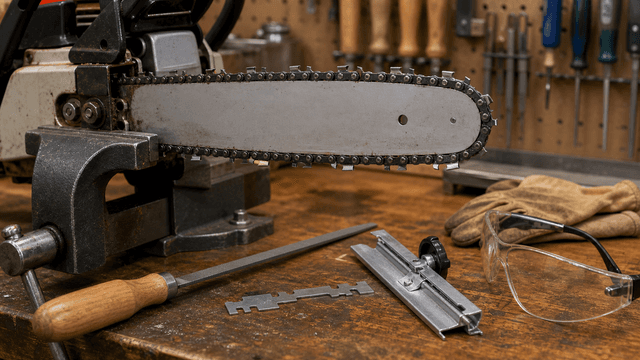
Clamp the bar in a stump vise, bench vise, or bar clamp. The chain needs to be tight enough that it does not flop around but loose enough to advance by hand. If you are in the field, wedge the bar between two logs or use a stump vise that straps to a tree.

Step 2: Identify the Starting Tooth

Find the shortest or most damaged tooth on the chain. Mark it with a dab of paint or a permanent marker. You will file every tooth to match this one's length — this ensures all teeth are the same length, which keeps the chain cutting straight.

Step 3: Set Up the File Guide

A file guide (also called a filing gauge) clamps onto the file and rests on the top of the chain. It holds the file at the correct diameter position relative to the tooth and gives you a reference line for the filing angle. Set the guide to the correct angle for your chain type (usually 30 degrees).

Step 4: File the First Direction

Start with the teeth that face one direction (every other tooth faces the same way). Place the file in the tooth's gullet, matching the angle marked on your guide. Apply pressure on the push stroke only — lift the file on the return stroke. Two to three strokes per tooth is usually enough for routine sharpening. For very dull teeth, take 4-5 strokes. Use the same number of strokes on each tooth to maintain consistent tooth length.

Step 5: File the Opposite Direction

Rotate the saw (or walk to the other side) and file all the teeth that face the other direction. Same angle, same number of strokes.

Step 6: Check the Depth Gauges (Rakers)

The depth gauge is the rounded nub in front of each cutting tooth. It controls how deep the tooth bites into the wood. After several sharpenings, the teeth get shorter but the depth gauges stay the same height — which means the chain takes a shallower bite and cuts slower. Place a depth gauge tool (a flat metal guide with a slot) over the chain. If the depth gauge protrudes above the tool, file it down flat using the flat file. Most depth gauge tools are set to 0.025 inches, which is correct for most chains.

Step 7: Test Cut

Start the saw and make a test cut on a log. The saw should pull itself into the wood, throw chips (not dust), and cut straight without veering.

Electric Sharpener Option

If you sharpen chains frequently (weekly or more), an electric bench-mount sharpener saves time and produces more consistent results. The Oregon 520-120 is a reliable, affordable option that handles all common chain pitches: An electric sharpener uses a small grinding wheel instead of a hand file. You set the angle on the sharpener, clamp the chain, and lower the wheel onto each tooth. Advantages over hand filing: The downside is that electric sharpeners remove more material per sharpening than hand files. A chain sharpened by hand gets 8-10 sharpenings before the teeth are too short. The same chain on an electric sharpener might only get 5-6 sharpenings. For a good file kit to get started with hand sharpening, the Stihl 5605 007 1027 file kit includes the round file, flat file, depth gauge tool, and file handle for most common chain sizes:

When to Replace Instead of Sharpen

Replace the chain when:

Common Mistakes

Wrong file size. This is the most common mistake. Using a file that is too large rounds over the top of the tooth. Too small grinds a hollow in the wrong place. Check your chain pitch and use the correct file diameter. Filing on the return stroke. Only apply pressure on the push stroke (away from you). Dragging the file backwards dulls the file and creates burrs on the tooth. Uneven stroke count. If you give some teeth 3 strokes and others 5, the teeth end up different lengths. The chain pulls to the side with shorter teeth. Use the same number of strokes on every tooth. Ignoring the depth gauges. After 3-4 sharpenings, the depth gauges are too high relative to the shortened teeth. The chain cuts slowly even though the teeth are sharp. File the depth gauges down using the flat file and a depth gauge tool. Sharpening a dirty chain. Sawdust, sap, and bar oil on the chain clog the file and reduce sharpening effectiveness. Wipe the chain with a rag before filing.

Bottom Line

Sharpening a chainsaw chain is a 15-minute job that makes a dramatic difference in cutting performance. A $15 file kit and some practice is all you need. File at 30 degrees, use the correct file diameter for your chain pitch, maintain consistent stroke counts, and check the depth gauges every few sharpenings. If you sharpen frequently, the Oregon 520-120 bench sharpener speeds up the process significantly. And when the teeth are too short or the chain is damaged, do not hesitate to replace — a new chain costs $15-25 and cuts like new.

Frequently Asked Questions

How often should I sharpen my chainsaw chain? Sharpen after every 2-3 hours of active cutting, or sooner if you hit dirt, rock, or metal. Signs that your chain needs sharpening include fine sawdust instead of chips, the saw pulling to one side, needing to push the saw instead of it feeding itself, and smoking even with proper chain oil.
What size file do I need to sharpen my chainsaw chain? The file size must match your chain's pitch. For 1/4-inch pitch chains, use a 5/32-inch file. For 3/8-inch low-profile chains (most homeowner saws), use a 5/32-inch file. For full 3/8-inch pitch chains, use a 7/32-inch file. For .325-inch pitch, use a 3/16-inch file. Check the markings on your chain or the owner's manual.
Can I sharpen a chainsaw chain too many times? Yes. Each sharpening removes a small amount of metal from the cutter. Most chains can be sharpened 5-10 times before the cutters become too short to cut effectively. Once the cutter length reaches the wear mark stamped on the chain, it is time for a new chain. Over-filing the depth gauges can also make the chain dangerously aggressive.
Is it better to sharpen a chainsaw chain by hand or with an electric sharpener? Hand filing with a round file and guide gives more control and is sufficient for most homeowners. Electric bench grinders sharpen faster and produce very consistent angles, making them worthwhile if you sharpen chains frequently. The trade-off is that grinders remove more material per pass, reducing the total number of sharpenings per chain.
What angle should I sharpen my chainsaw chain at? Most standard chains use a 30-degree horizontal filing angle and a 10-degree downward angle. Low-kickback chains and some specialty chains use 25 degrees. Check the chain manufacturer's specifications for your exact chain type. Using a filing guide with angle markings ensures consistency across all cutters.

Our Picks, Reviewed

#1 -- Best Electric Chain Sharpener

Oregon 520-120 Bench Chain Sharpener

4.5/5Check Amazon price →
Best for
Best Electric Chain Sharpener
Package
Package: verify current retailer listing before checkout
Pros
  • Motorized bench sharpener restores factory-sharp edges in minutes
  • Adjustable angle vise handles most chain pitches and gauges
  • More consistent results than hand filing for production use
Cons
  • Bench-mounted -- not portable for field sharpening
  • Higher upfront cost vs hand file kits
Check Price on Amazon
#2 -- Best Hand File Kit

Stihl 5605 007 1027 Filing Kit

4.7/5Check Amazon price →
Best for
Best Hand File Kit
Package
Kit/package: verify included batteries before checkout
Pros
  • Complete round file, flat file, and depth gauge tool in one kit
  • Portable -- fits in a pocket for sharpening in the field
  • Stihl-spec guides ensure correct filing angles for most chains
Cons
  • Requires more skill than motorized sharpeners -- technique matters
  • Hand filing is slower than bench sharpening for multiple chains
Check Price on Amazon
MethodologyHow we tested these tools

We buy and test our core review products; some buying-guide recommendations are research-backed and clearly labeled. Recommendations are labeled as hands-on tested, workshop tested, research-backed, spec checked, or price checked so readers can tell exactly what kind of evidence supports each pick. No paid placements influence our ratings.

  • Performance (30%)Torque, cut speed, material removal rate, and other category-specific output notes tracked with repeatable materials.
  • Runtime (25%)Continuous-use and intermittent-use battery tests under realistic working load. Manufacturer claims verified or refuted.
  • Durability (20%)Build quality, dust exposure, vibration, housing wear, and long-term jobsite notes when extended-use data is available.
  • Ergonomics (15%)Weight and balance, grip comfort during real project sessions, vibration fatigue, and glove-friendly control layout.
  • Value (10%)Performance-per-dollar across Amazon, Home Depot, Lowes, and Acme. Kit-vs-bare-tool math and ecosystem cost factored in.

Read our full testing methodology for the complete scoring rubric and equipment list.

Related

You Might Also Like

How to Start Your Lawn Mower After Winter Storage (Step-by-Step)
How-To

How to Start Your Lawn Mower After Winter Storage (Step-by-Step)

Your lawn mower won't start after winter? Here's exactly how to get gas, battery, and riding mowers running again with a step-by-step spring startup guide.

Read Article
Best Battery Powered Lawn Mowers 2026: 5 Top Picks for Spring Lawn Care
Buying Guide

Best Battery Powered Lawn Mowers 2026: 5 Top Picks for Spring Lawn Care

Five battery powered lawn mowers tested and ranked for peak spring 2026: with picks for every yard size and budget. Updated March 2026.

Read Guide
Best Chainsaw for Firewood 2026
Buying Guide

Best Chainsaw for Firewood 2026

We tested the best chainsaws for cutting and splitting firewood: top picks for homeowners stacking a cord or two each season in 2026.

Read Guide
JM
Jake MercerLead Reviewer

Former licensed general contractor with 14 years of residential construction experience. Leads ToolShed Tested's hands-on review program and spec-check process.

Licensed Contractor14 Years ExperienceEvidence-Labeled Reviews
Workshop Dispatch

Get the Workshop Dispatch

Reader questions, testing notes, and current tool-buying calls from ToolShed Tested.

Request DispatchSend a Tool Tip

Direct email signup for now. No paid reviews, no manufacturer lists.