A jigsaw is a precision tool for controlled cuts. A reciprocating saw is a demolition tool. They barely overlap -- the right one depends entirely on the work you're doing.
Current recommendations are research-backed. Each article identifies its evidence, sources, update date, and limitations. No current guide is presented as hands-on tested. As an Amazon Associate, ToolShed Tested earns from qualifying purchases. When you buy through our links we may earn a commission -- at no extra cost to you. Product links and article details last reviewed April 20, 2026. Full disclosure.
Our Picks, Reviewed
SPEC SHEET // #01 -- Best Homeowner JigsawREF: B0CFYM9L5W
Best for
Homeowners doing curved cuts, cutouts, and interior finish work
Package
Package: verify current retailer listing before checkout
The keyless blade system alone is worth the step up from budget jigsaws. Solid, practical tool for most homeowner applications.
Key features
- Brushless motor
- Keyless blade change system
- 4 orbital settings
- DEWALT 20V MAX XR compatible
✓ What Stands Out (Pros)
- Blade changes without tools or fumbling
- Brushless motor extends battery life noticeably
- Low vibration for a jigsaw
✕ Watch Out For (Cons)
- Bare tool -- battery sold separately
- Slightly heavier than Makita equivalent
- Not ideal for cutting thick hardwood above 2"
Who it's for: Homeowners on the DeWalt 20V MAX platform who need a jigsaw for interior work, tile, laminate, or curved cuts.
SPEC SHEET // #02 -- Best Recip SawREF: B00G0GLULQ
Best for
Demo work, pipe cutting, branch clearing, and nail-embedded lumber
Package
Package: verify current retailer listing before checkout
Best-in-class reciprocating saw for serious use. If you only do occasional light cuts, a cheaper model works, but this one earns its price fast on heavy work.
Key features
- POWERSTATE brushless motor
- REDLINK PLUS electronics prevent overload
- 1-1/8" stroke length
- Anti-vibration system
✓ What Stands Out (Pros)
- More power than most homeowners will ever need
- Anti-vibration makes extended cuts less fatiguing
- M18 battery ecosystem is one of the best in the industry
✕ Watch Out For (Cons)
- Overkill for light-duty users
- Bare tool -- Milwaukee M18 battery required
- Heavier than compact recip saws at 7.7 lbs
Who it's for: Homeowners doing real demo work or clearing branches. Anyone who uses a recip saw more than occasionally.
SPEC SHEET // #03 -- Best Mid-Range JigsawREF: B00K194J8E
Best for
Makita LXT users who need a budget-friendly jigsaw
Package
Kit/package: verify included batteries before checkout
Gets the job done for standard jigsaw work. A step down from the DeWalt in feel and battery efficiency, but solid at the price.
Key features
- 4 orbital settings
- Tool-less blade change
- Makita LXT 18V compatible
- Built-in LED light
✓ What Stands Out (Pros)
- Lower price point than DeWalt
- LXT compatibility if you're already in the Makita ecosystem
- Good blade visibility
✕ Watch Out For (Cons)
- Older design compared to newer brushless options
- Not brushless -- shorter battery runtime
- Blade clamping feels less refined than DeWalt
Who it's for: Makita LXT users or buyers looking for a capable jigsaw at a lower entry price.
People compare these two saws as if they're alternatives to each other. They're not. A jigsaw and a reciprocating saw do fundamentally different work. Buying one doesn't replace the other -- you choose based on what job you're actually doing.
What a Jigsaw Is For
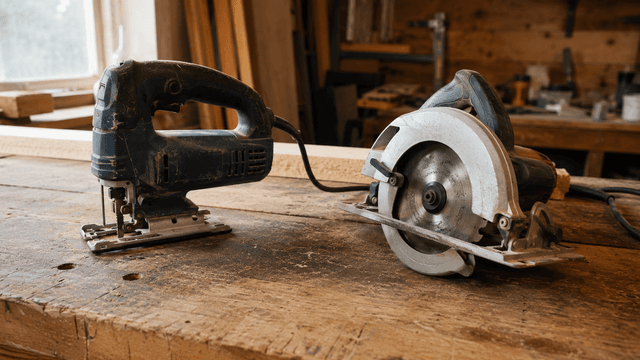
A jigsaw is a controlled cutting tool. The blade points straight down, the shoe sits flat on your workpiece, and you guide it through curves, shapes, or straight lines. It's the right tool for cutting holes in drywall for electrical boxes, trimming laminate countertops, cutting curves in plywood for a shelf, cutting tile with the right blade, or making plunge cuts into a finished surface.
The key word is control. You can follow a line with a jigsaw. You can make a circle. You can cut shapes. It's not fast, and it's not a demolition tool -- but for interior finish work and detail cuts, nothing else fills that role as cleanly.
What a Reciprocating Saw Is For
A reciprocating saw is an aggression tool. The blade moves in a fast back-and-forth stroke and will cut through almost anything -- nail-embedded lumber, copper pipe, cast iron, tree branches, walls during demo. It has almost zero precision. You point it at material and it removes that material.
If you're gutting a bathroom, cutting branches flush to a fence post, or removing a section of plywood that's already nailed in place, this is the right tool. Using it for finish work or detail cuts is the wrong approach -- the vibration and stroke length make controlled cuts nearly impossible.
Feature-by-Feature Comparison
Which One Do Most Homeowners Need First?
For most homeowners, the jigsaw comes first. Interior work -- cutting in outlets, trimming cabinet panels, modifying shelving -- benefits far more from controlled cuts than from raw aggression. If you do any renovation work at all that involves leaving surfaces intact, a jigsaw is more useful.
The reciprocating saw earns its place when you're doing actual demolition or outdoor work. Branch cleanup after a storm, removing an old deck, cutting through a wall during a remodel -- these are recip saw jobs. If your projects don't include any of that regularly, it can wait.
Can a jigsaw do what a reciprocating saw does?
Not really. A jigsaw can cut some of the same materials, but it's not built for demolition work. Trying to use a jigsaw to cut through a wall with nails in it, or to clear branches, will wear the blade fast and stress the motor. The tools are designed for different tasks -- the jigsaw for controlled cuts, the recip saw for aggressive removal.
Which saw do I need for cutting tree branches?
Reciprocating saw, with a pruning or demo blade. It handles branches up to 4--6" in diameter without much effort. A chainsaw is faster for anything larger. A jigsaw is not the right tool for this -- the blade is too short and the geometry is wrong for cutting branches.
What's a jigsaw used for that most people don't know?
Plunge cuts into finished surfaces. If you need to cut a hole in the middle of a floor or countertop -- not starting from an edge -- a jigsaw with a plunge blade is the cleanest way to do it. You tilt the saw forward on the shoe tip, start the blade, then slowly lower it into the material. It's a useful technique that a circular saw can't replicate safely.
Can I use a reciprocating saw for woodworking?
Not in any meaningful way. A recip saw is used for rough cuts in situations where access is tight and precision doesn't matter. Woodworking requires controlled cuts, stable surfaces, and clean edges -- none of which a reciprocating saw provides. Use a jigsaw, circular saw, or table saw for woodworking.