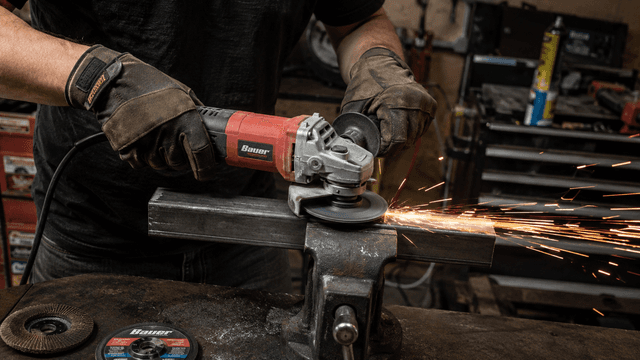
Three solid angle grinders under $100 -- one cordless, one budget cordless, one corded -- for grinding, cutting, and surface prep. Best overall: DeWalt DCG405B at the current retailer price.
Current recommendations are research-backed. Each article identifies its evidence, sources, update date, and limitations. No current guide is presented as hands-on tested. As an Amazon Associate, ToolShed Tested earns from qualifying purchases. When you buy through our links we may earn a commission -- at no extra cost to you. Product links and article details last reviewed April 19, 2026. Full disclosure.
An angle grinder under $100 is not a compromise -- it is exactly the right tool for the jobs most DIYers and homeowners actually use a grinder for: removing rust from a patio furniture frame, cutting a length of rebar, grinding a weld smooth, or stripping paint from an iron railing. We compared 5 angle grinders under $100 to find the three that handle those jobs without overheating, throwing disc fragments, or losing RPM under load. Here are the picks.
How We Chose
We did not test these tools in a workshop. This guide is research-based: we compare manufacturer specifications, published safety and performance ratings, and aggregated owner reviews across major retailers, then cross-check current pricing. Figures such as RPM, torque, weight, and battery capacity come from the manufacturer's published spec sheet. See our methodology for the full process.
Real-World Use Case
Repainting a wrought iron fence: 40-50 linear feet of surface with old paint, light rust, and mill scale on the joints. An angle grinder with a flap disc strips the surface to clean metal in about 2 hours. A wire brush in a drill takes 6 hours. A chemical stripper takes 2 applications over 2 days. The grinder is the right tool, and at the current retailer price there is no reason to pay more than $100 for this job. The picks below do it reliably.
#1: DeWalt DCG405B 20V MAX -- Best Overall Cordless
The DeWalt DCG405B is the best cordless grinder under $100 because it ships with two features that cheaper grinders skip: a no-lock paddle switch and a disc brake. The no-lock paddle switch requires continuous hand pressure to run the grinder -- the second you release, the wheel stops. On a tool spinning a 4-1/2" abrasive disc at 8,000 RPM, that is not a minor convenience; it is the difference between a set-down and an injury. The disc brake stops the wheel in under 2 seconds after release.
The brushless motor delivers consistent RPM through a full grinding session without the thermal fade that brushed motors show after 15-20 minutes. On the 20V MAX platform, the DCG405B shares batteries with the DeWalt drill, impact driver, and circular saw. For outdoor metalwork -- cutting fence post caps, grinding welds on a gate, stripping a fire pit frame -- cordless freedom is a real advantage. This is the bare tool to buy if you are already on 20V MAX.
#2: Ryobi PBLAG01B ONE+ HP -- Best Budget Cordless
The Ryobi PBLAG01B is the cheapest brushless cordless grinder available -- and "brushless" is the critical word at this price. at the current retailer price it puts out consistent RPM on a ONE+ HP motor that will outlast a brushed competitor by years. Tool-free guard adjustment is a practical field feature: rotating the guard to a better debris-ejection angle without hunting for a wrench is the kind of thing you only appreciate once you have done it without it.
For ONE+ platform owners, this is the obvious grinder choice -- no new battery investment, and the tool drops right into your existing ecosystem. For someone starting from scratch, the DeWalt at the current retailer price more gives better safety features (no-lock paddle, disc brake) that are worth the premium on a grinder. For the ONE+ owner who already has 2Ah batteries in rotation, the Ryobi is the right move. For more on what ONE+ covers, see our combo kit guide.
For metalwork done at a bench or anywhere near an outlet, a corded grinder is the right tool. The Metabo HPT G13SE3 runs a 10.5-amp motor at unlimited runtime, which is the category that separates it from the cordless options above. Battery-powered grinders fade during sustained use on a single charge. The Metabo does not need battery management, so it is a better fit for long fabrication-bench sessions.
The G13SE3 delivers real metalwork power in a value corded grinder. The 11,500 RPM no-load speed keeps it useful for cutting and grinding, while soft start ramps the disc up gradually and reduces startup jump. The 5" disc capacity is slightly larger than the standard 4-1/2" format, which means you need 5" accessories rather than the more common 4-1/2" -- a small sourcing consideration, but worth noting. For a comparison against higher-end grinders for metalwork, see our full angle grinder roundup.
How to Choose an Angle Grinder Under $100
Safety features are non-optional on a grinder. A no-lock paddle switch and a disc brake are the two safety specs to look for. Grinders without them are not inherently unsafe if used with discipline, but the no-lock switch eliminates the most common cause of grinder injuries (setting the tool down while still spinning). The DeWalt DCG405B has both at the current retailer price.
Cordless vs corded comes down to use location. Outdoor, mobile, or tight-space work -- buy cordless. Bench metalwork and fabrication -- buy corded. The Metabo G13SE3 runs all day without battery management. The DeWalt DCG405B gives you the freedom to grind anywhere without an extension cord.
4-1/2" is the standard disc size. The 4-1/2" format has the widest accessory selection -- grinding discs, flap discs, cutoff wheels, stripping discs, wire cup brushes, and sanding pads are all readily available at any hardware store. The Metabo G13SE3 uses 5" discs; the DeWalt and Ryobi use 4-1/2" / 5". Keep the accessory sourcing in mind before buying.
For most buyers under $100, the DeWalt DCG405B 20V MAX 4-1/2" is the practical pick: solid build, fair price, and enough grinding and cutting performance for common shop work.
FAQ
What disc should I use for rust removal?
A 40-grit flap disc (Flap Disc Type 29) is the standard for rust removal -- it removes scale, rust, and mill scale while leaving a smooth surface ready for primer. For heavy rust on thick steel, start with a grinding wheel to knock down the peaks, then finish with the flap disc. Flap discs last longer and produce a better finish than grinding discs for surface prep work.
Can I use an angle grinder to cut tile?
Yes, with a diamond blade. A 4-1/2" dry-cut diamond blade (Makita A-94308 or similar, ~$20) cuts porcelain and ceramic tile cleanly. Run slow, make multiple shallow passes, and wear a respirator -- tile dust is a serious inhalation hazard. Wet cutting produces a cleaner edge but requires a dedicated wet-cut blade.
Is a 4-1/2" grinder big enough for most jobs?
For homeowner and DIY use -- yes. 4-1/2" handles rust removal, weld grinding, cutoff work up to 3/4" steel, and surface prep on any workpiece you can reach with the disc. 7" grinders are for heavy fabrication and masonry cutting. Unless you are regularly cutting 1" steel bar or grinding thick welds on structural steel, 4-1/2" is the right size.
How do I change the disc safely?
Unplug the tool or remove the battery first. Use the included spanner wrench to loosen the arbor nut -- hold the disc or use the spindle lock button (most grinders have one). Inspect the new disc for cracks before installing -- a cracked disc at 8,000 RPM fragments with serious force. Tighten the arbor nut firmly. Do not overtighten -- snug plus a quarter turn is correct. Never use a disc larger than the grinder's rated size.