Cordless ratchet wrenches have quietly become one of the most useful tools in a mechanic's arsenal. These five spec-checked picks cover the main shop and garage use cases.
Current recommendations are research-backed. Each article identifies its evidence, sources, update date, and limitations. No current guide is presented as hands-on tested. As an Amazon Associate, ToolShed Tested earns from qualifying purchases. When you buy through our links we may earn a commission -- at no extra cost to you. Product links and article details last reviewed May 21, 2026. Full disclosure.
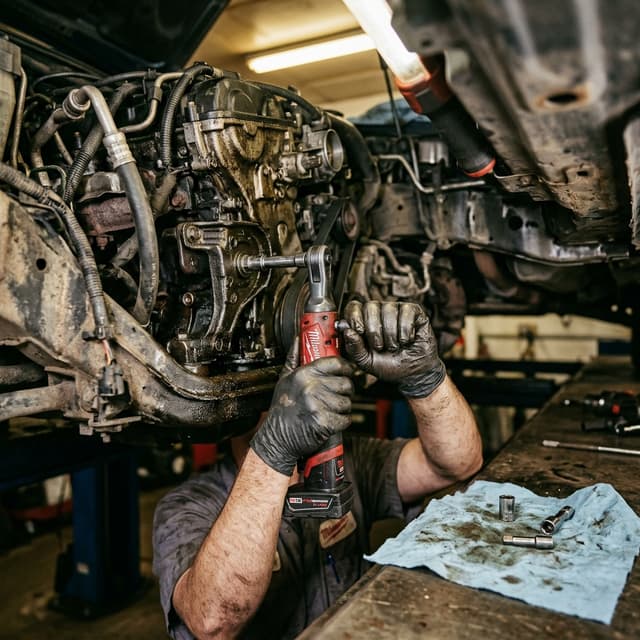
A cordless ratchet wrench is one of those tools you do not think you need until you use one, then wonder how you worked without it. Where a standard ratchet makes you flick your wrist over and over in a tight engine bay, a cordless ratchet spins fasteners continuously with a trigger pull. Faster teardowns, less fatigue, and fewer busted knuckles are the whole point.
This guide is research-backed, spec checked, and price checked. We compared current manufacturer pages, platform compatibility, torque/RPM claims, bare-tool versus kit status, warranty language, and whether the listed product URL actually matches the named model. Where a listing could not be confidently matched to the right tool, we point to the manufacturer page instead of forcing an affiliate link.
Quick Picks
- Best Overall: Milwaukee M12 FUEL 2560-20 3/8-In. Extended Reach Ratchet - extended reach, strong M12 platform fit
- Best Value: DeWalt DCF513B 20V MAX ATOMIC - compact 3/8-in. ratchet for DeWalt owners
- Best Heavy Duty: Milwaukee M12 FUEL 3053-20 - higher torque and speed in a compact body
- Best RIDGID 18V Pick: RIDGID R866011B - brushless 18V ratchet with LSA eligibility
- Best for LXT Users: Makita XRW01Z 18V LXT - dual-anvil flexibility on Makita batteries
What to Look For in a Cordless Ratchet
Torque is the headline spec, but context matters. Most powered ratchets are designed to run fasteners in and out after the nut or bolt has already been broken loose. They can help with light removal, but they are not torque wrenches and they are not impact wrenches. For typical home mechanic work, 35-55 ft-lbs is enough for speed and convenience. If you frequently fight seized suspension hardware, buy an impact wrench too.
Head size and clearance is the spec people overlook. The whole point of a ratchet is getting into tight spaces: an engine bay, a wheel well, under a dash, or behind a bracket. A smaller head gets into more places; an extended neck reaches past more obstructions. Those are different strengths, so do not buy only by torque rating.
Battery platform is a practical decision more than a performance one. If you already own DeWalt 20V MAX batteries, the DCF513B is an easy add. If you already own RIDGID 18V or Makita LXT, stay there unless the tool shape does not fit your work. If you are starting from scratch specifically for automotive and shop work, Milwaukee M12 remains the strongest dedicated ratchet ecosystem.
How We Chose
We compared cordless ratchets on five factors: torque output, speed, head and neck access, battery-platform value, and whether the product listing clearly matches the model being recommended. Model numbers matter in this category because one digit can separate a ratchet from an impact wrench, a 3/8-in. anvil from a 1/2-in. anvil, or a bare tool from a kit.
That is why this page no longer uses unverified cross-category listings. We removed a Milwaukee model that belonged to a different tool class and cleaned up battery-platform copy that mixed RIDGID with Ryobi language. Those are exactly the kinds of affiliate-site errors that break trust.
3/8-Inch vs. 1/2-Inch Ratchets
For most garage and automotive work, start with a 3/8-in. drive ratchet. It covers brake calipers, splash shields, interior brackets, engine-bay accessories, battery trays, and general maintenance hardware. A 1/2-in. ratchet is better when the sockets and fasteners get larger, but it is also bulkier. If you already own a strong impact wrench, a 3/8-in. cordless ratchet usually adds more everyday usefulness than a second 1/2-in. powered tool.
Ratchet vs. Right-Angle Impact
A cordless ratchet is for controlled fastening speed. A right-angle impact wrench is for breaking stubborn fasteners loose in tight quarters. They look similar at a glance, and some model numbers are easy to mix up, but they behave differently. Use the ratchet when you would otherwise use a hand ratchet and want to save time. Use the impact when the fastener needs hammering torque.
Who Should Buy Which
Buy the Milwaukee 2560-20 if access is your main problem and you want the extended neck. Buy the Milwaukee 3053-20 if you want the stronger, faster compact M12 option. Buy the DeWalt DCF513B if you already own 20V MAX batteries and want one 3/8-in. ratchet for general service work. Buy the RIDGID R866011B if you are already in RIDGID 18V and value the service agreement. Buy the Makita XRW01Z only if the LXT battery match matters more than chasing the highest torque spec.
Frequently Asked Questions
What size cordless ratchet do I need?
For automotive work, the most common use case, a 3/8-in. drive covers the widest spread of sockets without making the tool too bulky. A 1/2-in. drive is useful for larger hardware, but many buyers are better served by pairing a 3/8-in. ratchet with a separate 1/2-in. impact wrench.
Can a cordless ratchet replace an impact wrench?
No. A cordless ratchet is faster and easier than a hand ratchet, but an impact wrench is the right tool for lug nuts, seized bolts, and high-torque applications. Think of them as complementary tools: the ratchet for fast bolt cycling, the impact wrench for high-torque removal and installation.
If you are starting from scratch and mostly do automotive or home maintenance work, Milwaukee M12 is the best platform to build around for ratchets specifically. If you already own DeWalt 20V MAX, RIDGID 18V, or Makita LXT batteries, stay on that platform unless the tool shape is wrong for your work. Battery compatibility saves more money than chasing a small spec difference.