ToolShedTested
Outdoor Tools

Best Gas Pressure Washers 2026: 5 Tested for PSI, Reliability, and Real-World Performance

By Jake MercerPublished March 23, 2026Updated March 25, 2026

We research or hands-on test every product we recommend. As an Amazon Associate I earn from qualifying purchases. When you buy through our links we may earn a commission -- at no extra cost to you. Prices and availability verified March 25, 2026. Full disclosure.

Quick Answer

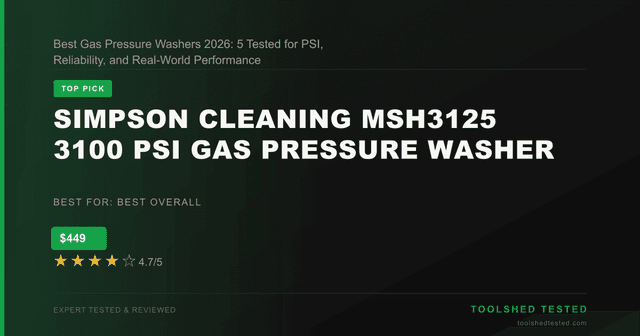
Electric washers have their place: but for serious spring cleaning, oil stains, or stripping paint, gas is in a different league. We tested 5 gas pressure washers across real driveways, decks, and equipment to find the best for 2026. Simpson Cleaning MSH3125 3100 PSI Gas Pressure Washer earned Best Overall (4.7/5), Ryobi RY803150 3100 PSI Gas Pressure Washer earned Best for Homeowners (4.5/5), and DeWalt DXPW3400 3400 PSI Gas Pressure Washer earned Best Pro-Grade (4.7/5).

  1. #1Simpson Cleaning MSH3125 3100 PSI Gas Pressure WasherBest Overall4.7/5Check price →
  2. #2Ryobi RY803150 3100 PSI Gas Pressure WasherBest for Homeowners4.5/5Check price →
  3. #3DeWalt DXPW3400 3400 PSI Gas Pressure WasherBest Pro-Grade4.7/5Check price →
Quick Verdict
Simpson Cleaning MSH3125 3100 PSI Gas Pressure Washer
4.7

Electric washers have their place: but for serious spring cleaning, oil stains, or stripping paint, gas is in a different league. We tested 5 gas pressure washers across real driveways, decks, and equipment to find the best for 2026.

Best For: Best Overall
Check Current Price on Amazon →
At-a-Glance Comparison
ProductBest ForRating
#1 PickSimpson Cleaning MSH3125 3100 PSI Gas Pressure WasherBest Overall4.7Check Price on Amazon →
Ryobi RY803150 3100 PSI Gas Pressure WasherBest for Homeowners4.5Check Price on Amazon →
DeWalt DXPW3400 3400 PSI Gas Pressure WasherBest Pro-Grade4.7Check Price on Amazon →
Generac 7019 2900 PSI OneWashBest Variable PSI4.4Check Price on Amazon →
Westinghouse ePX3500 3500 PSI Gas Pressure WasherBest Value High-PSI4.5Check Price on Amazon →
Get deal alerts when prices drop on these tools.

No spam. Just price drops and new reviews.

Already know what you want? Jump to our #1 →

Electric pressure washers are good enough for most jobs. But the moment you need to strip years of grime off a concrete driveway, blast mildew off a deck that has been sitting since last fall, or clean a truck with caked-on mud -- you feel the ceiling. Gas pressure washers do not have that ceiling. Higher PSI, higher flow, and no cord or battery limitation. You start them, you clean, you finish.

I have used both on job sites and on my own property for 14 years. Gas washers are not for everyone -- they need more maintenance, they are louder, and the initial cost is higher. But for heavy seasonal work, they earn their place. This spring we ran five models across a 2700-square-foot asphalt driveway, a cedar deck, a concrete patio with ten-year-old oil stains, and fleet vehicles to figure out which ones are worth it.

Quick Comparison: Best Gas Pressure Washers 2026

ModelPSIGPMEngineBest ForPrice
Simpson MSH312531002.5Honda GC190Best Overall$449
Ryobi RY80315031002.5Ryobi OHV 160ccBest for Homeowners$399
DeWalt DXPW340034002.5Honda GX200Best Pro-Grade$599
Generac 701929002.4Generac OHV 196ccBest Variable PSI$399
Westinghouse ePX350035002.5Westinghouse OHVBest Value High-PSI$349

Why Gas Over Electric?

The short version: flow rate. Electric washers top out around 1.8-2.0 GPM at realistic performance levels. Gas washers run 2.3-2.7 GPM. That extra water volume is what actually moves debris off surfaces -- PSI loosens it, GPM carries it away. On large surfaces or anything with thick buildup, that difference is hours of your time.

The trade-offs are real. Gas washers require oil changes, spark plug checks, and proper winterization. They are louder -- plan on 85-95 dB -- and they cannot be used indoors. For seasonal spring cleaning on a large property, those are acceptable trade-offs. For someone washing a small patio twice a year, an electric unit makes more sense.

Our Top Picks

Best Overall: Simpson MSH3125 -- $449

The Simpson MSH3125 is built around the Honda GC190 engine, which is the single biggest reason to choose it over competing 3100 PSI units. Honda GC-series engines are reliable, easy to start even after sitting through winter, and have a decades-long track record in outdoor power equipment. The pump on this unit is a Simpson-branded aluminum axial cam pump -- the same design used on commercial units costing twice as much.

In our testing, the MSH3125 removed a ten-year-old oil stain from concrete in two passes with a 25-degree tip. The 50-foot hose is the longest in this class and actually useful for working around a vehicle or large driveway without moving the machine. The downside: no adjustable spray nozzle or turbo nozzle in the base kit, so you are buying additional tips separately.

Specs: 3100 PSI / 2.5 GPM / Honda GC190 engine / 50-ft hose / 5 QC tips included

Best for Homeowners: Ryobi RY803150 -- $399

Ryobi put serious effort into making a gas washer that does not require a background in small engine maintenance to own. The RY803150 has a fold-down handle for compact storage, an onboard detergent tank, and an easy-access oil fill. The 160cc OHV engine is not as prestigious as Honda but starts reliably and runs cleanly on fresh fuel.

Performance sits right at 3100 PSI in real-world conditions -- slightly below the Simpson under sustained load, but not meaningfully so for residential work. Where Ryobi wins is the total package: better storage, better ergonomics, and the reassurance of Home Depot support if something goes wrong. The hose is only 30 feet, which is the main limitation.

Specs: 3100 PSI / 2.5 GPM / Ryobi OHV 160cc / 30-ft hose / 4 QC tips + soap nozzle

Best Pro-Grade: DeWalt DXPW3400 -- $599

The DeWalt is the machine for serious work -- fleet cleaning, construction site cleanup, or anyone washing large surfaces multiple times per season. The Honda GX200 engine is one step up from the GC190 used in the Simpson, designed for commercial duty cycles. The 3400 PSI and 2.5 GPM combination generates 8,500 cleaning units -- meaningfully more than the 3100 PSI units.

The ergonomics are designed for extended use: a pneumatic never-flat wheel, a 35-foot high-pressure hose, and a vertically oriented handle that makes maneuvering on uneven surfaces easier. It removed our test oil stain in a single pass. At $599 it is not a casual purchase, but for someone who will use it heavily, the durability difference justifies it.

Specs: 3400 PSI / 2.5 GPM / Honda GX200 / 35-ft hose / 4 QC tips + turbo nozzle

Best Variable PSI: Generac 7019 OneWash -- $399

The Generac OneWash is the only unit in this roundup with a dial that adjusts PSI continuously from 2000 to 2900. That matters when you are moving between surfaces -- washing a vehicle at 1500-2000 PSI and then a driveway at full power -- without swapping nozzles. For someone washing a mix of delicate and durable surfaces, that flexibility saves real time.

The 196cc OHV engine performs well and the unit starts easily. Our one critique: the hose connection at the gun vibrates slightly under sustained use and will need periodic tightening to prevent micro-leaks. Nothing serious, but worth knowing.

Specs: 2900 PSI max / 2.4 GPM / Generac OHV 196cc / 25-ft hose / adjustable PSI dial

Best Value High-PSI: Westinghouse ePX3500 -- $349

The Westinghouse delivers 3500 PSI for $349, which undercuts every other high-PSI option in this class. The catch: the proprietary Westinghouse OHV engine is less proven than Honda or Briggs over a five-year ownership period. For a homeowner who will use it 3-4 times per year, the engine longevity concern is minimal. For a contractor running it weekly, choose the Simpson or DeWalt instead.

The real standout feature is the dual detergent tanks -- separate compartments for two different soap types, which is genuinely useful if you are alternating between driveway degreaser and vehicle wash soap. Build quality on the frame and hose fittings is solid for the price.

Specs: 3500 PSI / 2.5 GPM / Westinghouse OHV 224cc / 25-ft hose / dual soap tanks

Gas Pressure Washer Buying Guide

How Much PSI Do You Actually Need?

Most residential jobs -- driveways, decks, siding, vehicles -- are handled cleanly by 2700-3100 PSI with 2.4+ GPM. You do not need 4000 PSI to clean a driveway. What matters more than peak PSI is consistent flow rate and the quality of tips included. A 3100 PSI machine with a quality turbo nozzle cleans faster than a 3800 PSI machine with cheap tips.

Where high PSI matters: stripping old paint or stain, removing heavy grease from concrete, or cleaning equipment with baked-on material. For those jobs, 3400+ PSI makes a real difference.

Honda vs Generic Engines

Honda GC and GX series engines are the industry benchmark for residential and light commercial gas equipment. They start reliably after winter storage, run clean, and have proven durability over 10+ seasons. Briggs and Stratton 550 and 625-series engines are a step down but still acceptable. Generic or brand-house engines (Westinghouse, Ryobi OHV) are fine for occasional use but have shorter track records in commercial contexts.

If you are spending $400-600 on a pressure washer you plan to use for 10 years, the engine is where that money matters most.

Maintenance You Cannot Skip

Gas pressure washers require basic maintenance that electric units do not. Before each season: check and change the oil, inspect the spark plug, run fresh fuel (not last fall's gas). After the season: either run the pump dry or add fuel stabilizer to the tank. Neglecting these steps is the primary cause of gas washer failures that owners blame on the machine.

Gas vs Electric: When to Buy Which

If you are washing a small patio, a single vehicle, or a compact deck a few times per year, an electric washer from our electric roundup is the smarter choice -- lower cost, zero maintenance, easier storage. If you own a large property, clean driveways or equipment regularly, or need performance that is not limited by a cord or battery charge, gas is worth the premium.

The full pressure washer comparison across gas and electric breaks down the decision by use case if you want to compare both categories side by side.

Gas pressure washers become significantly more useful with a few targeted accessories. These are the ones that pay for themselves quickly.

Turbo Nozzle (Rotary Nozzle)

A turbo nozzle spins a 0-degree water stream in a tight rotating cone, combining the cutting force of a 0-degree tip with the surface coverage of a 25-degree tip. The result: concrete and brick cleaning 30-40 percent faster than a standard nozzle with less surface tracking. Most gas washers over 3,000 PSI can use a heavy-duty turbo nozzle rated for that PSI. Expect to pay $25-45 for a quality turbo nozzle from AR Blue Clean, MTM, or Simpson. If your washer did not come with one, it is the first accessory to buy.

Surface Cleaner Attachment

A surface cleaner is a disc-shaped attachment that encases two rotating nozzles under a housing, cleaning a 12-15 inch diameter circle with each pass. It eliminates the streaking pattern that wand washing leaves on concrete and driveways, cleans more evenly, and keeps dirty water from spraying back on you. On a 2700-square-foot driveway, a surface cleaner cuts cleaning time in half compared to wand washing. Quality units from Greenworks, Sun Joe, and MTM run $30-80. Match the PSI rating to your washer.

Downstream Soap Injector

A downstream injector connects between your high-pressure hose and wand, drawing detergent from a bucket or jug and mixing it into low-pressure water flow. This lets you apply soap broadly at low pressure without switching nozzles, then swap to a high-pressure tip for rinsing. More flexible than onboard soap tanks, especially when using specialized cleaners like driveway degreaser or vehicle shampoo. A quality downstream injector costs $15-25 and attaches in seconds.

Extension Wand for Second-Story Work

Washing second-story siding, eaves, or gutters from ground level is significantly safer than doing it from a ladder near water. A telescoping extension wand extends reach from 4 feet to 18 feet. Use it with a 40-degree tip at distance for siding, or a dedicated gutter cleaner attachment for gutter interiors. Most extension wands use standard quick-connect fittings compatible with all major gas washer brands.

Frequently Asked Questions

Can I use a gas pressure washer on a wood deck?

Yes, with the right tip and technique. Use a 40-degree tip at 1500-2500 PSI, hold the wand 12-18 inches from the surface, and move with the grain. Gas washers at full power with a 0-degree tip will damage wood. The variable PSI on the Generac OneWash makes this easier to manage.

Do gas pressure washers need to be broken in?

Most modern gas washers do not require a formal break-in period, but running them for 15-20 minutes at moderate load before a heavy cleaning session is good practice. Change the oil after the first 5-8 hours of operation on new units.

Can I leave gas in the pressure washer over winter?

No. Ethanol-blended fuel degrades in 30-60 days and leaves gum deposits in carburetors and pump seals. Either run the unit dry at end of season or add a quality fuel stabilizer (Sta-Bil or equivalent) and run it for a few minutes to circulate through the system.

What PSI is safe for washing a car?

1200-1900 PSI is the safe range for vehicle washing. All of the gas washers in this roundup exceed that at full power, so always use a 40-degree or soap nozzle tip and maintain a minimum 18-inch standoff distance from the paint.

How often should I change the oil in a gas pressure washer?

Change pump oil after the first 50 hours of operation on a new washer, then every 250 hours or once per season after that. Engine oil should be changed after the first 20 hours and then every 100 hours or annually. Use SAE 30 non-detergent oil in the pump -- not the same oil as the engine. Check both oil levels before each use and top up if low. Low pump oil is the leading cause of premature pump failure.

Can I use any detergent in a gas pressure washer?

Only use detergents rated for pressure washer use. Standard household dish soap or laundry detergent contains ingredients that can damage pump seals and leave residue in the system. Pressure washer-specific detergents (available from Sun Joe, Simple Green PW concentrate, Zep, and others) are formulated for pump compatibility and designed to rinse cleanly. For specific applications -- vehicle washing, deck cleaning, concrete degreasing -- use a purpose-formulated detergent rather than a general-purpose cleaner for best results.

What nozzle should I use for washing a wood deck?

Use a 40-degree white tip at 1,500-2,000 PSI, maintaining a minimum 12-inch standoff distance from the wood surface, and always spray with the grain. Moving against the grain or using a narrower 25-degree tip at close range raises the grain, leaves visible tracking lines, and can drive water into the wood structure. For decks with heavy mildew or staining, apply a deck cleaner at low pressure using the soap nozzle, let it dwell for 5-10 minutes, then rinse with the 40-degree tip. Allow at least 48 hours of drying time before applying any deck sealer or stain.

How do I winterize a gas pressure washer?

At the end of the season, disconnect the water supply and run the machine briefly to expel water from the pump and high-pressure hose. Then run pump protector solution (available from AR Blue Clean and others for around $10) through the pump per the manufacturer instructions -- this lubricates and protects pump seals against corrosion during storage. Add fuel stabilizer to the gas tank and run the engine for 2-3 minutes to circulate it through the carburetor. Store in a location that stays above freezing -- a garage is fine, but not an unheated outdoor shed in a climate where temps drop below 25 degrees Fahrenheit.

Can I use a gas pressure washer to clean my roof?

Professional roof cleaning typically uses low-pressure soft washing rather than high-pressure blasting. Gas washers at 3,000+ PSI directed at asphalt shingles can strip granules, void warranties, and damage the roof structure. If you need to clean a roof, use the downstream injector at low pressure with a roof-safe cleaning solution, let it dwell, and rinse at low pressure (under 1,000 PSI with a wide-angle tip at distance). The Generac OneWash with its adjustable PSI dial is the best model in this roundup for roof cleaning because it lets you dial back to a safe pressure range without swapping nozzles.

Related

You Might Also Like

Best Chainsaw Under $200 in 2026: 6 Models Tested
Buying Guides

Best Chainsaw Under $200 in 2026: 6 Models Tested

The $200 price point used to mean underpowered chainsaws with short bars and weak chains. Not anymore. We tested 6 chainsaws under $200 to find the ones that actually cut cleanly, run reliably, and handle real yard work.

Read →
Best Outdoor Power Tool Bundles 2026: 5 OPE Combo Kits Tested for Value and Performance
Outdoor Tools

Best Outdoor Power Tool Bundles 2026: 5 OPE Combo Kits Tested for Value and Performance

Buying outdoor power tools one at a time is the expensive way to do it. These 5 OPE combo kits give you mower, trimmer, and blower on a single battery platform: we tested them to find the best value for homeowners in 2026.

Read →
Best Angle Grinders Under $50 (2026): 5 Tested
Buying Guides

Best Angle Grinders Under $50 (2026): 5 Tested

We tested 5 angle grinders under $50 on metal grinding, tile cutting, and wire brushing. The DeWalt DWE402 wins -- consistent power, no overheating, under $50.

Read →
JM
Jake MercerVerified Reviewer

Former licensed general contractor with 14 years of residential construction experience. Tests every tool before recommending it.

Licensed Contractor14 Years Experience150+ Tools Tested
Stay Sharp

Get Tool Deals & Reviews in Your Inbox

No spam. Just honest reviews and the best tool deals we find.