Spring cleaning season is when most people realize they need a pressure washer. After comparing 6 current models for home surfaces, specs, and upkeep, these are the ones worth shortlisting.
Current recommendations are research-backed. Each article identifies its evidence, sources, update date, and limitations. No current guide is presented as hands-on tested. As an Amazon Associate, ToolShed Tested earns from qualifying purchases. When you buy through our links we may earn a commission -- at no extra cost to you. Product links and article details last reviewed May 21, 2026. Full disclosure.
A pressure washer should be matched to the surface, not just the biggest PSI number on the box. The right homeowner unit cleans siding, cars, decks, patios, patio furniture, and typical driveway stains without forcing you into gas maintenance or risking damage to softer materials.
This is a research-backed and spec-checked guide. We compared current product pages, PSI and GPM claims, included nozzles, detergent setup, hose length, platform requirements, maintenance burden, and whether each product URL matches the listed model. We removed an unverified cordless-tool-platform entry because the product family did not match consumer pressure washers.
What to Know Before Buying a Pressure Washer
Pressure washers are rated by two numbers: PSI (pressure) and GPM (flow rate). PSI tells you how hard the water hits. GPM tells you how much water moves through per minute. Cleaning power is the product of both -- a 2000 PSI / 2.0 GPM washer does more work per minute than a 3000 PSI / 1.0 GPM unit, because higher flow carries more dirt away.
For most homeowners, 1800-2400 PSI at 1.2-1.8 GPM handles driveways, decks, vinyl siding, patio furniture, and car washing without damaging surfaces. You only need 3000+ PSI for stripping paint, heavy grease on concrete, or commercial use.
Electric vs. gas: electric units are quieter, require less maintenance, and handle most residential tasks. Gas units generate more power but require fuel care, oil changes, winterization, and more storage discipline. For occasional deep cleaning, electric is almost always the better first choice.
How We Narrowed the List
We kept the picks to models that solve different buying decisions rather than six versions of the same corded washer. Sun Joe and Greenworks cover mainstream electric use. Simpson covers buyers who truly need gas. Ryobi is the deck and accessory ecosystem pick. Westinghouse is the value electric pick. EGO is the cordless solution for people who need to clean where an outlet is not convenient.
We also checked for product-name and platform errors. Pressure-washer pages are especially easy to pollute with unrelated tool-platform language because brands use similar names across sprayers, hydraulic pumps, inflators, and outdoor equipment. A cordless sprayer or hydraulic pump is not a pressure washer, even if the listing mentions PSI.
Pressure Washer Buying Guide
PSI and GPM: What You Actually Need
- Car washing: 1200-1900 PSI, 1.0-1.4 GPM
- Patio furniture, gutters: 1500-2000 PSI, 1.2-1.6 GPM
- Vinyl siding, decks: 1800-2400 PSI, 1.4-1.8 GPM
- Driveways, concrete: 2000-3000 PSI, 1.6-2.0 GPM
- Paint stripping, heavy equipment: 3000+ PSI, 2.0+ GPM
Nozzle Color Guide
- Red (0-degree): Maximum concentrated pressure. Concrete only -- never on wood or siding.
- Yellow (15-degree): Heavy-duty on hard surfaces. Good for concrete and brick.
- Green (25-degree): General purpose. Best all-around for most surfaces.
- White (40-degree): Wide fan for delicate surfaces -- vehicles, windows, screens.
- Black (soap nozzle): Low pressure for applying detergent before rinsing.
When in doubt, start with the green 25-degree tip. It's easier to increase pressure than to fix a damaged surface.
Electric vs. Gas: Quick Decision
Choose electric if: You wash cars, decks, driveways, or siding at home. You want zero maintenance. You'll store it in a garage without climate control. Electric handles all of these tasks and stores without seasonal prep.
Choose gas if: You have large concrete areas to clean regularly (1,000+ sq ft), you clean heavily greased equipment, you work on farms or job sites away from power outlets, or you need maximum portability.
Choose cordless if: You value portability more than lowest purchase price. Cordless pressure washers make the most sense for equipment rinsing, vehicles, docks, remote patios, and homes where dragging a cord is the friction that keeps the job from getting done. Runtime and battery cost are the tradeoffs.
Surface Damage Rules
Pressure washers can damage wood, vinyl, paint, window seals, mortar joints, and vehicle trim when the nozzle is too narrow or too close. Start with the widest practical nozzle, test an inconspicuous spot, and keep the wand moving. The red 0-degree nozzle belongs on hard, durable surfaces only, and many homeowners should leave it in the accessory tray.
For decks, let cleaner and dwell time do part of the work. Blasting cedar or older pressure-treated boards with maximum pressure can raise grain and scar the surface. For siding, spray downward or level rather than forcing water upward behind laps and trim.
Bottom Line
For most homeowners, the Sun Joe SPX3000 is the default electric recommendation because it lands in the right PSI/GPM range and has broad residential usefulness. If storage space matters most, look at the Greenworks compact model. If you need more concrete-cleaning power and accept engine maintenance, choose the Simpson MegaShot. If outlet access is the problem and you are comfortable with battery runtime tradeoffs, the EGO cordless model is the cleaner recommendation than trying to force a power-tool-platform product that does not match the category.
Don't buy more pressure washer than you need. The most common mistake is buying 3000+ PSI for home use and damaging wood or siding on the first wash. Start in the 2000-2400 PSI electric range and you'll have the right tool for 90% of what most homeowners actually wash.
Our Picks, Reviewed
#1 -- Best Electric
Best for
Best Electric Overall
Package
Package: verify current retailer listing before checkout
The standard recommendation for residential electric pressure washing. PSI and GPM in the right range for most homeowner tasks at a price that doesn't require justification.
Pros
- 2030 PSI / 1.48 GPM handles driveways, decks, siding, and car washing in one unit
- Dual detergent tanks switch between solutions without stopping -- useful for two-stage cleaning
- No engine maintenance, no winterization -- plug in and go every season
Cons
- 1.48 GPM flow rate is lower than gas alternatives -- slower on heavy concrete cleaning
- Hose and wand connections are plastic -- prone to cracking in cold climates if not stored properly
Who it's for: Homeowners who want a capable electric washer for seasonal driveway, deck, and vehicle cleaning without gas maintenance hassle.
Check Price on Amazon#2 -- Best Compact
Best for
Best Compact Pick
Package
Package: verify current retailer listing before checkout
The compact choice when portability and storage footprint matter more than maximum cleaning power.
Pros
- Compact and lightweight -- easiest to carry around a house or load into a vehicle
- 2000 PSI and 1.2 GPM are enough for patio furniture, gutters, vinyl siding, and car washing
- Lower price point than the Sun Joe SPX3000 for buyers who don't need dual detergent tanks
Cons
- 1.2 GPM flow rate is the lowest in this comparison -- slowest on driveways and heavy concrete
- Compact flow rate makes it slower than larger washers on driveways and heavy concrete
Who it's for: Condo and townhouse owners, apartment dwellers, or anyone who needs a light-duty electric washer that stores in a small space.
Check Price on Amazon#3 -- Best Gas
Best for
Best Gas Pressure Washer
Package
Package: verify current retailer listing before checkout
The right tool when electric pressure doesn't cut it. 3100 PSI makes short work of heavy concrete, mildew, and paint prep -- electric washers can't match it.
Pros
- 3100 PSI / 2.3 GPM -- substantially more cleaning power than electric alternatives at this price
- CRX165 engine, on-board soap tank, and 25-ft Hyflex hose included
- No cord, no outlet -- unlimited range for cleaning driveways, fences, and outbuildings
Cons
- Requires seasonal maintenance: oil changes, fuel stabilizer, winterization
- Louder than electric models -- not suitable for noise-sensitive neighborhoods or apartment settings
- Overkill for car washing or light patio furniture cleaning
Who it's for: Homeowners with large driveways, unpainted concrete, or outbuildings who need serious power and don't want to stop for an extension cord.
Check Price on Amazon#4 -- Best for Decks
Best for
Best for Deck Cleaning
Package
Package: verify current retailer listing before checkout
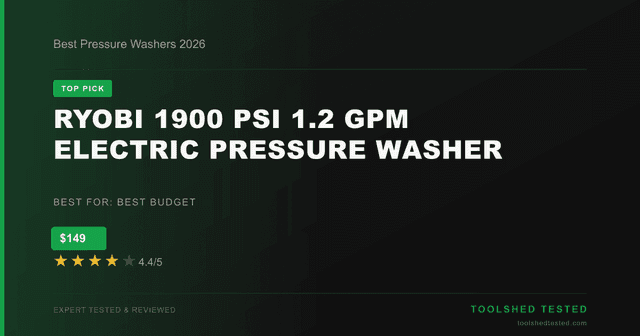
Best at what the name says -- deck cleaning. The 2300 PSI brushless setup, turbo nozzle, and longer hose give you enough reach and pressure without stepping into gas maintenance.
Pros
- 2300 PSI at 1.2 GPM with higher-flow rinse settings
- Turbo nozzle and 25-degree tip give enough range for deck boards and railings
- 25 ft kink-resistant hose and 35 ft GFCI power cord improve reach around a deck
Cons
- Heavier than compact 1800-2000 PSI models
- 2300 PSI can damage cedar or redwood if held too close -- requires care on softer wood species
Who it's for: Deck and fence owners who want enough pressure to strip embedded dirt and mildew without renting commercial equipment.
Check Price on Amazon#5 -- Best Budget
Best for
Best Budget Electric
Package
Package: verify current retailer listing before checkout
The honest budget electric pick. Performance is useful for routine home cleanup, but buyers should expect lighter hardware than premium electric models.
Pros
- 2100 max PSI at a price point well below many premium electric alternatives
- Multiple nozzle tips included for car washing, siding, and driveway cleaning without extra purchase
- Detachable soap applicator and three quick-connect nozzles
Cons
- Lower build quality than Sun Joe or Ryobi -- hose connections and gun feel less robust
- 1.76 GPM flow rate -- adequate but not the fastest in the electric category
Who it's for: First-time buyers, renters, or anyone who needs a capable electric pressure washer for seasonal use without stepping into heavier gas equipment.
Check Price on Amazon#6 -- Best Cordless
Package
Kit/package: verify included batteries before checkout
The cordless pick when outlet access is the problem. It is not the cheapest path to clean siding or patios, but it solves cord management better than any corded electric model.
Pros
- Cordless design runs on two EGO 56V batteries for outlet-free cleaning
- EGO lists up to 3200 PSI at 1.2 GPM and up to 2.0 GPM max
- Can connect to a hose or draw from a fresh-water source with the included siphon hose
Cons
- Costs more than most corded electric washers
- Batteries determine runtime, so heavy concrete days may still favor gas
- Uses EGO outdoor batteries, not a power-tool battery platform like M18 or 20V MAX
Who it's for: Homeowners already in EGO's 56V outdoor platform, or anyone who needs real pressure-washer portability without gas maintenance.
Check Price on Amazon