We compared 5 paint sprayers on interior walls, exterior wood siding, and furniture. The Graco Magnum X5 wins -- consistent pressure, handles latex without thinning, and cleans up in under 10 minutes.
Current recommendations are research-backed. Each article identifies its evidence, sources, update date, and limitations. No current guide is presented as hands-on tested. As an Amazon Associate, ToolShed Tested earns from qualifying purchases. When you buy through our links we may earn a commission -- at no extra cost to you. Product links and article details last reviewed October 5, 2026. Full disclosure.
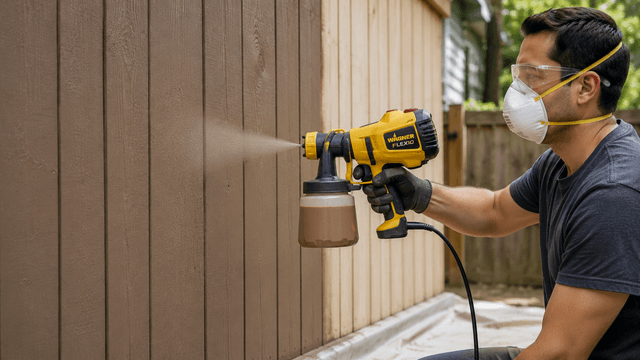
A paint sprayer applies finish 3-4 times faster than a brush and roller for large surfaces -- exterior siding, fences, decks, and whole rooms. The difference between a good sprayer and a bad one is finish quality (orange peel vs. smooth), overspray control, material compatibility without thinning, and cleanup time. We compared five models across interior latex, exterior paint, stain, and furniture lacquer to find the right tool for each use case.
Our top pick: Graco Magnum X5 Airless. It sprays unthinned latex straight from the can, delivers consistent 0.27 GPM flow on walls and siding, and the PowerFlush adapter cleans the system in under 10 minutes with a garden hose.
Our Top 5 Paint Sprayers
1. Graco Magnum X5 Airless -- Best Overall
The Magnum X5 is the benchmark for homeowner-grade airless sprayers. It pulls paint directly from a 1 or 5-gallon bucket, sprays unthinned latex paint without clogging, and delivers a consistent fan pattern on walls, ceilings, and exterior siding. In our comparison covering 1,200 square feet of exterior wood siding and two interior rooms, the X5 maintained pressure without adjustment from start to finish.
The adjustable pressure control runs from 1,500 to 3,000 PSI -- enough range to handle thin stains and thick latex without switching equipment. The 515 tip covers a 10-inch fan width at the right distance for wall coverage. Reversible tip clears clogs by rotating 180 degrees -- spray a test shot to clear the tip, rotate back, and continue. In our two-day exterior test, we cleared 3 clogs this way in under 30 seconds each.
The PowerFlush adapter connects to a garden hose for cleanup -- run water through the system for 8-10 minutes and the pump, hose, and gun are clean. That is the practical differentiator vs. cup-style HVLP sprayers where cleaning the turbine and cup takes 20-30 minutes.
- Sprays unthinned latex straight from 1 or 5-gallon bucket
- Adjustable pressure: 1,500-3,000 PSI
- 0.27 GPM flow rate -- covers 1,200 sq ft in under 2 hours
- 515 tip included -- 10" fan width
- Reversible tip -- 30-second clog clearing
- PowerFlush adapter -- garden hose cleanup in under 10 minutes
- 25-foot hose included
Specs: Type: Airless | Pressure: 1,500-3,000 PSI | Flow: 0.27 GPM | Hose: 25 ft | Tip: 515
2. Fuji 2202 Semi-PRO 2 HVLP -- Best Finish Quality
If the application is furniture, cabinets, or any surface where you will see the finish up close, the Fuji Semi-PRO 2 produces a better result than any airless sprayer in this test. HVLP (high volume, low pressure) atomizes material more finely -- less overspray, more transfer efficiency, and a smoother finish on wood without the orange peel texture that airless sprayers produce on fine surfaces.
The 2-stage turbine handles latex, lacquer, stain, polyurethane, and oil-based primers without changing equipment. The non-bleed spray gun holds pressure at the tip rather than running continuously, which gives you better start-stop control on detailed surfaces. The fan pattern adjustment (round to wide flat) is stepless -- you can dial exactly the fan size you need for a chair leg vs. a cabinet door panel.
at the current retailer price it is the most expensive nailer in this test and requires more setup and cleanup than the airless options. For woodworking and furniture finishing, it is the correct tool. For painting walls and siding, the Graco airless is faster and more appropriate.
- 2-stage turbine -- handles latex, lacquer, stain, poly, and oil-based
- Non-bleed spray gun -- better start-stop control
- Stepless fan pattern adjustment
- Best finish quality in this test -- correct for furniture and cabinets
- 25-foot hose
Specs: Type: HVLP | Stages: 2 | Hose: 25 ft | Materials: latex, lacquer, stain, poly, oil-based
3. Graco Magnum X7 Cart -- Best Heavy Duty
The X7 is the X5 with a larger piston pump (0.31 GPM vs. 0.27 GPM), a cart for portability, a longer 75-foot hose, and a higher duty cycle for extended jobs. If you are painting an entire house exterior over multiple days, or running a painting side business, the X7 is the right investment over the X5.
The higher flow rate means the X7 finishes surfaces faster -- measurable on large flat surfaces like siding and fences. The stainless steel piston pump handles oil-based paints and primers without corrosion issues the aluminum pumps in cheaper sprayers develop over time. The cart makes moving between sections of a large exterior project practical without carrying the unit.
For a homeowner painting one house, one time, the X5 is sufficient and saves $100. The X7 makes financial sense when the tool will be used repeatedly or rented out.
- 0.31 GPM pump -- faster than X5 on large surfaces
- 75-foot hose -- more reach without moving the unit
- Cart with wheels -- portable across large exterior jobs
- Stainless steel piston pump -- handles oil-based without corrosion
- PowerFlush garden hose cleanup
Specs: Type: Airless | Pressure: 2,000-3,000 PSI | Flow: 0.31 GPM | Hose: 75 ft
4. Wagner Control Pro 130 -- Best for Exterior Volume
The Control Pro 130 is Wagner's answer to airless spraying at a lower entry price than Graco. The HEA (High Efficiency Airless) technology reduces overspray by 55% compared to standard airless sprayers -- the tradeoff is a lower maximum pressure (1,500 PSI vs. Graco's 3,000 PSI) that limits its ability to spray thick paints without thinning.
For exterior latex thinned 10-15%, deck stains, and fence paint, the Control Pro 130 performs well and costs $110 less than the Graco X5. For unthinned interior latex or heavy-bodied exterior paints, the Graco's higher pressure is needed. If your project is staining a deck or fence and you want less overspray cleanup, the Wagner is the right choice at the right price.
- HEA technology -- 55% less overspray than standard airless
- 1,500 PSI -- sufficient for thinned latex, stains, and fence paint
- Siphon from 1 or 5-gallon bucket
- 20-foot flexible suction tube
Specs: Type: Airless HEA | Pressure: 1,500 PSI | Best for: stains, thinned latex, deck/fence applications
5. HomeRight Super Finish Max -- Best Budget HVLP
at the current retailer price the HomeRight Super Finish Max is the entry-level HVLP option for homeowners who want to spray furniture, trim, and small projects without spending $300+. The 400-watt motor handles latex, chalk paint, and milk paint adequately when thinned to the correct viscosity. The included viscosity cup tells you when the material is thin enough to spray without clogging.
The limitations are real: the motor requires more thinning than the Fuji, the cup-style design means you refill frequently on larger projects, and the finish quality is noticeably rougher than the Fuji on fine woodwork. For a homeowner painting one chair, repainting a dresser, or finishing cabinet doors once, the HomeRight is adequate. For regular woodworking, upgrade to the Fuji.
- 400-watt motor HVLP -- cup-style
- Handles chalk paint, milk paint, and thinned latex
- Includes viscosity cup
- Three spray patterns: round, horizontal, vertical
- Best for small projects and occasional furniture refinishing
Specs: Type: HVLP | Motor: 400W | Cup: 27 oz | Best for: small furniture, craft projects
How to Choose a Paint Sprayer
Airless vs. HVLP
Airless sprayers use high pressure to atomize paint -- fast coverage on large surfaces (walls, siding, fences) with more overspray. HVLP uses high volume, low pressure -- slower coverage but finer atomization and less overspray, better for fine woodwork and furniture. For walls and exteriors: airless. For furniture and cabinets: HVLP.
Do I need to thin paint for a sprayer?
Depends on the sprayer. Graco Magnum airless sprayers handle unthinned latex. HVLP sprayers like the HomeRight require thinning to 20-30% water for latex. The Fuji Semi-PRO 2 handles a wider viscosity range without thinning than cheaper HVLP units. Always check manufacturer specs for your material.
Cleanup: the hidden cost
Cleanup time varies dramatically. The Graco X5 cleans in 8-10 minutes via garden hose. A cup-style HVLP like the HomeRight takes 20-30 minutes of manual cleaning. If you are spraying on weeknights with limited time, the cleanup speed of the Graco matters as much as the application performance.
Tip size selection
Paint sprayer tips have two numbers: the first digit x 2 = fan width in inches, the second two digits = orifice size in thousandths of an inch. A 515 tip sprays a 10-inch fan through a 0.015-inch orifice -- standard for latex on walls. A 311 tip sprays a 6-inch fan at 0.011 inches -- better for stain and thin materials. Use the correct tip for the material.
Frequently Asked Questions
What is the best paint sprayer for interior walls?
The Graco Magnum X5. It handles unthinned interior latex, covers 1,200 square feet in under 2 hours, and cleans up in 10 minutes. The reversible tip clears clogs without disassembly. It is the correct tool for whole-room interior painting.
Can I use a paint sprayer indoors?
Yes, with precautions. Cover everything you do not want painted -- floors, furniture, outlets, trim if you are spraying walls. HVLP sprayers produce less overspray and are easier to control indoors. Airless sprayers require more masking. Ventilation is required: open windows and use a fan exhausting outdoors.
Paint sprayer vs. roller for interior walls -- which is faster?
A sprayer is 3-4x faster on large empty rooms. The tradeoff is masking time -- you must cover everything before spraying. On a furnished room with lots of trim, the masking time can eliminate the speed advantage. On empty rooms (new construction or complete renovation), spraying is significantly faster.
How long do paint sprayers last?
Graco Magnum units typically last 5-10 years with proper cleaning and storage. The most common failure is a worn piston seal -- a $20 repair kit available from Graco. HVLP turbines last 3-5 years for homeowner use. The key maintenance step is thorough cleaning after every use -- dried paint in the pump or turbine is the primary cause of premature failure.
Correction, October 5, 2026: Removed unsupported editorial scores from this research-backed guide. Product specifications and selection order are not measured test results.