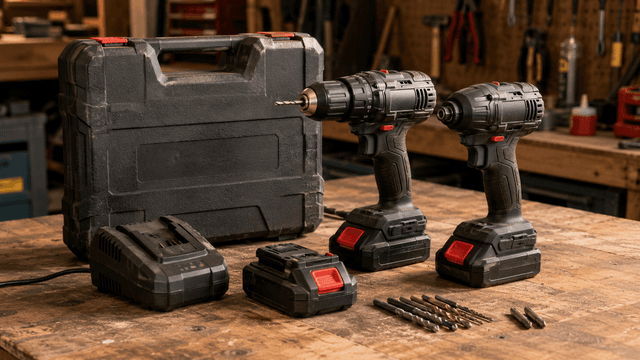
DeWalt DCK240C2 vs DCD771C2 is the real first-buy decision for shoppers trying to avoid overspending while still covering the jobs that show up immediately.
Current recommendations are research-backed. Each article identifies its evidence, sources, update date, and limitations. No current guide is presented as hands-on tested. As an Amazon Associate, ToolShed Tested earns from qualifying purchases. When you buy through our links we may earn a commission -- at no extra cost to you. Product links and article details last reviewed June 11, 2026. Full disclosure.
The buyer intent behind this search is simple: you want to buy one DeWalt kit first and avoid regretting it two weekends later. The problem is that DeWalt sells a complete combo kit, a drill-only kit, and an impact-driver kit that all look close enough to trigger overthinking.
The real answer is job-based, not spec-sheet based. If your first month includes both holes and screws, the DCK240C2 is the right buy. If your first jobs are mostly anchors, pilot holes, and light hardware, the DCD771C2 can be enough. If the immediate pain is driving long screws into studs, shelves, garage cleats, or deck boards, the DCF787C1 solves that faster.
Quick Answer
Buy the DeWalt DCK240C2 if you are starting from zero and want the least risky first purchase. Buy the DCD771C2 only if you know your next jobs are mostly drilling and light fastening. Buy the DCF787C1 only if fastening is the main problem and you can wait on a drill.
Why the Combo Kit Usually Wins
The DCK240C2 wins because it closes the most obvious gap in one step. A drill is better for holes, pilot work, and controlled screw starts. An impact driver is better for repetitive fastening, longer screws, and harder material where a drill starts fighting your wrist. Most buyers who start with only one of those tools end up buying the other soon after.
That is the practical issue with choosing the DCD771C2 or DCF787C1 first. They can be right in narrow cases, but the combo kit avoids the second purchase, the duplicated comparison cycle, and the moment when a project stalls because the tool in your hand is only half-right for the job.
When the DCD771C2 Is Enough
The DCD771C2 is enough when the first jobs look like blinds, curtain rods, cabinet pulls, furniture assembly, picture ledges, basic wall anchors, or small repair work. A drill-driver handles those jobs well because you need controlled starts, straight holes, and moderate fastening instead of raw screw-driving speed.
It is also the cleaner first buy for shoppers who are still proving they will actually use cordless tools. If you are not yet building shelves, workbenches, deck framing, or garage systems, the drill-only kit can keep the first purchase smaller while still opening the DeWalt platform.
When the DCF787C1 Makes More Sense
The DCF787C1 is the better first buy when the urgent work is fastening-heavy. Think garage wall cleats, long cabinet screws, storage rails, deck screws, fence repairs, or repetitive assembly where a drill works but feels slower and more fatiguing.
An impact driver is not a better all-purpose first tool than a drill. It is a better problem-solver when screws are the actual bottleneck. If you still need to drill pilot holes often, buy the combo kit and stop trying to force a one-tool answer onto a two-tool job.
Which Kit Fits Your Project List
Choose the DCK240C2 if your list includes shelves, garage organization, gate hardware, workbench assembly, furniture, anchors, closet systems, deck fixes, or general first-house setup. It is the strongest broad answer.
Choose the DCD771C2 if the list is lighter and cleaner: pictures, blinds, curtain rods, cabinet handles, furniture assembly, and occasional pilot holes. It is the budget-protecting answer when the work is more setup than building.
Choose the DCF787C1 if the list is dominated by screws into wood: cleats, rails, shelves, deck boards, or repeated hardware installs. It is the narrow but efficient answer when the work pattern is already clear.
What Most Buyers Miss
Most buyers compare torque and speed first. That is not the first question. The first question is whether you are solving a drilling problem, a fastening problem, or both. If it is both, the DCK240C2 wins before the comparison even gets complicated.
The second thing buyers miss is battery-platform momentum. Once you buy into DeWalt 20V MAX, the next tool becomes the real value unlock: a circular saw, sander, oscillating multi-tool, blower, or shop light. The right first kit is the one that gets you into that platform without creating regret around the first month of work.
Bottom Line
For most buyers, the DeWalt DCK240C2 is the right first-tool purchase because it covers more real jobs immediately and reduces the chance of a second purchase right away. The DCD771C2 is for lighter drilling-focused use. The DCF787C1 is for buyers who already know screws are the immediate pain point.
If you want the broader starter path, see our best Amazon tool starter kit for new homeowners and the more direct homeowner comparison at DeWalt DCK240C2 vs Ryobi PCL1200K2.
FAQ
Is the DeWalt DCK240C2 worth it over a drill-only kit?
Yes for most buyers. If you expect to drill holes and drive more than a handful of screws, the combo kit removes the need to come back for an impact driver almost immediately.
Can the DeWalt DCD771C2 handle household screws?
Yes. It handles normal household screws and light fastening well. It becomes less ideal when screws get longer, repeated, or driven into denser framing material.
Should I buy the DCF787C1 as my first DeWalt tool?
Only if fastening is clearly the main need. If you still need regular drilling and pilot-hole work, the combo kit is the cleaner first purchase.
What should I buy after the DCK240C2?
Usually a circular saw, shop vac, or sander depending on whether the next bottleneck is cutting, cleanup, or finish work.