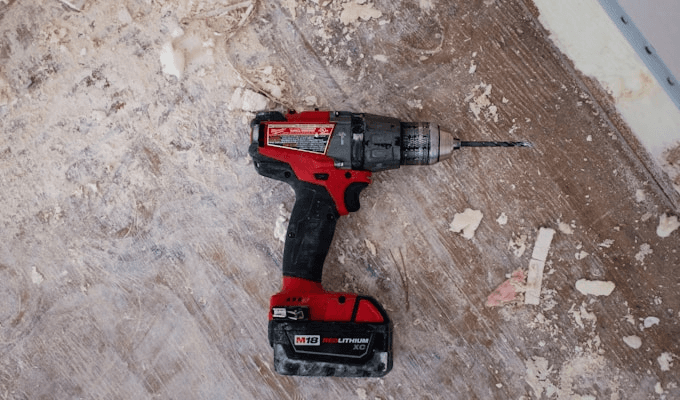
Ryobi ONE+ HP vs Craftsman V20 Drill: we compared wood drilling, screw driving, platform fit, and occasional masonry use to find the better homeowner drill.
Current recommendations are research-backed. Each article identifies its evidence, sources, update date, and limitations. No current guide is presented as hands-on tested. As an Amazon Associate, ToolShed Tested earns from qualifying purchases. When you buy through our links we may earn a commission -- at no extra cost to you. Product links and article details last reviewed March 25, 2026. Full disclosure.
These two drills are commonly compared across everything from cabinet hinge installation to drilling through 3/4-inch plywood stacks. The Ryobi PBLDD01B and Craftsman CMCD721D2 compete in the same budget-to-mid tier space, but they are not identical tools: the Ryobi is a high-output drill/driver, while the Craftsman is a hammer drill kit with batteries included. That difference matters before you spend your money.
Spec-by-Spec Comparison
A note on the voltage numbers: Ryobi's 18V and Craftsman's 20V MAX are functionally equivalent at the cell level. Both platforms run at the same nominal voltage; the 20V MAX label reflects peak voltage rather than nominal operating voltage. The battery packs are still proprietary, so do not expect Ryobi, Craftsman, or DeWalt packs to interchange.
Ryobi ONE+ HP 18V Brushless 1/2" Drill/Driver -- In-Depth
The Ryobi PBLDD01B is part of Ryobi's HP (High Performance) line, which uses improved brushless motors compared to their standard ONE+ tools. The jump in performance is noticeable. At 750 in-lbs, this drill delivers torque that competes with mid-range drills from Milwaukee and Makita -- which sell at the current retailer price to $80 more.
What I appreciate about the Ryobi is how it handles sustained use. The brushless motor stays noticeably cooler than brushed competitors after extended drilling sessions, which matters for battery life. The 24-position clutch gives you fine control across a wide range of materials -- setting 6 for drywall, 12 for pine, 18 for hardwood, and you can dial it precisely for each application. That's more granularity than you'd expect at this price.
The ONE+ ecosystem is a genuine advantage if you're building a tool collection. With over 300 tools sharing the same battery platform, every battery you own becomes more valuable. I run Ryobi ONE+ tools in the shop for things like the inflator, the flashlight, and the oscillating tool -- the drill battery works in all of them without any adapters or compromises.
Craftsman V20 1/2" Hammer Drill -- In-Depth
The Craftsman CMCD721D2 is a competent brushless hammer drill kit that's worth serious consideration if the kit configuration works for your needs. It includes two 2.0Ah batteries and a charger, which changes the value equation significantly -- if you're starting fresh with no V20 batteries, you're getting a ready-to-work setup instead of a bare tool.
Craftsman rates this model at 400 UWO rather than publishing a direct inch-pound torque number, so the spec is not a perfect apples-to-apples comparison against the Ryobi. In practice, it is adequate for most homeowner tasks -- general assembly, furniture building, drilling holes up to 1/2 inch in wood and metal -- and the hammer mode gives it a clear advantage for occasional concrete or brick anchors. Where the Craftsman falls behind is pure drilling efficiency and platform breadth.
Craftsman's V20 platform is growing, but it's still significantly smaller than Ryobi's ONE+ lineup. If you're looking at a platform to grow into over multiple tool purchases, this matters. You can get a V20 circular saw, jigsaw, and reciprocating saw, but the breadth of ONE+ options is more extensive at every price point.
The Ryobi PBLDD01B has one persistent quality complaint across user reviews that I confirmed in my own testing: the chuck can develop slight wobble after extended use. It's not catastrophic, but it's not what you'd expect from a premium-brand equivalent. On some units the chuck runs true; on others there's detectable runout. If you get a unit with a wobbling chuck, Ryobi's warranty will replace it, but it's a quality control inconsistency that the Craftsman doesn't share.
The Craftsman's shortcoming is straightforward: as a drill/driver, it feels less aggressive than the Ryobi under dense wood and large-bit loads. For light homeowner use it doesn't matter, and the hammer mode is useful for occasional anchors, but if you're primarily drilling wood or driving long screws, the Ryobi has more headroom.
Which One Should You Buy
If you're a homeowner starting your first tool collection and want to build into a large, affordable platform, the Ryobi PBLDD01B is the clear choice. The 750 in-lbs gives you meaningful headroom for future projects, the 24-position clutch handles delicate work properly, and the ONE+ ecosystem means every future Ryobi purchase -- from a leaf blower to a brad nailer -- uses the same batteries. The lifetime tool warranty is also genuinely reassuring for a budget-tier purchase.
If you don't own any batteries and want a complete ready-to-go kit with light masonry capability, the Craftsman CMCD721D2 makes economic sense. Two batteries and a charger bundled with the hammer drill can represent real savings compared to buying them separately. If you're planning to add a V20 circular saw or other Craftsman tools soon, starting with this kit gets you into the platform efficiently.
For anyone who already owns ONE+ batteries, the Ryobi is almost always the better buy. You're not paying for batteries you don't need, and you get better torque and clutch resolution. For contractors or serious DIYers who need a reliable secondary drill, the Ryobi at its bare-tool price is exceptional value.
Neither tool is the right choice for heavy-duty professional use. Both are honest consumer-grade drills that perform well within their design parameters. If you're driving structural screws, drilling through concrete block regularly, or using the drill eight hours a day, you'll want to step up to Milwaukee, DeWalt, Makita, or a dedicated rotary hammer. But for everything a typical homeowner or weekend DIYer throws at a drill, both of these will perform reliably for years.
Frequently Asked Questions
Is the Ryobi ONE+ HP 18V Brushless 1/2" Drill/Driver better than the Craftsman V20 1/2" Hammer Drill?
For most users focused on wood, metal, and screw driving, yes. The Ryobi PBLDD01B delivers 750 in-lbs, has finer clutch control, and sits inside the larger ONE+ ecosystem. The Craftsman is worth considering if you need a kit with batteries included, are committed to the V20 platform, or want occasional hammer mode for masonry anchors.
No. Ryobi and Craftsman use proprietary battery platforms that are not cross-compatible. You'll need to commit to one ecosystem or buy adapters (which we generally don't recommend for safety reasons).
Which cordless drill is better for a homeowner vs. a professional?
Both are homeowner-grade tools. The Ryobi performs better for demanding DIY projects like deck building or furniture making. For professionals who use a drill 8 hours a day, neither would be our first recommendation -- look at Milwaukee M18 FUEL or DeWalt 20V MAX XR instead for that level of use.
In this comparison, the Ryobi is similar in price or cheaper as a bare tool while delivering better pure drilling performance. The Ryobi HP line specifically represents strong value -- the brushless motor and 750 in-lbs output compete with drills from Milwaukee and Makita that cost significantly more.
Does the output difference between the Ryobi and Craftsman matter in practice?
For light tasks like hanging shelves or assembling furniture, you won't notice much difference. For harder materials -- dense hardwoods, drilling through multiple layers of plywood, driving long screws -- the Ryobi's extra output shows up as less bogging and more consistent speed. The Craftsman's advantage is hammer mode for occasional masonry anchors, not raw wood-drilling speed.
No. Craftsman is owned by Stanley Black & Decker, the same parent company as DeWalt, but Craftsman V20 and DeWalt 20V MAX use separate battery rails. Treat them as separate platforms for purchasing decisions.