Precision is the backbone of quality woodworking. Whether you're crafting fine furniture, cutting joinery, or working on detailed inlays, your measurements need to be accurate to the thousandth of an inch.
Evidence varies by article. Hands-on pages describe the exact tools and tasks used; research-backed guides compare exact-model specifications, warranties, current pricing, and recurring owner feedback. Each page shows the evidence labels that support its recommendations. As an Amazon Associate, ToolShed Tested earns from qualifying purchases. When you buy through our links we may earn a commission -- at no extra cost to you. Product links and article details last reviewed August 14, 2026. Full disclosure.
Precision is the backbone of quality woodworking. Whether you're crafting fine furniture, cutting joinery, or working on detailed inlays, your measurements need to be accurate to the thousandth of an inch. This is where digital calipers become indispensable. Unlike traditional analog calipers, digital calipers give you instant, easy-to-read measurements that eliminate guesswork and reduce material waste. For serious woodworkers, investing in the best digital calipers for woodworking is a decision that pays dividends in both accuracy and workflow efficiency.
In this guide, we'll explore what makes digital calipers essential for woodworking, what features matter most, and which models stand out for workshop use. Whether you're a hobbyist or a professional, finding the right caliper can transform how you approach precision work.
Why Digital Calipers Matter in Woodworking
Traditional vernier calipers require steady hands and good eyesight to read accurately. Digital calipers eliminate this friction entirely. With an LED or LCD display showing measurements in real time, you can capture exact dimensions in seconds—critical when you're matching stock thickness, drilling precise holes, or ensuring components fit together perfectly.
Woodworking demands precision at multiple scales. You might need to measure the thickness of a delicate veneer (measured in hundredths of an inch) or verify that a mortise is exactly 3/4 inch deep. Digital calipers handle both with equal confidence. The speed and accuracy they offer means less time double-checking measurements and more time focusing on the craft itself.
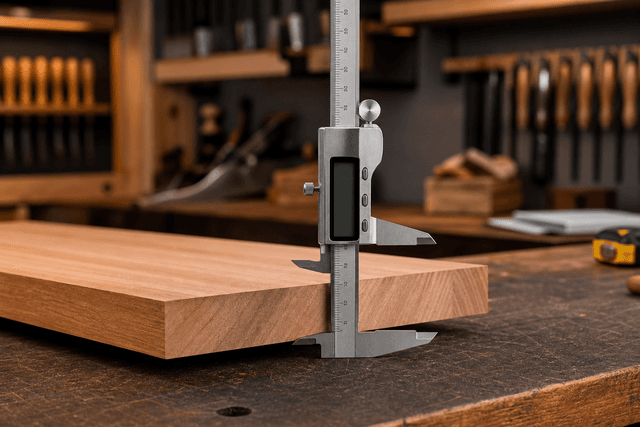
Beyond accuracy, digital calipers offer versatility. Most models measure both inside dimensions (for checking mortise widths or hole sizes) and outside dimensions (for stock thickness or component widths). Some can also measure depth, making them a three-in-one precision tool. For a woodworker's tool roll, that's exceptional value.
Key Features to Consider When Choosing Digital Calipers for Woodworking
Measurement Range and Resolution
For woodworking, you'll typically need a caliper with at least a 6-inch measurement range. This covers most common tasks—from measuring thickness of boards to checking the width of panels. Resolution (the smallest unit the tool can measure) matters just as much. Look for calipers with 0.01-inch or 0.5-millimeter resolution. This level of precision is sufficient for joinery, veneering, and fitting work without being so fine that you're chasing impossible tolerances.
Build Quality and Materials
Workshop environments are demanding. Calipers get dropped, bumped, and exposed to dust and humidity. Stainless steel construction resists rust and corrosion far better than standard steel. Look for models with hardened stainless steel jaws and a robust body. The sliding mechanism should move smoothly without play or binding—this directly affects measurement reliability.
Display Type and Readability
Digital displays come in two flavors: LED and LCD. LED displays are brighter and more readable in low-light workshops, but they drain batteries faster. LCD screens are standard on most models and offer good visibility with lower power consumption. Choose based on your workshop lighting. Look for displays with large numbers that are easy to read at arm's length without tilting the tool.
Battery Life and Type
Most digital calipers use button-cell batteries (usually LR44 or CR2032). Check how long a battery lasts; quality models run for 12 to 24 months of moderate use. Some premium calipers offer solar backup, which extends battery life significantly. For a woodworker who uses calipers regularly, this can be a worthwhile feature—it means fewer battery changes and less risk of the tool dying mid-project.
Ease of Use and Zero Reset
A good digital caliper has a simple zero-reset function (often a button marked "ZERO" or "ON/OFF"). This lets you set the tool to zero against a reference surface, then measure the difference from that baseline. This feature is invaluable for checking consistency across multiple pieces. The button should be easy to reach and press without shifting the caliper's position.
Precision Grade and Accuracy
Manufacturing tolerances on digital calipers vary. Entry-level models are accurate to ±0.05 inch; better ones to ±0.03 inch or better. For woodworking, ±0.03 inch is a practical sweet spot. You won't need laboratory-grade precision, but you need enough accuracy to ensure joints fit properly and surfaces are truly flat.
Best Digital Calipers for Woodworking: Top Choices
When evaluating digital calipers for workshop use, several models consistently emerge as reliable performers. Check Price options from manufacturers like Mitutoyo are known for durability and precision, though they command premium prices. For the budget-conscious woodworker, several solid alternatives deliver excellent performance without breaking the bank.
One highly regarded option is the Neiko Digital Caliper, which offers stainless steel construction, a 6-inch range, and accurate 0.01-inch resolution at a reasonable price point. The tool features both metric and inch measurements, a convenient zero-reset button, and decent battery life. It's a workhorse that handles the demands of active workshop use without fussing.
Another strong contender is the Check Price Adesso brand, which combines affordability with solid build quality. Adesso calipers typically feature hardened stainless steel, smooth sliding action, and large, easy-to-read displays. They're particularly well-suited to woodworkers who need a tool that won't fail when it matters.
For those willing to invest in premium quality, Check Price Starrett digital calipers are considered benchmarks in the industry. Starrett has built its reputation on manufacturing precision tools, and their digital calipers reflect that heritage. You'll pay more, but you get superior accuracy, longer battery life, and a tool that will serve reliably for decades.
Dewalt also makes a capable digital caliper that appeals to woodworkers who prefer buying from brands they already trust in the workshop. Check Price Their models typically focus on ruggedness and simplicity—straightforward tools without excess features, which is exactly what many woodworkers appreciate.
For budget-conscious makers, the Silverline digital caliper is worth considering. These tools prioritize value, offering decent accuracy and stainless steel construction at a price that makes it easy to keep multiple calipers in different locations around the workshop—one at the miter saw, one at the bandsaw, one in your measuring kit.
Practical Tips for Using Digital Calipers in Your Workshop
Storage and Protection
Keep your calipers in a dry location, ideally in a small case or cloth pouch. Humidity and dust are the enemies of any precision instrument. If you notice the jaws develop a light patina, clean them gently with a soft cloth. Avoid soaking or rinsing calipers unless absolutely necessary, as water can seep into the battery compartment.
Measurement Technique
Hold the caliper gently but firmly. Your grip shouldn't be so tight that you're forcing the sliding mechanism. Position the jaws square to the surface you're measuring—a slight angle introduces error. For outside measurements, slide the jaws over the stock until they just kiss the surface; don't force them on. For inside measurements (like checking mortise width), position the inner jaws and gently rock the tool until you find the maximum reading—that's your true inside dimension.
Calibration and Accuracy Checks
Over time, any measurement tool can drift slightly. Every few months, check your caliper's accuracy against a known standard. Many workshop rules or measuring blocks have accurately marked dimensions. Close the jaws completely and verify the display reads 0.00. Then measure a reference standard you trust and compare. If the reading is off by more than 0.05 inch, it's time to recalibrate or consider replacing the tool.
Taking Advantage of the Zero Function
Use the zero-reset feature to check consistency across multiple pieces. Zero the caliper against your first piece, then measure each subsequent piece. The display now shows how much each differs from your baseline, which is faster and more reliable than reading absolute measurements and doing mental math.
Common Mistakes to Avoid
Many woodworkers underestimate how much damage improper storage does to digital calipers. Leaving them in a damp workshop cabinet or throwing them loose in a toolbox exposes them to moisture and impact. A simple padded pouch costs little and extends the life of your tool significantly.
Another common error is over-tightening the lock mechanism. Most digital calipers have a small screw that locks the sliding jaws in place. Tightening this too hard can damage the sliding track and affect accuracy. It should be snug enough to hold position, but not so tight you're straining to turn it.
Finally, don't ignore battery warnings. When the display starts looking dim or dim patches appear, replace the battery immediately. Working with a dying battery introduces measurement uncertainty at the worst possible moment.
Digital calipers aren't meant to replace every measuring tool in your shop—they're specialized. A quality tape measure is faster for rough layout. A combination square or machinist's square are better for checking angles and flatness. What digital calipers do uniquely well is capture precise, repeatable dimensions quickly. For comparing parts, checking uniformity, and verifying that critical dimensions are exactly what you intended, they're unmatched.
In a complete woodworking toolkit, digital calipers sit alongside your tape measure, squares, and marking gauge. Each tool has its purpose, and a digital caliper handles the precision measurement tasks where repeatability and accuracy are paramount.
Conclusion
The best digital calipers for woodworking are tools that combine accuracy, durability, and ease of use without unnecessary complexity. Whether you choose a premium option like Starrett, a trusted name like Dewalt, or a budget-friendly alternative, investing in a quality digital caliper will improve your measurement confidence and the precision of your work.
Digital calipers have become essential to modern woodworking practice because they solve a real problem: they make precise measurement fast and reliable. For joinery work, fitting components, veneer application, or any task where tolerances matter, a good digital caliper is worth its weight in sawdust. Select one that feels comfortable in your hand, reads clearly in your workshop lighting, and matches your budget. Then keep it dry, store it carefully, and let it become one of your most-reached-for tools.