Whether you're stocking firewood for the season or preparing lumber for a woodworking project, understanding moisture content is essential.
Evidence varies by article. Hands-on pages describe the exact tools and tasks used; research-backed guides compare exact-model specifications, warranties, current pricing, and recurring owner feedback. Each page shows the evidence labels that support its recommendations. As an Amazon Associate, ToolShed Tested earns from qualifying purchases. When you buy through our links we may earn a commission -- at no extra cost to you. Product links and article details last reviewed August 12, 2026. Full disclosure.
Whether you're stocking firewood for the season or preparing lumber for a woodworking project, understanding moisture content is essential. Too-wet firewood produces more smoke and creosote buildup; lumber with excessive moisture will warp, twist, and cause your work to fail. A reliable moisture meter is the only accurate way to measure what you can't see with your eyes alone.
This guide covers the best moisture meters for firewood and lumber, helping you understand which tools match your needs, budget, and application.
Why Moisture Content Matters for Firewood and Lumber
Moisture affects performance, safety, and durability. Firewood with moisture content above 25% is inefficient and dangerous—it creates excessive smoke, burns cooler, and accelerates creosote accumulation inside chimneys, raising fire risk. Properly seasoned firewood typically measures between 15–20% moisture content, burning cleanly and producing more usable heat.
For woodworking and lumber projects, moisture control is equally critical. Wood expands and contracts as it absorbs or releases moisture from the air. Lumber used for framing, furniture, or flooring that hasn't acclimated to your workshop's humidity will move after installation, causing splits, gaps, and warping. Most woodworkers target moisture levels between 6–12%, depending on the project and climate.
Without a moisture meter, you're guessing. A quality meter removes the guesswork, saving money on wasted material and preventing failed projects.
Pin-Type Moisture Meters vs. Pinless Moisture Meters
Understanding the two main types helps you choose the right tool for your situation.
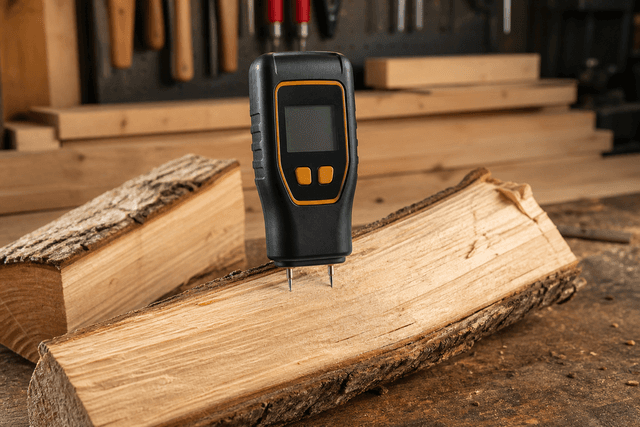
Pin-type meters have two small electrodes that penetrate the wood's surface. As they push into the material, the meter measures electrical resistance between the pins—a property that correlates directly to moisture content. Pin-type meters are accurate, affordable, and durable. They work well for firewood, rough lumber, and general use. The downside: they leave small holes in finished surfaces and can be inconsistent if pins don't contact wood evenly.
Pinless meters use electromagnetic wave technology to measure moisture beneath the surface without breaking the skin. They scan a larger area and provide an average reading across a wider depth. Pinless meters are ideal for fine woodworking, flooring, and finished surfaces where pin marks would be unacceptable. They're faster for scanning multiple pieces and excellent for detecting moisture gradients. The trade-off is higher cost and slightly less precision at extreme moisture levels.
Many professionals own both—a pin-type for rough work and initial assessment, and a pinless for finished material and detailed analysis.
Key Features to Look For
Range and Accuracy: Look for meters covering 5–50% moisture content with ±2–3% accuracy. Firewood assessments need less precision than cabinetry, but broader range is always useful.
Species Compensation: Better meters allow adjustment for wood species. Different woods have different electrical properties, so a meter calibrated for oak may misread pine or maple. Species compensation ensures accurate readings across your material.
Display Type: Digital displays with backlighting are standard. Consider readability if you'll be working in dim light or outdoors.
Build Quality: Meters take abuse in workshops and job sites. Durable construction with sealed electronics resists dust and moisture damage. Rubber grips and reinforced housings matter.
Battery Life: Alkaline batteries in most consumer models last 100+ hours. Solar-assisted or rechargeable options reduce long-term cost if you use the meter frequently.
Response Time: Pinless meters often give readings in seconds; pin-type meters may require 10–20 seconds. Speed matters when testing dozens of pieces.
Best Moisture Meters for Firewood
Firewood assessment is less demanding than fine woodworking. You need accuracy in the 10–30% range and durability for outdoor use. Pin-type meters are standard here and deliver excellent value.
The Lignomat Mini-Ligno Moisture Meter is a professional-grade option trusted by arborists and forestry professionals. It covers 6–44% moisture content with excellent accuracy and species compensation. The meter is robust, battery-efficient, and reads wood-specific values directly without conversion. For serious firewood processors or those who season large quantities, this investment pays for itself quickly in better decisions about wood readiness.
A more accessible choice is the General Tools Moisture Meter, a straightforward pin-type tool designed for woodworking and construction. It delivers solid accuracy in the 5–50% range and includes a backlit display. The durable plastic housing and stainless-steel pins withstand weathering, and the price point is budget-friendly for homeowners checking firewood or testing rough lumber.
For casual firewood users on a strict budget, basic pin-type meters under $20 work adequately for simple firewood screening. They lack advanced features but provide enough accuracy to identify obviously wet wood.
Best Moisture Meters for Lumber and Woodworking
Fine woodworking demands higher precision and better surface protection. Pinless meters excel here, but quality pin-type meters remain viable if you're comfortable with small holes in rough lumber.
The Delmhorst J-4 Pinless Moisture Meter is an industry standard among cabinetmakers and furniture builders. It scans 0–40% moisture content without damaging surfaces, includes species-compensation for 50+ wood types, and features a large display readable from across the workshop. The electromagnetic technology penetrates ¾ inch into the material, giving you a true average rather than a surface-only reading. The build quality is exceptional—it's the tool you buy once and use for decades.
For woodworkers seeking a mid-range pinless option, research-based comparisons highlight models that combine respectable accuracy with lower price. These pinless meters typically cover 5–50% range with species compensation and run $50–$100, making them accessible to serious hobbyists.
Pin-type meters remain excellent for lumber applications if surface marks aren't a concern. The Extech MO210 Moisture Meter offers broad range, species compensation, and reliable accuracy favored by construction professionals and lumber inspectors. It's rugged, battery-efficient, and affordable compared to pinless alternatives—a smart choice if you're testing rough-sawn lumber or framing stock.
How to Use a Moisture Meter Effectively
Proper technique ensures reliable readings, whether you're using pin-type or pinless meters.
For pin-type meters: Insert pins perpendicular to the grain into the wood's interior, not just the surface. Surface readings are unreliable and often skewed by moisture film or weathering. Press pins fully into the wood—incomplete insertion creates high resistance and false readings. Take readings from multiple locations on each piece (top, middle, bottom, sides) to assess moisture distribution. On firewood, test several pieces from different parts of the stack; the interior is often wetter than the exterior.
For pinless meters: Keep the scanning surface clean and flat against the wood. Scan multiple locations and look for consistent readings. On thick material, position the meter to measure the depth zone you care most about—the surface or the interior. Some meters allow shallow and deep scanning modes; use deep mode for lumber you'll be cutting and reworking, shallow mode for finish surfaces.
General best practices: Always test in stable conditions. Fresh-cut or rain-soaked wood gives distorted readings. For firewood, test after the wood has been stacked for several hours; surface drying from wind skews immediate post-rain readings. Allow fresh batteries 30 minutes to stabilize before critical measurements. Document readings—track moisture trends over time to better understand your stacking and seasoning results.
Maintenance and Longevity
Quality moisture meters are robust and require minimal maintenance. Clean pins occasionally with a cloth to remove sawdust and resin. Store meters in a cool, dry location; extreme heat damages electronics. Replace batteries before they fully deplete to prevent corrosion. Some advanced models include calibration checks; refer to the manual periodically to verify accuracy.
Pin-type meters occasionally develop bent or dull pins; replace pins if readings become inconsistent (usually a $10–$20 service). Pinless meters are sealed and rarely need service if handled carefully.
Common Mistakes to Avoid
Testing surface only: Surface moisture doesn't reflect what's inside. Firewood can feel dry after a week in the sun but remain 35% moisture internally. Test 1–2 inches deep with pin meters.
Ignoring species differences: Oak and pine have different electrical properties. A meter set for general hardwood may misread softwood significantly. Use species compensation if available.
Testing in wrong conditions: Fresh rain, recent snow melt, or high-humidity days skew readings. Wait for stable conditions; early morning or after a dry night usually gives the most reliable baseline.
Assuming uniform moisture: Even a single log or board varies across its cross-section. The center remains wetter longer than the edges. Take multiple readings and look for the highest values—that's your true indicator of readiness.
Neglecting battery maintenance: Low batteries produce erratic readings. Replace proactively before the indicator suggests replacement.
Conclusion: Choosing Your Best Moisture Meter
The best moisture meter for firewood and lumber depends on your specific application and budget. For firewood seasoning, a durable pin-type meter in the $40–$150 range delivers everything you need to ensure wood is ready for burning. For woodworking and fine lumber, pinless meters justify their $100–$300+ investment by protecting finished surfaces and providing superior accuracy for critical projects.
Start by honestly assessing your needs: How often will you test? What materials do you measure most? How important is surface protection? A $50 pin-type meter serves occasional firewood users perfectly; serious woodworkers typically prefer a pinless meter's non-destructive scanning and species compensation.
Whichever meter you choose, understanding moisture content transforms your firewood and lumber decisions from guesswork into confidence-backed judgment. That clarity saves wood, prevents failures, and—in the case of firewood—keeps your chimney safer and your stove running more efficiently.