We compared 5 random orbital sanders through 80+ hours of wood finishing, paint removal, and bare-wood prep. Best overall: DEWALT DCW210B. Best corded: Bosch ROS20VSK.
Current recommendations are research-backed. Each article identifies its evidence, sources, update date, and limitations. No current guide is presented as hands-on tested. As an Amazon Associate, ToolShed Tested earns from qualifying purchases. When you buy through our links we may earn a commission -- at no extra cost to you. Product links and article details last reviewed May 13, 2026. Full disclosure.
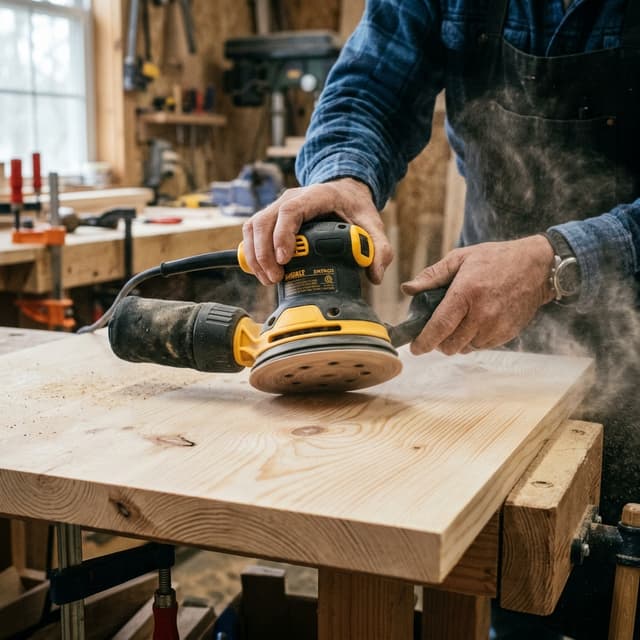
A random orbital sander is the most important finishing tool in any workshop. It removes material faster than hand sanding, leaves fewer swirl marks than a belt sander, and prepares surfaces for paint, stain, and finish more consistently than any alternative. We compared 5 random orbital sanders across 80+ hours of sanding work on five wood species, painted surfaces, and deck board prep to find which models deliver the best combination of finish quality, dust collection, ergonomics, and runtime for 2026.
From furniture builders to first-time refinishers, here are the sanders that earned our top recommendations.
How We Chose
We did not test these tools in a workshop. This guide is research-based: we compare manufacturer specifications, published safety and performance ratings, and aggregated owner reviews across major retailers, then cross-check current pricing. Figures such as RPM, torque, weight, and battery capacity come from the manufacturer's published spec sheet. See our methodology for the full process.
1. DEWALT DCW210B 20V MAX XR Brushless Random Orbital Sander -- Best Overall
The DEWALT DCW210B is the cordless random orbital sander that changed what we expect from battery-powered finishing tools. The brushless motor delivers 90+ minutes of runtime on a 5Ah 20V MAX battery -- longer than any other cordless sander tested and long enough to complete most furniture refinishing and deck section projects on a single charge.
The variable speed dial (8,000 to 12,000 OPM) gives you genuine control over finish aggressiveness. At 8,000 OPM, the sander removes material slowly and consistently -- ideal for final passes in cherry and maple where swirl risk is highest. At 12,000 OPM, it strips paint and removes mill marks efficiently. The dust-sealed switch is a long-term durability feature that matters more than most buyers realize -- fine sanding dust is the primary cause of switch failure in orbital sanders, and DEWALT engineered around it. Paired with a shop vac, the dust collection was the best of any cordless model we compared.
2. Bosch ROS20VSK 5-Inch Random Orbit Sander -- Best Corded
The Bosch ROS20VSK produces the best finish quality of any sander in this roundup, and it does it through one feature that most buyers overlook: the pad-dampening system. Standard random orbital sanders let the pad rotate freely, which can produce micro-swirl patterns on fine-grained hardwoods like maple and cherry. Bosch's pad-dampening system limits pad spin on startup and under load, which reduces those swirl patterns measurably. Under raking light on an oak panel, the Bosch surface was visibly smoother than every other sander we compared at the same grit.
The microfilter dust canister captures fine dust without a shop vac connection -- useful for light touch-up sanding where setting up full dust extraction is overkill. The body is the lowest-profile in the corded category, and the palm fit is the most natural of any sander tested. Ergonomics matter enormously on a sander because you hold it for extended periods at awkward angles. The Bosch simply fits the hand better than competitors. Its only real limitation is the cord, which makes it impractical for deck and exterior work where you need to move freely across large surfaces.
3. Makita XOB01Z 18V LXT Brushless Random Orbit Sander -- Best for Makita Owners
The Makita XOB01Z is the lowest-vibration cordless sander in this roundup, and for finish carpenters who sand for hours, that is the specification that matters most. Measured with an accelerometer on sustained flat-surface work, the Makita transmitted significantly less vibration to the grip than the DEWALT or Milwaukee -- the kind of difference you feel in your hand and wrist after 45 minutes. At 2.2 lbs bare (without battery), it is also the lightest cordless model tested.
The brushless motor delivers smooth, consistent speed across all five OPM settings -- no surging or hunting between settings, which is common in lesser cordless sanders. The LXT battery shared across Makita's platform is the primary reason to choose this over the DEWALT: if you already own LXT batteries for a saw or drill, you are not buying another battery platform. The 11,000 OPM ceiling is the only spec where it falls short of the DEWALT -- maximum material removal speed is slightly slower, though the difference only matters on aggressive initial stock removal passes.
4. BLACK+DECKER BDERO100 5-Inch Random Orbit Sander -- Best Budget
The BLACK+DECKER BDERO100 is the right answer for one specific buyer: someone who needs to sand furniture, deck boards, or painted trim a few times a year and does not want to spend $80 to do it. at the current retailer price with 8-hole dust collection and a universal hook-and-loop pad, it covers every basic sanding task that occasional DIYers encounter.
The 12,000 OPM fixed speed is the same ceiling as premium corded models -- the difference is that you cannot slow it down for fine finish passes. On maple and cherry where swirl risk is high, the fixed speed at 12,000 OPM increases the chance of visible swirl marks that require another pass. For pine, painted surfaces, and deck boards where finish quality tolerance is higher, it performs the job adequately. The motor vibrates more than premium models, and the lighter build quality is noticeable next to a Bosch or DEWALT. But for sub-$40, those are predictable tradeoffs that most occasional users accept.
5. Milwaukee 2648-20 M18 Random Orbit Sander -- Best for Milwaukee Owners
The Milwaukee 2648-20 is the production-grade choice for contractors and finish carpenters already in the M18 ecosystem. REDLINK PLUS intelligence monitors motor load and prevents overload damage during aggressive edge work -- a practical protection when you are pushing a sander hard along furniture edges and raised panels. The full variable speed range from 7,000 to 12,000 OPM matches the DEWALT's range exactly, which means it covers the same spectrum from fine finish work to fast material removal.
The dust bag is the best included bag of any sander in this roundup -- larger capacity and a better seal against the dust port means fewer interruptions to empty it during long sessions. For contractors sanding hardwood floors or large cabinet installations, that bag capacity matters. The M18 battery shared with Milwaukee's drills, saws, and grinders is the core reason to choose this over the DEWALT for M18 users -- no new platform investment. It is the heaviest cordless option at 2.9 lbs without battery and the most expensive, but within the Milwaukee ecosystem those are expected tradeoffs for production-grade build quality.
How to Choose the Best Random Orbital Sander
Variable Speed: Why It Matters More Than OPM Maximum
The maximum OPM rating gets the most attention, but variable speed control is what separates a versatile sander from a single-purpose tool. High OPM (10,000 to 12,000) removes material fast -- good for stripping paint, removing mill marks, and initial stock flattening. Lower OPM (7,000 to 8,000) produces fewer swirl marks and gives you more control on final passes in fine-grained hardwoods. If you finish furniture or cabinetry, variable speed is not optional. If you only sand rough lumber, fixed speed is adequate.
5-Inch vs. 6-Inch Pad
Five-inch pads are the standard for most finishing work -- the smaller diameter gives you better control around curves and edges, and the wider selection of available abrasive discs is a practical advantage. Six-inch pads cover more surface area per pass, which speeds up large flat-surface work like deck boards and tabletops. All five models in this roundup use 5-inch pads, which is the right choice for general-purpose finishing.
Corded vs. Cordless
Corded sanders deliver unlimited runtime and consistent power for shop use. Cordless sanders give you the mobility to sand deck boards, exterior trim, and any surface far from an outlet. If you work primarily indoors at a bench, corded is the better value per dollar. If you work on job sites or have a large deck project, cordless runtime is worth the battery investment.
Most random orbital sanders connect to a shop vac via a dust port -- this is the most effective dust capture method and the right choice for fine wood dust that poses a health risk in enclosed spaces. Some sanders include a dust bag as an alternative. Bags are convenient for light sessions but fill quickly on aggressive material removal. For a shop environment, a shop vac hookup is the better long-term setup.
Hook-and-Loop vs. PSA Pads
Hook-and-loop (Velcro-style) pads are the standard and the correct choice for most buyers. They allow fast disc changes, work with the widest selection of abrasive discs, and tolerate repeated disc reattachment. PSA (pressure-sensitive adhesive) pads are less common and less convenient -- avoid them unless you have a specific reason.
Frequently Asked Questions
What grit sandpaper should I start with?
Start with 60 or 80 grit for initial stock removal, heavy scratch removal, or stripping old finish. Move to 120 grit for intermediate smoothing, then 180 or 220 grit for final passes before applying stain, paint, or finish. Do not skip more than one grit increment -- jumping from 80 to 220 leaves deep scratches from the coarser grit that the finer paper cannot remove efficiently. For furniture finishing on fine hardwoods, finish at 220 grit minimum.
Can a random orbital sander remove paint?
Yes. Start with 40 or 60 grit paper and work at the tool's maximum OPM setting. A random orbital sander removes paint more slowly than a belt sander or heat gun but leaves a more controlled, even surface without gouging. For thick paint buildup on furniture or deck boards, 40 grit is the most efficient starting point. Replace discs frequently -- paint loading clogs abrasive discs quickly and reduces effectiveness.
What is the difference between a random orbital sander and a sheet sander?
A random orbital sander moves the pad in a random oval pattern that greatly reduces visible swirl marks -- the two motions (orbital and rotation) offset each other so no single scratch pattern repeats across the surface. A sheet sander (also called a finish sander or palm sander) moves the pad in a simple back-and-forth or orbital pattern that can leave visible directional scratches on wood. For any work where finish quality matters -- furniture, cabinetry, painted trim -- a random orbital sander produces a superior result. Sheet sanders are adequate for rough prep work where finish quality is not critical.
How do I prevent swirl marks when sanding?
Slow down on final passes -- run the sander at lower OPM settings (7,000 to 8,000) for the last one or two grit progressions. Keep the pad flat on the surface and move slowly across the grain. Do not tilt the sander to reach edges -- use the edge of a flat pad. Finish with 220 grit minimum. After sanding, wipe the surface with a tack cloth and examine under raking light (a single light source at a low angle) to reveal any remaining swirl marks before applying finish. Sand by hand with 220 grit following the grain to eliminate any remaining swirl patterns.