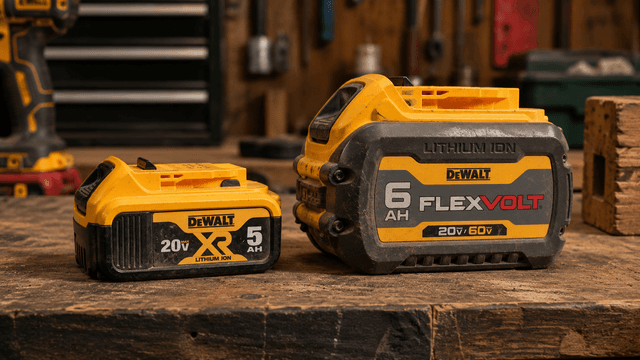
DeWalt runs two cordless ecosystems. 20V MAX covers everyday tools. FLEXVOLT handles the heavy work. Here's how to decide which one -- or both -- belongs in your shop.
Current recommendations are research-backed. Each article identifies its evidence, sources, update date, and limitations. No current guide is presented as hands-on tested. As an Amazon Associate, ToolShed Tested earns from qualifying purchases. When you buy through our links we may earn a commission -- at no extra cost to you. Product links and article details last reviewed April 20, 2026. Full disclosure.
Our Picks, Reviewed
SPEC SHEET // #01 -- Best 20V MAXREF: B08J8JK9GW
Best for
Best 20V MAX Tool
Package
Kit/package: verify included batteries before checkout
The smartest 20V MAX drill. Runs fine on 20V, gets a real power boost on FLEXVOLT -- best of both worlds.
Key features
- 1,000 UWO on 20V MAX; boosted output with FLEXVOLT battery
- 3-speed transmission: 0-450/1,350/2,000 RPM
- Works with all 20V MAX and FLEXVOLT batteries
- FLEXVOLT ADVANTAGE technology built in
✓ What Stands Out (Pros)
- Fully backward compatible with every 20V MAX battery you already own
- FLEXVOLT battery unlocks higher power without buying a new tool
- 20V MAX ecosystem -- over 250 compatible tools
✕ Watch Out For (Cons)
- Peak FLEXVOLT ADVANTAGE power requires an expensive FLEXVOLT battery
- Still a 20V design -- won't match a true 60V tool in sustained heavy use
- No FLEXVOLT ADVANTAGE on older 20V MAX tools
Who it's for: Existing 20V MAX users who want headroom to grow into heavier work without switching platforms.
SPEC SHEET // #02 -- Best FLEXVOLT ToolREF: B086MN8MZW
Best for
Best FLEXVOLT Heavy-Duty Tool
Package
Package: verify current retailer listing before checkout
Corded power in a cordless body. The right tool when a 20V grinder just can't keep up.
Key features
- 60V MAX / 9,000 RPM -- corded-replacement power
- Electronic brake stops disc in under 2 seconds
- Kickback brake detects sudden disc grab and kills power
- 4.5-5" wheel compatibility
✓ What Stands Out (Pros)
- Sustained power that 20V grinders can't match for extended grinding and cutting
- Electronic clutch and kickback brake make it safer than corded at equivalent power
- Runs on the same FLEXVOLT battery as your 20V tools
✕ Watch Out For (Cons)
- Requires a FLEXVOLT battery -- won't accept standard 20V MAX packs
- Heavier than 20V grinders
- Overkill for occasional light grinding
Who it's for: Metalworkers, fabricators, and contractors doing sustained grinding, cutting, or surface prep where a 20V grinder bogs down.
SPEC SHEET // #03 -- Best FLEXVOLT BatteryREF: B01MQTIEMD
Best for
Best Bridging Battery
Package
Kit/package: verify included batteries before checkout
The smartest buy in the FLEXVOLT system. One expensive battery that does everything across both voltages.
Key features
- Auto-senses voltage: 20V MAX in 20V tools, 60V in FLEXVOLT tools
- 9.0Ah at 20V / 3.0Ah at 60V -- 54Wh total
- Fits every 20V MAX tool and all FLEXVOLT tools
- Fuel gauge LED on battery
✓ What Stands Out (Pros)
- One battery that works across both platforms -- eliminates separate battery stacks
- 9.0Ah on 20V tools means extended runtime on drills, drivers, and circular saws
- Pays for itself if you're buying into both platforms
✕ Watch Out For (Cons)
- premium per-battery cost -- expensive entry point
- Heavy at 2.4 lbs -- not great in compact tools all day
- 3.0Ah effective capacity at 60V means shorter runtime on FLEXVOLT tools
Who it's for: Anyone running both 20V MAX and FLEXVOLT tools who wants one battery pack that crosses both platforms.
DeWalt runs two separate cordless ecosystems under one brand. Understanding which one you need -- and how they interact -- is the key to building a tool collection that actually works together.
Here's the short version: 20V MAX is the everyday platform. It covers drills, drivers, circular saws, nailers, and 250+ other tools. 60V FLEXVOLT handles the heavy work -- angle grinders, table saws, miter saws, and reciprocating saws in sustained-use applications. The smart play for most users is to anchor on 20V MAX and add one or two FLEXVOLT tools where 20V genuinely falls short.
Both systems use lithium-ion cells. The difference is how many cells are wired in series.
20V MAX packs have 5 cells in series. "20V MAX" is peak open-circuit voltage -- the nominal working voltage is 18V, which is why DeWalt tools are compatible with competing 18V ecosystems in terms of cell count (though not physically).
60V FLEXVOLT packs have 15 cells in series at full voltage. But the key innovation is the auto-switching design: the same FLEXVOLT battery reconfigures itself to 3 groups of 5 cells (20V) when inserted into a 20V MAX tool. That's what makes the bridge battery concept work.
The result: you can buy a FLEXVOLT battery and run it in every 20V MAX tool you own with no adapters. It just delivers more capacity (runtime) in those tools, not more voltage.
When 20V MAX Is Enough
For most homeowners and general DIYers, 20V MAX handles everything:
- Drilling into wood, drywall, and light masonry
- Driving screws and fasteners
- Cutting with a circular saw (up to 2x4s easily, sheet goods with a good blade)
- Nailing and stapling
- Most oscillating multi-tool work
- Light-to-medium grinding and cutting
The 20V MAX platform's real strength is breadth. Over 250 tools run on it. When you invest in 20V MAX batteries, you're investing in access to every tool class DeWalt makes at the entry and mid-range level.
When You Need FLEXVOLT
FLEXVOLT tools are designed around sustained high-draw applications where 20V packs drain fast or throttle under load:
- Sustained angle grinding (surface prep, weld removal, cutting metal for extended periods)
- Miter saw work for a full job site day -- the DCW872B FLEXVOLT table saw runs full 8-hour shifts
- Table saw ripping through hardwood or thick material where a 20V saw bogs down mid-cut
- Large reciprocating saw demolition where you're cutting for minutes at a time, not seconds
The honest take: most homeowners don't need FLEXVOLT. Most contractors doing heavy sustained work do.
Battery Compatibility at a Glance
Important: Standard 20V MAX batteries do NOT work in FLEXVOLT-only tools. The connector physically fits, but the tool won't operate. FLEXVOLT batteries always work in 20V MAX tools.
FLEXVOLT ADVANTAGE: The Third Option
DeWalt added a wrinkle with FLEXVOLT ADVANTAGE tools -- a subset of 20V MAX tools engineered to extract more power from a FLEXVOLT battery without becoming full FLEXVOLT tools.
The DCD999B drill is the best example. On a 20V MAX battery, it outputs 1,000 UWO. Plug in a FLEXVOLT battery, and the tool senses the higher-capacity pack and increases motor output. You get more power without buying a 60V tool.
This is the best buy for 20V MAX users who occasionally need more performance: upgrade your battery, not your tool.
Cost Comparison
Bottom line on cost: 20V MAX batteries are significantly cheaper. If you're running a full FLEXVOLT setup alongside 20V MAX, budget at the current retailer price+ per battery. The 9.0Ah bridge battery at the current retailer price is the most cost-efficient way to bridge both systems.
Who Should Start With 20V MAX
- Homeowners doing general repairs, projects, and occasional heavy work
- Anyone new to cordless tools -- build the battery collection before adding expensive FLEXVOLT tools
- Budget-conscious buyers -- 20V MAX kits start at the current retailer price with battery and charger included
Who Should Add FLEXVOLT
- Contractors doing sustained heavy work: grinding, large miter cuts, ripping hardwood
- Existing 20V MAX users who find themselves limited by power or runtime in specific applications
- Shop users who want to cut the cord on a table saw or miter saw without losing performance
Verdict
Start with 20V MAX. Add FLEXVOLT where 20V genuinely falls short -- usually one or two heavy-use tools. Buy a FLEXVOLT 9.0Ah bridge battery so both ecosystems share the same high-capacity pack. That's the most efficient DeWalt setup for users who bridge both platforms.