We compared 5 electric snow blowers for 2026. Compare clearing width, battery life, and throwing distance from EGO, Toro, Snow Joe, Greenworks, and Ryobi.
Current recommendations are research-backed. Each article identifies its evidence, sources, update date, and limitations. No current guide is presented as hands-on tested. As an Amazon Associate, ToolShed Tested earns from qualifying purchases. When you buy through our links we may earn a commission -- at no extra cost to you. Product links and article details last reviewed March 25, 2026. Full disclosure.
Electric snow blowers have become genuinely practical alternatives to gas models for residential driveways and walkways. We compared 5 of the best electric snow blowers for 2026 — both corded and battery-powered — measuring clearing width, intake height, throwing distance, runtime, and ease of use so you can pick the right machine for your winter conditions.
Quick Comparison: Best Electric Snow Blowers 2026
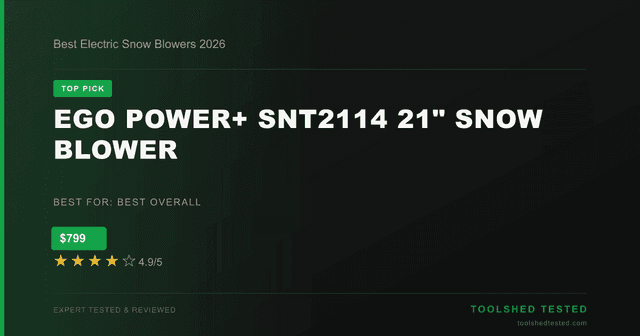
1. EGO Power+ SNT2114 21" Snow Blower — Best Overall
Pros
- Peak power equivalent to 212cc gas engine
- Two 56V batteries for extended runtime
- LED headlights for early-morning clearing
- Variable-speed auger and chute control
Cons
- Premium price with batteries
- Heavy at 62 lbs
2. Toro 60V Power Clear e21 (39921) — Best Runner-Up
Pros
- Self-propel Power Curve rotor clears to pavement
- Anti-clogging system handles wet snow
- 60V battery delivers strong performance
- Folds for compact storage
Cons
- Single battery limits runtime to ~45 min
- Chute adjustment is manual
3. Snow Joe iON18SB 18" Cordless Snow Blower — Best Value
Pros
- Affordable entry-level cordless
- 18-inch clearing width for walkways and decks
- Rubber-tipped auger safe for composite decking
- Lightweight at 32 lbs
Cons
- 40V limits runtime to ~25 minutes
- Struggles with snow over 8 inches deep
4. Greenworks 80V 22" Snow Blower (SNB401) — Best Power
Pros
- 80V delivers gas-equivalent torque
- 22-inch clearing width and 13-inch intake
- Up to 30-foot throwing distance
- Quiet compared to gas models
Cons
- Heaviest in this comparison at 65 lbs
- 80V battery ecosystem is limited
5. Ryobi 40V HP Brushless 21" Snow Blower (RY40806) — Best Ecosystem
Pros
- Compatible with 75+ Ryobi 40V tools
- Brushless motor for efficiency
- Jet-action chute for precise throwing direction
- LED headlights standard
Cons
- 40V limits heavy-snow performance
- Battery and charger sold separately on some SKUs
How to Choose the Right Electric Snow Blower
Electric snow blowers have become genuinely competitive with gas models for residential use in the right conditions. Here is how to determine whether electric is right for your situation and which specs matter most.
Clearing Width: Match It to Your Driveway
Clearing width determines how many passes you need to clear your driveway. For a standard single-car driveway (8-10 feet wide), an 18-21 inch clearing width takes 5-7 passes. A 22-inch model takes one fewer pass per length -- which adds up over a full season. For two-car driveways (16-20 feet) or long driveways, the time savings from a wider clearing path become significant. All five models in this roundup offer 18-22 inch clearing widths, appropriate for most residential properties. Wider gas two-stage units (24-30 inches) are better suited to commercial or large estate driveways.
Intake Height: The Spec Most Buyers Miss
Intake height is how deep of snow the machine can handle in a single pass. The Snow Joe iON18SB handles 8 inches of depth. The EGO SNT2114 and Greenworks SNB401 handle up to 12-13 inches. This matters enormously if your area receives heavy snowfalls. A machine with an 8-inch intake height on a 14-inch snowfall requires multiple passes and significantly more time. Know your average and maximum storm depth and buy accordingly. For areas that regularly see 8+ inches in a single storm, the EGO or Greenworks are the right choices.
Single-Stage Electric vs Gas Two-Stage
All electric snow blowers in this roundup are single-stage machines -- an auger scoops snow and throws it through the chute in one motion. Gas two-stage machines use a separate impeller to throw snow farther and can handle heavier, wetter snow more effectively. For light-to-medium snow (under 10 inches of dry-to-moderate snow) on flat surfaces, single-stage electric performs well. For heavy, wet snow (the dense coastal and transition-zone snow that arrives in late winter), slopes, or gravel driveways where an auger should not contact the surface, a gas two-stage is more capable. Electric is the right choice for most homeowners in lighter-snow climates.
Battery Voltage and Runtime
Higher voltage batteries generally deliver more sustained power and longer runtime. The EGO SNT2114 uses two 56V batteries for maximum power and runtime -- effectively doubling available energy. The Toro 60V and Greenworks 80V deliver strong single-battery performance. The Snow Joe 40V and Ryobi 40V are adequate for shorter driveways and lighter snowfall but will fall short on heavy clearing sessions. For any driveway longer than 40 feet, plan for at least 45 minutes of runtime -- which means a high-voltage model or a spare battery.
Throwing Distance
Throwing distance (how far the machine projects cleared snow) matters for where you clear to. Most electric models throw 20-35 feet. The Greenworks 80V claims up to 30 feet -- among the best in class for electric. If your driveway borders a lawn or open space, maximum throw distance is less critical. If you need to clear snow precisely over a fence or property line, adjustable chute direction and shorter throw is actually preferable. Chute direction control (manual crank vs joystick) affects how quickly you can redirect where snow lands during a clearing pass.
Corded vs Battery: When Corded Makes Sense
Corded electric snow blowers (not covered in this roundup but available from Snow Joe and Greenworks) offer unlimited runtime at consistent power -- ideal for driveways under 50 feet from an accessible outlet. The limitation is the power cord, which requires management and limits mobility. For most homeowners, a battery-powered model's freedom of movement is worth the runtime tradeoff. If you have a very short, straight driveway close to an outlet and want the simplest possible solution at lowest cost, corded is a viable option.
Pro Tips for Efficient Snow Clearing
Clear During the Storm, Not After
Clearing in 2-3 inch increments during an active snowfall is significantly easier than clearing 10+ inches at the end. Fresh snow is lighter and throws farther. Compacted or settled snow from a completed storm is denser, heavier, and harder on the auger. If you know a storm will deliver 12 inches, a mid-storm pass at 6 inches saves time and battery compared to one post-storm clearing of the full depth. This also prevents ice formation at the bottom of the snow pack where compaction against warm pavement creates an icy layer.
Overlap Passes by 2-3 Inches
Overlapping each pass slightly ensures complete coverage and prevents a thin strip of snow between passes that accumulates over multiple storms. Work in a consistent pattern -- either parallel strips from one side of the driveway to the other, or a perimeter-inward spiral pattern for irregular shapes. Alternate your throwing direction every other pass to spread snow evenly rather than building a large pile on one side.
Single-stage electric snow blowers have an auger that contacts the pavement surface. This works well on smooth concrete and asphalt. For gravel driveways, the auger picks up stones and throws them at high velocity -- a safety hazard and machine damage risk. Single-stage electric models are not appropriate for gravel surfaces. For paver or decorative concrete driveways, check whether the auger has rubber edge protection (the Snow Joe iON18SB features rubber-tipped paddles for this purpose).
Lithium batteries lose 20-30 percent of their effective capacity in temperatures below 20 degrees Fahrenheit. Store batteries inside between uses during severe cold snaps -- bring them out just before clearing and return them inside immediately after. Starting the machine with a warm battery and working quickly is more effective than leaving the battery in the unheated garage overnight before a storm. High-voltage batteries (56V, 60V, 80V) tend to handle cold better than lower-voltage options due to their larger cell capacity.
End-of-Season Storage
After the final snowfall of the season, clean packed snow and ice from the chute and auger housing. Apply a light silicone spray to the chute interior -- it prevents snow from sticking during future storms. For battery storage, charge to approximately 50-60 percent, store indoors, and check charge monthly through the off-season. Inspect the auger paddles for wear before storing -- replacement paddles are inexpensive and worth having on hand for the following season.
Final Verdict
For most people, the EGO Power+ SNT2114 21" Snow Blower is the electric snow blower to beat in 2026. It earned our top pick for delivering the best combination of performance, build quality, and reliability.
If you are on a tighter budget, the Snow Joe iON18SB 18" Cordless Snow Blower punches well above its price point and handles typical residential tasks with ease.
Choose by snowfall type, driveway length, and battery platform. EGO is the strongest electric pick for regular storms, Toro is the runner-up for paved drives, and corded Snow Joe only fits short driveways with easy outlet access.
Frequently Asked Questions
Should I choose a corded or battery electric snow blower?
Corded models offer unlimited runtime and consistent power, perfect for longer driveways, but require extension cords and limit mobility. Battery models provide freedom of movement but typically deliver 20-40 minutes of runtime. Based on our research, corded suits properties under 50 feet from outlets.
Can electric snow blowers handle wet or heavy snow?
Electric models struggle with wet, heavy snow because they have less power than gas equivalents and can clog easily. Spec analysis shows motor stall-outs occur when encountering thick, compacted snow. If your region gets frequent heavy snow, a gas two-stage model is more reliable.
What extension cord do I need for a corded snow blower?
For corded blowers (typically 15-amp motors), use a 10-gauge extension cord at 50 feet or less, or 8-gauge beyond 50 feet to prevent voltage drop. Undersized cords cause power loss and motor overheating. Based on our research, a quality outdoor-rated cord prevents frustration.
How should I store an electric snow blower off-season?
Store in a dry location away from direct sunlight and temperature extremes. For battery models, charge fully before storage and check monthly to maintain charge. Our analysis shows corded models need minimal care besides coiling cords properly.
How do electric snow blowers handle ice or slush?
Electric single-stage snow blowers struggle with heavy slush and ice. Slush is dense and wet enough to stall underpowered machines. The EGO SNT2114 and Greenworks SNB401 handle moderate slush better than lower-voltage models due to their higher torque output. Pure ice requires an ice chopper or a gas two-stage machine -- no single-stage snow blower handles solid ice effectively. For the best results in slushy conditions, clear more frequently and never let snow pack and refreeze before clearing.
Can electric snow blowers handle a 100-foot driveway?
Yes, with the right model and battery strategy. A 100-foot driveway at 20 feet wide requires roughly 25-30 minutes of clearing time at a normal pace with a 21-inch clearing width. The EGO SNT2114 with two 56V batteries delivers approximately 45-60 minutes of runtime at typical temperatures -- sufficient for a single pass. For heavier storms requiring multiple passes, a second set of batteries or a mid-job battery swap may be needed. Plan your battery inventory around the longest likely clearing session, not an average one.
Are electric snow blowers safe to use near landscaping and garden beds?
Yes, and they are actually better suited to areas near landscaping than gas two-stage models. The adjustable chute lets you direct snow away from specific areas. The shorter throw distance of single-stage electric models (20-30 feet vs 40+ feet on gas two-stage) provides more control over where snow lands. The absence of engine exhaust also means no fuel or oil residue on adjacent garden beds. The main concern is the auger throwing ice chunks if present in the snow pack -- clear the area of rocks or debris before starting.
Do electric snow blowers work on steep driveways?
Single-stage electric snow blowers work on moderate slopes but can be challenging on steep inclines (over 10 degrees) because there is no self-propel mechanism -- you push the machine through the snow. The EGO SNT2114 and Toro e21 are the heaviest at 55-65 lbs, which makes uphill pushing on a steep grade tiring. For steep driveways, a two-stage machine with self-propel is a better mechanical fit. For moderate slopes, lighter single-stage electrics are manageable if you work in smaller passes.
What happens if I leave my electric snow blower outside in the cold?
The snow blower unit itself can be stored in an unheated garage or shed -- cold temperatures do not damage the housing or auger. The battery is the critical component to protect. Remove the battery after each use and store it indoors at room temperature. A battery left in a snow blower sitting in a 0-degree garage overnight will work, but with reduced capacity, and repeated deep-cold storage accelerates cell aging. The unit, without battery, is fine in cold storage. The battery should always come inside.