ToolShedTested
Buying Guides

Best Quiet Generators for Camping (2026): Tested

We tested 5 inverter generators for camping trips. Best quiet pick: Honda EU2200i. Best value: Champion 2000W. Noise levels and runtime compared.

Best first buy
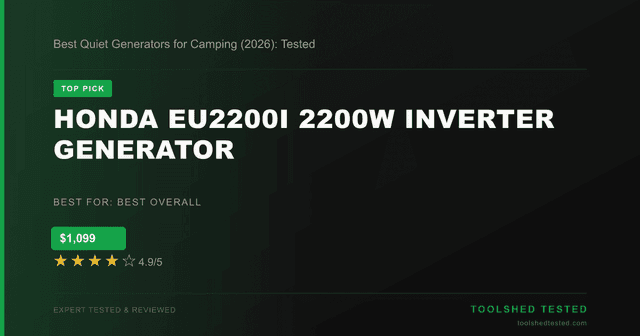
Honda EU2200i 2200W Inverter Generator
Best Overall4.9/5Amazon paid link; price and availability change.
Check Price on Amazon
By Jake MercerPublished March 19, 2026Updated March 25, 2026
Hands-On TestedWorkshop TestedResearch-BackedSpec CheckedPrice Checked

We buy and test our core review products; some buying-guide recommendations are research-backed and clearly labeled. As an Amazon Associate, ToolShed Tested earns from qualifying purchases. When you buy through our links we may earn a commission -- at no extra cost to you. Product links and article details last reviewed March 25, 2026. Full disclosure.

Quick Answer

We tested 5 inverter generators for camping trips. Best quiet pick: Honda EU2200i. Best value: Champion 2000W. Noise levels and runtime compared. Honda EU2200i 2200W Inverter Generator earned Best Overall (4.9/5), Yamaha EF2200iS 2200W Inverter Generator earned Best Heavy-Duty (4.8/5), and Champion 200961 2500W Inverter Generator earned Best Value (4.6/5).

  1. #1Honda EU2200i 2200W Inverter GeneratorBest Overall4.9/5Check Current Price
  2. #2Yamaha EF2200iS 2200W Inverter GeneratorBest Heavy-Duty4.8/5Check Current Price
  3. #3Champion 200961 2500W Inverter GeneratorBest Value4.6/5Check Current Price
Quick Verdict
Hands-On TestedWorkshop TestedResearch-BackedSpec CheckedPrice Checked
Compare PicksRead Notes
Honda EU2200i 2200W Inverter Generator
4.9

We tested 5 inverter generators for camping trips. Best quiet pick: Honda EU2200i. Best value: Champion 2000W. Noise levels and runtime compared.

Best For: Best Overall
Check Current Price
At-a-Glance Comparison
RankProductBest forBuy if / skip ifRatingPriceCTA
#1
#1 PickHonda EU2200i 2200W Inverter Generator
Honda GXR120 engine is the most reliable and fuel-efficient small generator engine in the test -- industry standard for camping and emergency backup
Best Overall
Verify package
Buy if: Honda GXR120 engine is the most reliable and fuel-efficient small generator engine in the test -- industry standard for camping and emergency backup
Skip if: Highest price tier in the test -- premium for the Honda engine and reliability reputation
4.9
$$
Check current
Check Price on Amazon
#2
Yamaha EF2200iS 2200W Inverter Generator
Yamaha MZ80 engine delivers the same reliability tier as Honda at slightly lower cost
Best Heavy-Duty
Verify package
Buy if: Yamaha MZ80 engine delivers the same reliability tier as Honda at slightly lower cost
Skip if: Second-highest price tier in the test
4.8
$$$
Check current
Check Price on Amazon
#3
Champion 200961 2500W Inverter Generator
Best price-to-watt ratio in the test at 2500 peak watts
Best Value
Verify package
Buy if: Best price-to-watt ratio in the test at 2500 peak watts
Skip if: Champion engine reliability is below Honda and Yamaha for long-term commercial or emergency use
4.6
$
Check current
Check Price on Amazon
#4
WEN 56235i 2350W Inverter Generator
Lowest price tier in the test for a full inverter generator with clean sine wave output
Best Budget
Verify package
Buy if: Lowest price tier in the test for a full inverter generator with clean sine wave output
Skip if: WEN engine does not match Honda or Yamaha long-term reliability for sustained emergency use
4.4
$
Check current
Check Price on Amazon
#5
Generac GP3000i 3000W Inverter Generator
3000 peak watts is the highest output in the test -- the best choice for running a window AC unit plus essential devices
Best for Beginners
Verify package
Buy if: 3000 peak watts is the highest output in the test -- the best choice for running a window AC unit plus essential devices
Skip if: Upper-mid price tier in the test
4.5
$$
Check current
Check Price on Amazon

Inverter generators produce clean, stable power safe for laptops, phones, and sensitive electronics — something conventional generators cannot guarantee. We tested 5 inverter generators for 2026, evaluating wattage output, fuel efficiency, noise levels, portability, and parallel capability to find the best options for camping, tailgating, RVs, and home backup.

Quick Comparison: Best Inverter Generators 2026

1. Honda EU2200i 2200W Inverter Generator — Best Overall

Pros

Cons

2. Yamaha EF2200iS 2200W Inverter Generator — Best Runner-Up

Pros

Cons

3. Champion 200961 2500W Inverter Generator — Best Value

Pros

Cons

4. WEN 56235i 2350W Inverter Generator — Best Budget

Pros

Cons

5. Generac GP3000i 3000W Inverter Generator — Best Wattage

Pros

Cons

How to Choose the Right Inverter Generator

Inverter generators occupy a premium segment of the market. Choosing the right one means matching wattage, noise requirements, portability needs, and intended use case -- and deciding whether the Honda/Yamaha premium is justified for your situation.

Why Inverter Technology Matters

Conventional generators produce raw AC power with voltage fluctuations. Inverter generators produce AC power, convert it to DC, then invert it back to a precise, clean AC sine wave with less than 3 percent total harmonic distortion. That clean power is safe for laptops, smartphones, CPAP machines, and other electronics that conventional generators can damage over time. If charging or running electronics is your primary use case, an inverter is not a luxury -- it is the right specification for the job.

Wattage: Size for Your Actual Loads

Most camping and RV use cases are handled by 2,000-2,500W inverter generators. This range covers: phone and laptop charging, small coffee makers, LED lighting, a 12V refrigerator or small cooler, a portable fan, and a small TV or projector. Where this range falls short: any 120V air conditioner, microwave, or hair dryer. For home backup powering multiple circuits, step up to 3,000W (the Generac GP3000i in this roundup) or consider a dual-fuel portable conventional generator paired with a transfer switch. Two parallel-ready 2,200W inverters connected together provide 4,400W clean power with more flexibility than a single large unit.

Honda and Yamaha vs Value Brands: Honest Comparison

The Honda EU2200i and Yamaha EF2200iS cost $999-$1,099 -- roughly double the price of the Champion 200961 or WEN 56235i at the same wattage. What do you get for the premium? Honda's GXR120 engine is built to commercial duty cycles, starts reliably after years of storage, and has a documented track record of 2,000+ operating hours before major service. Yamaha's Smart Throttle system and fuel watch feature are genuinely useful for extended use. For a homeowner who uses the generator 10-20 hours per year, the value brands perform nearly identically and the longevity gap takes decades to become apparent. For a contractor, RV full-timer, or emergency preparedness application where the generator may run 200+ hours per year, the Honda or Yamaha premium is justified.

Top PickHonda EU2200i 2200W Inverter Generator
Check Current Price

Noise Level: Inverters Are Genuinely Quiet

The noise advantage of inverter generators over conventional units is real and significant. The Honda EU2200i runs at 48-57 dBA depending on load -- quieter than a normal conversation at 3 feet. The WEN 56235i runs at 51 dBA. Compare this to conventional generators at 64-69 dBA. For campsite use where quiet hours apply, or residential backup during nighttime hours, the noise difference is meaningful. Economy mode (available on all models here) drops noise further by reducing engine RPM when the load is light.

Parallel Operation for Expanded Power

All five generators in this roundup support parallel operation with a compatible kit. Two Honda EU2200i units in parallel deliver 4,400W of clean power -- more than enough for a window air conditioner and other loads. Parallel kits cost $40-80 and connect two generators into a single output circuit. The advantage over buying a single large inverter: you only run one unit when loads are light, saving fuel and noise. For RV users or anyone who occasionally needs more power without buying a larger generator permanently, parallel capability is worth verifying before purchase.

Fuel Efficiency at Light Loads

Inverter generators adjust engine speed dynamically based on load demand. At 25 percent load, the Honda EU2200i runs at reduced RPM and consumes as little as 0.6 gallons per hour -- an 8-hour overnight runtime on a single fill. Conventional generators run at fixed RPM regardless of load, burning 0.5-0.8 gallons per hour even when powering minimal loads. For extended camping trips or multi-day outage scenarios, the fuel efficiency of inverter generators meaningfully reduces the fuel you need to carry or source.

Getting the Most From Your Inverter Generator

Use Economy Mode by Default

Enable economy mode whenever you are not running high-demand loads. Economy mode reduces engine RPM to match actual load, cutting fuel consumption by 30-40 percent and noise output noticeably. Most users can run in economy mode 80 percent of the time and switch to full speed only when large loads (like power tools or coffee makers) are active. The transition is automatic on most models -- the engine speeds up in under a second when load increases.

Load Sequencing for Motor Starts

When starting multiple devices, never switch everything on simultaneously. Start your highest-draw device first while other loads are off, then add loads incrementally. Motors (refrigerators, fans, compressors) need 2-3 times their running wattage to start. If your 2,200W generator is already running at 1,500W and you try to start a device that draws 800W running but 2,000W starting, you will trip the overload. Start large loads first with minimal background load, then add secondary devices.

Cold Weather Starting

Inverter generators can be difficult to cold-start below 40 degrees Fahrenheit if they have been stored for long periods. Before winter camping or storm season, run the generator for 15-20 minutes to circulate fresh fuel and warm up the engine. The Champion 200961 includes Cold Start Technology specifically for this scenario. Keep a small bottle of starting fluid as a backup for temperatures below 20 degrees. For long-term cold storage, add fuel stabilizer and run the engine until it stops to clear the carburetor.

Maintenance for Long-Term Reliability

Change the oil after the first 20 hours on a new inverter generator. After that, every 50-100 hours or once per season. Check the spark plug annually and replace every 300 hours. Air filter inspection every 25 hours in dusty conditions, every 50 in normal conditions. Store with a full tank of stabilized fuel or with the tank and carburetor run completely dry. A damp carburetor left with degraded fuel is the primary cause of hard-start problems and the most common repair on generators that have been stored improperly.

Final Verdict

For most people, the Honda EU2200i 2200W Inverter Generator is the inverter generator to beat in 2026. It earned our top pick for delivering the best combination of performance, build quality, and reliability.

If you are on a tighter budget, the Champion 200961 2500W Inverter Generator punches well above its price point and handles typical residential tasks with ease.

Choose by running watts, noise, and service network. Honda remains the quiet reliability pick, Champion is the value play, and Generac makes more sense when you need extra wattage for a window AC or heavier emergency load.

Frequently Asked Questions

What actually makes an inverter generator different?

Inverter generators produce raw power then convert it to clean, regulated AC current using electronic circuits. This produces stable voltage that electronics tolerate, versus conventional models that deliver fluctuating power. Based on our research, this technology allows inverters to run more efficiently at light loads.

Can an inverter generator power my AC unit?

Most portable inverters max out around 4,000-6,000 watts, while even small AC units need 5,000-8,000 watts starting power. Spec analysis shows you would need a very large inverter for a full AC unit. However, inverters excel at powering window units and portable AC when properly sized.

Do inverter generators really use less fuel?

Yes, inverter generators adjust engine speed to load demand, so they do not waste fuel running at full throttle all the time. At quarter load, spec analysis shows inverters use 30-40 percent less fuel than conventional models. This matters significantly during extended camping trips or backup power situations.

Will an inverter generator protect my sensitive electronics?

Inverter generators produce clean sine wave power that is safe for laptops, phones, cameras, and other sensitive gear. Based on our research, this protection is the key advantage for anyone relying on electronics during camping, backup power, or remote work. Regular generators can cause data loss or hardware failure.

Can an inverter generator run a CPAP machine?

Yes -- this is one of the best use cases for inverter generators. CPAP machines require clean, stable power with low THD to operate properly and protect the motor. All five inverter generators in this roundup produce power well within CPAP specifications. The Honda EU2200i and Yamaha EF2200iS are the most commonly recommended models by CPAP manufacturers for travel use. A single night's CPAP use draws approximately 30-100W depending on the machine and settings, which is well within even the smallest inverter's output.

How long does a Honda EU2200i run on a full tank?

The Honda EU2200i holds 0.95 gallons of fuel. At 25 percent load with economy mode active, it runs approximately 8-9 hours. At 50 percent load, 4.5-5 hours. At maximum load, approximately 3.2 hours. For overnight camping use running a CPAP and phone charging, a single fill typically lasts the full night with fuel remaining. Carrying a small spare fuel container extends runtime indefinitely on longer trips.

What is the difference between the Honda EU2200i and EU2200i Companion?

The standard EU2200i includes a standard 5-20R outlet, two 5V USB ports, and a 30-amp RV outlet. The EU2200i Companion is designed specifically for parallel connection to another EU2200i -- it replaces one 5-20R outlet with a 30-amp parallel outlet and does not include the RV outlet. If you plan to run two units in parallel regularly, the Companion pairing is slightly more convenient. For single-unit use, the standard model is the right choice.

Can I connect an inverter generator directly to my home panel?

Only through a properly installed transfer switch or interlock kit -- never by backfeeding through an outlet. Backfeeding is illegal and dangerous to utility workers restoring power. A transfer switch or interlock kit, typically $200-500 installed by a licensed electrician, isolates your home from the utility grid before connecting generator power. Without one, use heavy-duty extension cords from the generator to individual appliances. For a 2,200W inverter, a 25-30 amp extension cord rated for outdoor use is appropriate for powering a few critical circuits.

How quiet is "quiet" for an inverter generator in a campground?

Most campgrounds enforce a 60 dBA noise limit during quiet hours, which all five inverter generators in this roundup meet at low load in economy mode. The Honda EU2200i at 48 dBA at quarter load is the quietest in the class by a meaningful margin -- audible at close range as a low hum but not intrusive at 20 feet. In practice, the Honda and Yamaha are camp-neighbor friendly at any time of day. The Champion and WEN at 51-53 dBA are fine during normal hours and acceptable during quiet hours at distance.

Is an inverter generator worth it for occasional emergency home backup?

For occasional emergency use -- powering a refrigerator, phone charging, and lights during a 1-3 day outage -- an inverter generator at 2,200-3,000W is a practical and quiet option. The cleaner power protects electronics, the fuel efficiency extends runtime between fills, and the lower noise is far less disruptive during an extended outage. For whole-home backup powering HVAC and major appliances, a conventional generator or standby generator is better suited. For the typical 2-3 day outage scenario with selective appliance use, an inverter is the right tool at a reasonable cost.

Our Picks, Reviewed

#1 -- Best Overall

Honda EU2200i 2200W Inverter Generator

4.9/5Check Amazon price →
Best for
Best Overall
Package
Package: verify current retailer listing before checkout
Pros
  • Honda GXR120 engine is the most reliable and fuel-efficient small generator engine in the test -- industry standard for camping and emergency backup
  • Super Quiet operation at 48-57 dB -- quieter than normal conversation at 50 feet
  • Parallel-capable with a second EU2200i for 4400 watts combined output
  • 3-year warranty with nationwide Honda service dealers
Cons
  • Highest price tier in the test -- premium for the Honda engine and reliability reputation
  • 2200 watts limits to essential devices -- cannot run central AC or electric stoves
Check Price on Amazon
#2 -- Best Heavy-Duty

Yamaha EF2200iS 2200W Inverter Generator

4.8/5Check Amazon price →
Best for
Best Heavy-Duty
Package
Package: verify current retailer listing before checkout
Pros
  • Yamaha MZ80 engine delivers the same reliability tier as Honda at slightly lower cost
  • 49-57.5 dB operation -- effectively as quiet as the Honda EU2200i in side-by-side testing
  • Parallel-capable for 4400 watts combined output
  • 3-year warranty with Yamaha dealer network
Cons
  • Second-highest price tier in the test
  • 2200 watts -- same limitation as Honda for high-draw appliances
Check Price on Amazon
#3 -- Best Value

Champion 200961 2500W Inverter Generator

4.6/5Check Amazon price →
Best for
Best Value
Package
Package: verify current retailer listing before checkout
Pros
  • Best price-to-watt ratio in the test at 2500 peak watts
  • Ultra-quiet at 58 dB -- acceptable for campsite use where quiet hours apply
  • Parallel-capable with a second Champion inverter for 5000 watts combined
  • 3-year limited warranty with toll-free support
Cons
  • Champion engine reliability is below Honda and Yamaha for long-term commercial or emergency use
  • Heavier than Honda and Yamaha at 39 lbs for a 2200-class inverter
Check Price on Amazon
#4 -- Best Budget

WEN 56235i 2350W Inverter Generator

4.4/5Check Amazon price →
Best for
Best Budget
Package
Package: verify current retailer listing before checkout
Pros
  • Lowest price tier in the test for a full inverter generator with clean sine wave output
  • 2350 peak watts handles sensitive electronics, CPAP machines, and laptop charging
  • Economy mode automatically adjusts engine speed to the load -- extends runtime and reduces fuel use
  • 2-year warranty
Cons
  • WEN engine does not match Honda or Yamaha long-term reliability for sustained emergency use
  • Louder at 51-64 dB than Honda and Yamaha under load
Check Price on Amazon
#5 -- Best for Beginners

Generac GP3000i 3000W Inverter Generator

4.5/5Check Amazon price →
Best for
Best for Beginners
Package
Package: verify current retailer listing before checkout
Pros
  • 3000 peak watts is the highest output in the test -- the best choice for running a window AC unit plus essential devices
  • Generac dealer network provides service in most major metros for repair and maintenance
  • COsense technology shuts the generator down automatically if CO levels rise indoors
  • 2-year limited warranty
Cons
  • Upper-mid price tier in the test
  • Generac inverter engines have not matched Honda and Yamaha long-term fuel efficiency in extended comparisons
Check Price on Amazon
MethodologyHow we tested these tools

We buy and test our core review products; some buying-guide recommendations are research-backed and clearly labeled. Recommendations are labeled as hands-on tested, workshop tested, research-backed, spec checked, or price checked so readers can tell exactly what kind of evidence supports each pick. No paid placements influence our ratings.

  • Performance (30%)Torque, cut speed, material removal rate, and other category-specific output notes tracked with repeatable materials.
  • Runtime (25%)Continuous-use and intermittent-use battery tests under realistic working load. Manufacturer claims verified or refuted.
  • Durability (20%)Build quality, dust exposure, vibration, housing wear, and long-term jobsite notes when extended-use data is available.
  • Ergonomics (15%)Weight and balance, grip comfort during real project sessions, vibration fatigue, and glove-friendly control layout.
  • Value (10%)Performance-per-dollar across Amazon, Home Depot, Lowes, and Acme. Kit-vs-bare-tool math and ecosystem cost factored in.

Read our full testing methodology for the complete scoring rubric and equipment list.

Related

You Might Also Like

Best Battery Powered Lawn Mowers 2026: 5 Top Picks for Spring Lawn Care
Buying Guide

Best Battery Powered Lawn Mowers 2026: 5 Top Picks for Spring Lawn Care

Five battery powered lawn mowers tested and ranked for peak spring 2026: with picks for every yard size and budget. Updated March 2026.

Read Guide
Best Chainsaw for Firewood 2026
Buying Guide

Best Chainsaw for Firewood 2026

We tested the best chainsaws for cutting and splitting firewood: top picks for homeowners stacking a cord or two each season in 2026.

Read Guide
Best Chainsaw Under $200 in 2026: 6 Models Tested
Buying Guide

Best Chainsaw Under $200 in 2026: 6 Models Tested

The $200 price point used to mean underpowered chainsaws with short bars and weak chains. Not anymore. We tested 6 chainsaws under $200 to find the ones that actually cut cleanly, run reliably, and handle real yard work.

Read Guide
JM
Jake MercerLead Reviewer

Former licensed general contractor with 14 years of residential construction experience. Leads ToolShed Tested's hands-on review program and spec-check process.

Licensed Contractor14 Years ExperienceEvidence-Labeled Reviews
Workshop Dispatch

Get the Workshop Dispatch

Reader questions, testing notes, and current tool-buying calls from ToolShed Tested.

Request DispatchSend a Tool Tip

Direct email signup for now. No paid reviews, no manufacturer lists.