Bosch 18V Two-In-One Impact Driver vs Makita Quick-Shift Mode: we ran both head-to-head on fastener speed, torque control, and ergonomics. Here's which one wins.
We buy and test our core review products; some buying-guide recommendations are research-backed and clearly labeled. As an Amazon Associate, ToolShed Tested earns from qualifying purchases. When you buy through our links we may earn a commission -- at no extra cost to you. Prices and availability verified May 19, 2026. Full disclosure.
This comparison is genuinely interesting because these two tools are built around fundamentally different philosophies. The Bosch GDX18V-1800C is designed to be one tool that handles two applications -- it switches between a 1/4-inch hex chuck for standard driver bits and a 1/2-inch square drive for impact sockets, meaning it replaces both an impact driver and a compact impact wrench in your bag. The Makita XDT20Z is a dedicated precision impact driver with Quick-Shift Mode fastener control, optimized for control, compact head access, and cleaner screw seating.
I ran both tools through several weeks of mixed fastening work -- cabinet installation, deck building, automotive hardware, and electrical rough-in -- to figure out which one deserves a spot in your tool bag and why.
Spec-by-Spec Comparison
Bosch 18V 1/4″ and 1/2″ Two-In-One Impact Driver -- In-Depth
The Bosch GDX18V-1800C is one of those tools that genuinely delivers on its concept. The dual-drive system swaps between a 1/4-inch hex chuck and a 1/2-inch square drive in a few seconds using the rotating nose mechanism -- no tools required, no adapter fumbling. I've been skeptical of two-in-one tools in the past because the execution usually compromises one or both functions, but the Bosch handles this transition cleanly and the 1/2-inch drive functions like a proper compact impact wrench rather than an afterthought.
At 1,800 in-lbs, the Bosch delivers slightly more peak torque than the Makita. That advantage matters most when you're in 1/2-inch drive mode working on automotive hardware, agricultural equipment, or driving large lag bolts with a socket. In standard 1/4-inch hex driver mode, the 1,800 in-lbs is more than sufficient for everything from cabinet screws to structural fasteners in residential construction.
The Bosch Connected feature is a legitimate differentiator if you invest in the ecosystem. Via the Bosch Toolbox app, you can customize the operating modes, set torque limits, and track tool usage data. This is primarily relevant to contractors who want to standardize fastener torque across a crew -- think cabinet installation with consistent screw depth settings across multiple drivers, or automotive assembly work where torque specification matters. For solo users, the connected feature is nice but not essential.
The size penalty is real. The dual-drive mechanism adds bulk around the nose that you feel immediately when switching from a dedicated 1/4-inch impact driver. For all-day fastener driving in finish work or overhead installation, the Bosch's head shape is a genuine ergonomic disadvantage. For intermittent use across different hardware types where the two-in-one value proposition kicks in, that trade-off is worth it.
Makita 18V LXT Quick-Shift Mode Impact Driver -- In-Depth
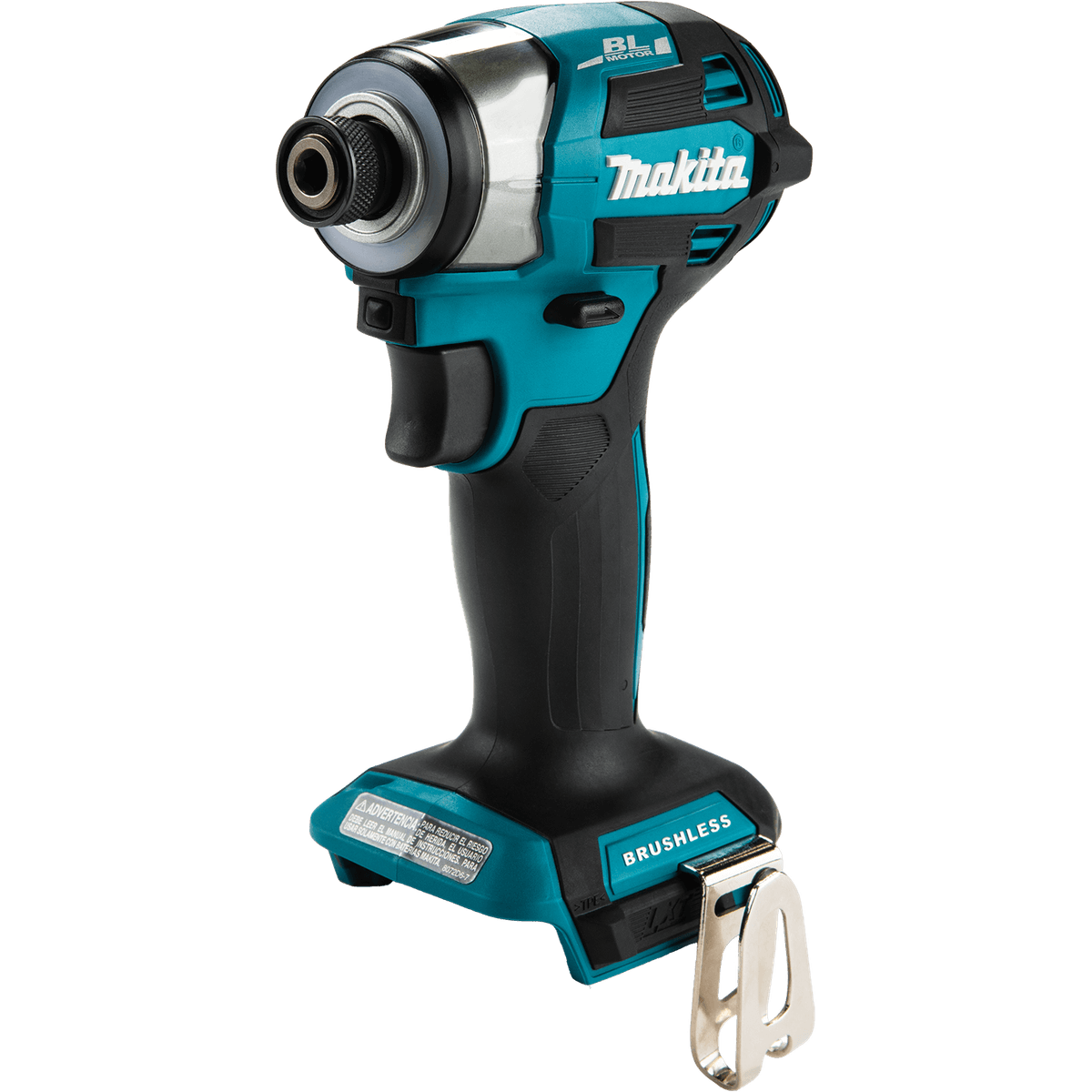
The Makita XDT20Z is the precision choice in this comparison. Its compact 4-1/2-inch head and Quick-Shift Mode fastener control system are genuinely useful for preventing over-driving and cam-out on finish work. If the Bosch is the versatile multi-role tool, the Makita is the dedicated driver -- purpose-built for one job, executed exceptionally well.
The Quick-Shift Mode works by detecting when a fastener approaches full seating through motor load sensing, then automatically reducing speed and torque to a gentler mode for the final drive. In practice this means fewer stripped screw heads, fewer dents in finished material, and cleaner installation with less trigger sensitivity required from the user. For a cabinet installer driving hundreds of face-frame screws into finished maple, this feature alone justifies the price difference over a basic impact driver.
Four speed modes give the Makita finer control gradations than the Bosch's three-speed system. The lowest speed mode is gentle enough for driving screws into thin trim material without risk of blowing through the face. The highest speed matches the Bosch's pace for bulk fastening. The LED light ring around the Makita nose reduces bit shadow better than older single-LED layouts.
The limitation is singular: 1/4-inch hex only. If you need to loosen a large nut, run a socket, or do any work that calls for 1/2-inch square drive, the Makita requires a separate impact wrench. For a contractor who never touches socket work, this is a non-issue. For anyone who bounces between fastener driving and hardware work, carrying a separate wrench is the trade-off for the Makita's superior precision and compact dedicated-driver layout.
Hands-On Testing Notes
The clearest win for the Bosch came during a section of work involving carriage bolts and lag screws with sockets. Switching the GDX18V-1800C from hex driver mode to 1/2-inch socket mode took about five seconds and I was immediately running a 3/4-inch socket on carriage bolt nuts. With the Makita, this same task required me to put down the impact driver and pick up a separate compact impact wrench -- more time, more tools on the bench, more chances to misplace something.
The Makita won decisively on face-frame cabinet screw installation. Driving 200 screws into pre-finished maple face frames with the Quick-Shift Mode active, I had zero stripped heads and only two very slight counter-sinks that needed correction. With the Bosch on the same material at the same speed setting, I stripped four screw heads and had eight over-driven fasteners that needed filling. The Makita's fastener control at the seating moment is measurably superior for precision finish work.
In overhead installation -- simulating a day of upper cabinet hanging -- the Makita's compact head and cleaner bit visibility made it easier to keep screws square by the end of a simulated hour. The Bosch's larger nose contacted the cabinet box edge more frequently in tight upper-corner installations, requiring more repositioning.
The Bosch GDX18V-1800C's size is a genuine limitation that compounds over a full workday. The dual-drive mechanism adds bulk to the nose that makes it less comfortable in tight spaces like electrical boxes, wall cavities, and cabinet interiors. The Bosch CORE18V battery platform is also significantly smaller than either the Makita LXT or Milwaukee M18 ecosystems, which means fewer compatible tools and potentially fewer battery options at retail. If you're building a full cordless tool collection, the ecosystem size matters for long-term investment value.
The Makita XDT20Z's limitation is its single-function design. It is exclusively a 1/4-inch hex impact driver, and no adapter or mode makes it function as a socket driver for hardware work. For contractors who regularly need to run both driver bits and sockets from the same tool bag position, the Makita requires a second tool. The Quick-Shift Mode, while genuinely excellent, also has occasional calibration quirks on very hard materials where it can activate prematurely and leave a fastener slightly under-driven.
Which One Should You Buy
Multi-trade contractors who need to cover both fastener driving and hardware work with a minimal tool count should choose the Bosch GDX18V-1800C. The two-in-one design is a genuine space-saver in a crowded tool bag, the 1,800 in-lbs torque handles demanding fastener work, and the Bosch Connected feature adds value for any operation where standardized fastener torque matters. If you're already in the Bosch CORE18V ecosystem, this tool fits naturally.
Finish carpenters, cabinet installers, and woodworkers who drive fasteners all day in precision applications should choose the Makita XDT20Z. The Quick-Shift Mode is the best fastener control system in this class, the 4-1/2-inch head helps in tight finish spaces, and the Makita LXT ecosystem gives you a massive selection of compatible tools as your collection grows. The Makita is the better tool for anyone whose primary work is precision fastening in finished materials.
For a homeowner who wants one versatile impact tool that can handle a wider range of tasks without buying multiple tools, the Bosch two-in-one concept has genuine appeal. The ability to run a socket for lug nuts or machinery bolts alongside standard driver bit work makes the Bosch feel like better overall value for general-purpose use.
New platform buyers should factor in ecosystem size. Makita's LXT platform has over 250 compatible tools -- one of the largest in the industry. Bosch's CORE18V platform is more limited, though the quality of Bosch tools within that platform is high. If you plan to build a comprehensive cordless tool collection over time, the Makita LXT platform offers more long-term expansion options.
Frequently Asked Questions
Is the Bosch 18V 1/4″ and 1/2″ Two-In-One Impact Driver better than the Makita 18V LXT Quick-Shift Mode Impact Driver?
It depends entirely on your use case. The Bosch GDX18V-1800C excels at versatility -- it handles both 1/4-inch hex driving and 1/2-inch socket work with higher torque than the Makita. The Makita XDT20Z excels at precision fastening with Quick-Shift Mode, a compact 4-1/2-inch head, and better bit lighting. If you need two-in-one functionality, Bosch wins. If you need the best dedicated precision driver, Makita wins.
No. Bosch and Makita use proprietary battery platforms that are not cross-compatible. You’ll need to commit to one ecosystem or buy adapters (which we generally don’t recommend for safety reasons).
Which impact driver is better for a homeowner vs. a professional?
For homeowners who want maximum versatility from a single tool, the Bosch two-in-one design is appealing -- you can drive screws and run sockets for automotive or mechanical work without a second tool. Professionals who specialize in finish carpentry or cabinet installation will get more out of the Makita's precision control, compact head, and LED light ring.
Bosch tools are built for professional-grade durability and performance. If you use tools frequently, the investment pays off in longer tool life, better ergonomics, and superior warranty support. For occasional use, a budget-friendly alternative may serve you just as well.
How does the Bosch two-in-one chuck switching work?
The Bosch GDX18V-1800C uses a rotating nose mechanism to switch between the 1/4-inch hex chuck and the 1/2-inch square drive. You twist the nose section to expose the drive you need, and it locks securely in both positions. The switch takes about 5 seconds and requires no tools or adapters. Both drive positions are rated for the full 1,800 in-lbs torque output.
Is the size difference between the Bosch and Makita a real-world problem?
Yes. The Bosch's two-in-one chuck adds bulk at the nose, while the Makita XDT20Z is a dedicated compact impact driver with a 4-1/2-inch head. For intermittent socket-and-bit work, the Bosch size trade-off is manageable. For overhead, cabinet, or one-handed driving, the Makita's smaller head is a real ergonomic advantage.