Ryobi and Milwaukee are both made by Techtronic Industries -- but they're built for completely different buyers. Here's how to decide if upgrading from Ryobi to Milwaukee actually makes sense for your work.
Current recommendations are research-backed. Each article identifies its evidence, sources, update date, and limitations. No current guide is presented as hands-on tested. As an Amazon Associate, ToolShed Tested earns from qualifying purchases. When you buy through our links we may earn a commission -- at no extra cost to you. Product links and article details last reviewed March 25, 2026. Full disclosure.
Ryobi and Milwaukee share a parent company (Techtronic Industries), but that's where the similarity ends. They use different batteries, different motor technology, different price points, and are built for different users. If you're currently on Ryobi and wondering whether Milwaukee is worth the step up, this is the comparison you need. Owner reports cover both platforms in the shop and on job sites, and the answer -- like most tool questions -- depends entirely on how you actually work.
Who Each Brand Is For
Ryobi ONE+ 18V
Ryobi is built for homeowners and occasional DIYers. Their ONE+ platform offers the widest tool selection at the lowest entry price -- 300+ tools including outdoor equipment that run on the same 18V battery. The HP brushless line has genuinely closed the gap with lower-tier professional tools. If you're doing home projects a few times a month, Ryobi delivers real value.
The Ryobi PBLID02B brushless impact driver is a good example of where the line has improved. It hits 2,200 in-lbs of rated torque -- more than some Milwaukee non-FUEL models -- and handles deck screws, structural screws, and cabinet hardware without drama. If I handed this tool to someone five years ago and told them it was from a pro brand, they'd have believed me for most tasks.
Milwaukee M18
Milwaukee is a professional tool brand. Their M18 FUEL lineup targets tradespeople who use tools every day and demand maximum performance, durability, and battery life under sustained load. The price premium is significant. So is the performance gap -- especially in demanding applications.
The gap shows up most clearly in three areas: REDLINK PLUS intelligence that modulates power delivery under load, POWERSTATE brushless motors with higher efficiency ratings, and M18 REDLITHIUM HIGH OUTPUT batteries that deliver more consistent voltage under sustained discharge than Ryobi's packs. For a user who works tools hard every day, these differences compound over a shift.
The performance gap column deserves a closer look. "Moderate" on the drill comparison means Ryobi's PBLDD01 handles 95% of DIY drilling tasks without meaningful disadvantage -- the gap only becomes apparent when you're drilling large holes in hardwood repeatedly or driving long bolts into dense lumber. "Large" on the reciprocating saw comparison is honest: the Milwaukee 2821-20 FUEL recip saw is in a different class for demo work, cutting through nails in framing, or long cuts in heavy dimensional lumber. The Ryobi runs slower, generates more heat, and throttles more aggressively under sustained load.
The biggest gap shows up when you push tools hard. Milwaukee's REDLINK PLUS intelligence manages heat and power delivery under sustained load -- cutting through 3" decking repeatedly, driving dozens of lag bolts back-to-back, or demo work with a reciprocating saw. Ryobi tools throttle more aggressively when hot to protect the motor, which is sensible but means slower throughput on heavy jobs.
If you're hanging a single TV or building occasional furniture, you'll never feel this difference. If you're building a deck, framing a room, or doing any kind of sustained commercial-adjacent work, Milwaukee's stamina is real.
Battery Runtime and Longevity
Milwaukee's M18 batteries -- particularly the HIGH OUTPUT packs -- deliver more runtime per charge than comparable Ryobi 18V batteries and hold capacity better over years of heavy cycling. Milwaukee batteries typically maintain 80%+ capacity after 500+ charge cycles. Ryobi packs degrade faster under heavy professional use, though they hold up fine for light DIY.
The practical implication for heavy users: with Ryobi, you might start replacing battery packs every 2-3 years under regular professional use. With Milwaukee HIGH OUTPUT, that replacement cycle extends to 4-5 years. Over a 10-year period, the battery savings can partially offset the higher initial tool cost.
Ergonomics and Build Quality
Milwaukee tools feel more substantial. The grip textures are better, the chucks seat tighter, and the overall fit and finish is noticeably higher. For occasional use this is irrelevant. After holding a tool for 4-6 hours per day, it matters.
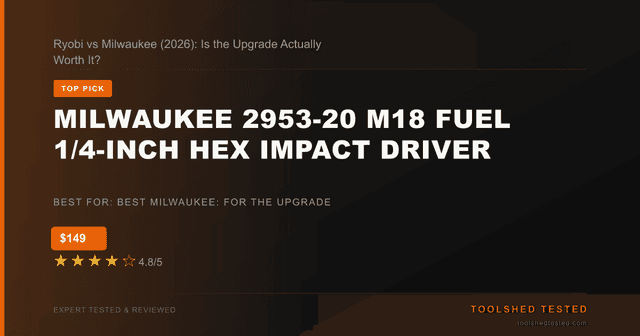
- Milwaukee 2953-20 M18 FUEL Impact Driver
- Ryobi PBLID02B Impact Driver
Where Ryobi Wins or Holds Its Own
Ecosystem Breadth for Homeowners
Ryobi's ONE+ platform includes outdoor tools -- mowers, blowers, pressure washers, hedge trimmers, snow blowers -- that Milwaukee's M18 platform simply doesn't cover at competitive prices. One Ryobi battery platform can power your entire home maintenance routine. That's a real advantage for homeowners who don't need trade-level performance.
Entry Cost and Tool Availability
A Ryobi drill + impact combo kit with 2 batteries and a charger runs $149-$199 at Home Depot. Getting equivalent Milwaukee tools to the same starting point costs $350-$500. That $150-$300 gap either buys more Ryobi tools or pays for other project materials.
For the actual tasks most homeowners do -- hanging shelves, assembling furniture, light demo, seasonal outdoor work -- Ryobi HP brushless tools are genuinely adequate. The performance gap with Milwaukee only becomes apparent at sustained high load. Occasional users won't hit that threshold.
- Ryobi PBLDD01 18V HP Brushless Drill
- Milwaukee 2801-21P M18 Drill/Driver Kit
The Battery Ecosystem Switch Cost
This is the calculation that most comparison articles skip. If you already own 3+ Ryobi tools and 2 batteries, switching to Milwaukee isn't just buying new tools -- it's abandoning your battery investment. Ryobi and Milwaukee batteries are not cross-compatible.
Real switch cost estimate for a 4-tool kit transition:
- New Milwaukee drill: ~$149 bare
- New Milwaukee impact: ~$149 bare
- New Milwaukee circ saw: ~$179 bare
- New Milwaukee recip saw: ~$149 bare
- 2x M18 batteries (5Ah): ~$140
- Charger: ~$59
- Total: ~$825 bare minimum
If you replace tools gradually as old ones fail rather than switching all at once, the transition is more manageable -- but only if the performance gain on each tool justifies the cost for your actual work.
When Ryobi Is the Right Call
There are scenarios where staying on Ryobi -- or starting on Ryobi -- is the genuinely smart financial and practical decision.
The first-time homeowner building a starter kit. If you're setting up your first real tool collection and you need a drill, impact driver, circular saw, and a few outdoor tools on a $300-400 budget, Ryobi delivers all of that. A Ryobi 6-tool combo kit with 2 batteries costs less than buying two individual Milwaukee bare tools. For light home projects -- assembling furniture, hanging shelves, basic repairs, seasonal yard work -- the Ryobi HP brushless tools are genuinely adequate. Starting here and upgrading specific tools to Milwaukee later as needs grow is a sensible strategy.
The homeowner who wants outdoor and indoor tools on one battery. If you want to run your cordless drill, impact driver, hedge trimmer, leaf blower, and push mower on a single battery platform, Ryobi is the only major brand that covers all of these at competitive price points with one 18V system. Milwaukee's M18 outdoor equipment exists but is priced for commercial use. For a homeowner who wants one charger and one battery type to cover the whole property, Ryobi's ONE+ ecosystem is hard to beat.
The occasional-use DIYer with existing Ryobi investment. If you already own 4-5 Ryobi tools and a couple of batteries, and your use pattern is bi-weekly or less for light to moderate projects, there's no compelling reason to switch. The performance gap between Ryobi HP brushless and Milwaukee won't show up at your usage level, and the switching cost is real money you'd be spending to gain performance headroom you'll never need.
When Milwaukee Pays Off
There are also clear scenarios where the Milwaukee premium is genuinely justified and pays back over time.
The weekend warrior doing real construction projects. If your weekends regularly involve framing, decking, tile work, or any task that puts tools under sustained load for hours at a time, Milwaukee's performance advantage becomes tangible. Ryobi's throttling under heat is most noticeable in exactly this usage pattern -- tools that run hard, rest briefly, and run hard again. The Milwaukee M18 FUEL line handles this cycle without the performance drop that Ryobi users notice after the first hour of heavy work.
The tradesperson or serious side-hustle contractor. If you're doing paid work -- remodeling, decks, fencing, landscaping -- where tool downtime costs real money and performance matters for throughput, Milwaukee is the right investment. The battery longevity alone (5+ years vs 2-3 on Ryobi under heavy use) reduces the lifetime cost of the platform. And the broader M18 FUEL tool catalog -- especially in trades-specific tools like the M18 FUEL pipe threader, press tool, or soldering iron -- gives Milwaukee an ecosystem depth that Ryobi simply doesn't have for professional trade work.
The buyer starting fresh who wants one long-term platform. If you don't have a Ryobi investment to protect and you're buying your first serious set of tools, Milwaukee M18 is the better long-term platform if budget allows. You're buying into a professional ecosystem that will be supported for years, with a tool catalog that grows to meet more demanding needs as your skills and projects grow. Starting on Milwaukee and expanding gradually is smarter than starting on Ryobi and eventually switching -- you avoid the switching cost entirely.
FAQ
Are Ryobi and Milwaukee batteries compatible?
No. Ryobi ONE+ 18V and Milwaukee M18 batteries use different form factors and electronics. They are not interchangeable. This is the primary switching cost if you change platforms.
Is Milwaukee really worth twice the price of Ryobi?
For daily professional use, yes -- the durability, power output, and battery longevity justify the premium over years. For occasional DIY use, no -- Ryobi delivers 80-85% of Milwaukee's performance for significantly less money, and that gap rarely matters for light projects.
Milwaukee's M18 line does include lighter, more affordable options -- the M18 Compact series (not FUEL) is priced closer to mid-range tools. But Milwaukee's positioning and distribution skews toward professionals, so their value proposition for casual users is weaker than Ryobi's.
M12 is Milwaukee's compact 12V line -- lighter tools at lower prices. For a DIYer who mostly does light work (electrical, trim, finish carpentry), M12 can actually be a smarter entry into Milwaukee than buying full M18. But M12 and M18 batteries don't cross-charge on the same charger, so you'd be managing two systems.
You can own both -- many people do. But you'll need separate batteries and chargers for each platform, which adds cost and complexity. It only makes sense if there's a specific Milwaukee tool (like the M18 FUEL recip saw for demo work) where the performance jump is worth managing two battery systems.
For typical homeowner use (a few hours per week on projects), Ryobi HP brushless tools routinely last 5-8 years without major issues. The brushless motor eliminates the carbon brush wear that killed older Ryobi tools prematurely. Battery packs tend to degrade faster than the tools themselves under regular use -- budget for a battery replacement every 3-4 years if you're using them regularly. For heavy weekend-warrior use, expect tools to last 4-6 years before performance degradation becomes noticeable.
Yes, and it's a reasonable approach for specific tasks. The most common hybrid setup I see is a full Ryobi tool set for general use plus one Milwaukee M18 FUEL tool in the category where performance matters most -- typically the recip saw for demo work or the circular saw for sustained cutting. You'll need Milwaukee batteries and a separate charger for that tool, which adds $100-140 to the cost, but it's a more affordable path to Milwaukee performance in your highest-demand application than a full platform switch.