Current recommendations are research-backed. Each article identifies its evidence, sources, update date, and limitations. No current guide is presented as hands-on tested. As an Amazon Associate, ToolShed Tested earns from qualifying purchases. When you buy through our links we may earn a commission, at no extra cost to you. Product links and article details last reviewed November 11, 2026. Full disclosure.
Short answer
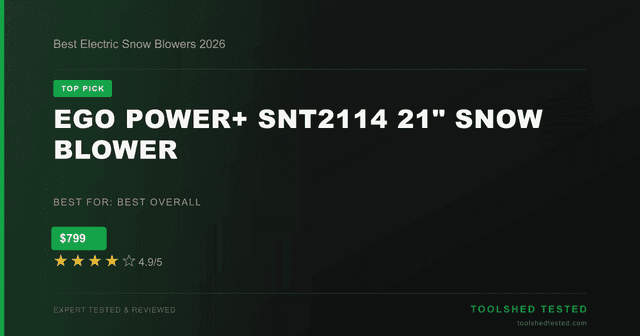
EGO Power+ leads overall cordless snow clearing: choose the single-stage SNT2114 with two 7.5Ah 56V batteries for paved driveways in moderate snow, or step up to the two-stage SNT2405 for municipal plow berms and gravel. Pick Greenworks Pro 80V or Ryobi 40V HP RY40807 when your garage already runs those mower batteries.
How we chose: Compared published manufacturer specifications for clearing width, intake height, single-stage steel/polymer auger vs two-stage impeller mechanics, total battery watt-hours (nominal voltage times amp-hours), self-propelled drive, and cold-storage requirements. Research-based specification comparison rather than physical bench evaluation.
SNT2114 21-inch steel-auger snow blower, two 56V 7.5Ah ARC Lithium batteries (756Wh nominal / 840Wh max), and dual-port charger
✓ Buy if:The gold-standard cordless single-stage kit because EGO bundles two 7.5Ah packs and a steel auger that actually handles moderately packed snow.
✕ Skip if:Push-style single-stage chassis without wheel self-propulsion; not meant for loose gravel driveways
✓ Buy if:The gold-standard cordless single-stage kit because EGO bundles two 7.5Ah packs and a steel auger that actually handles moderately packed snow.
Best for
Best Overall Single-Stage for Paved Driveways
Package
SNT2114 21-inch steel-auger snow blower, two 56V 7.5Ah ARC Lithium batteries (756Wh nominal / 840Wh max), and dual-port charger
✕ Skip if:Push-style single-stage chassis without wheel self-propulsion; not meant for loose gravel driveways
True two-stage serrated steel auger plus separate high-speed discharge impeller rated up to 50-foot throw
24-inch clearing width and tall 20-inch intake height with adjustable skid shoes for gravel clearance
Variable-speed self-propelled forward and reverse wheel drive with four LED headlights
✓ What Stands Out (Pros)
Separate second-stage impeller blasts heavy slush and compacted municipal street-plow berms without clogging
Adjustable skid shoes keep the steel auger elevated off crushed-stone and gravel driveways
Self-propelled wheel drive climbs sloped driveways without shoving dead weight
✕ Watch Out For (Cons)
Requires full two-stage garage floor space year-round and costs substantially more than single-stage units
Deep 12-inch+ wet storms across long rural driveways benefit from keeping spare charged EGO packs warm indoors
Who it's for: Snowbelt homeowners in New England, the Upper Midwest, and mountain states dealing with county snowplow berms, sloped drives, or gravel surfaces.
Winter reveals bad cordless marketing faster than any other season. In July, a single mid-size lithium-ion battery trims grass or blows dry leaves without breaking a sweat. Drop ambient temperatures to 15 degrees Fahrenheit and shove a snow chute into eight inches of wet, plow-packed slush at the end of the driveway, and voltage stickers (40V vs 56V vs 80V) mean almost nothing next to two hard engineering numbers: total stored watt-hours (Wh) and single-stage vs two-stage auger mechanics.
This three-brand winter comparison evaluates published manufacturer specifications across EGO Power+ 56V, Greenworks Pro 80V, and Ryobi 40V HP cordless snow blowers. Whether you are starting a year-round outdoor battery platform from scratch or leveraging mower packs already sitting in your mudroom, matching clearing mechanics to your driveway surface and snowfall depth prevents an expensive January mistake. Because winter stock and bundle pricing move rapidly as storms hit the forecast, we do not publish static prices; every link opens live Amazon listings so you can verify current pricing, included battery amp-hours, and delivery dates. All analysis is a specification and platform comparison rather than a physical snow-clearing evaluation.
Published Specification Matrix: EGO 56V vs Greenworks 80V vs Ryobi 40V HP
To compare battery snow blowers fairly across different voltage labels, convert battery capacity into nominal watt-hours (nominal pack voltage multiplied by amp-hours, summed across active packs). An "80V" pack with 2.0Ah holds roughly 144 nominal watt-hours; two "56V" (50.4V nominal) 7.5Ah packs hold 756 nominal watt-hours, more than five times the stored energy despite the lower voltage badge.
Model & Platform
Stage & Auger Type
Clearing Width & Intake
Drive Type
Battery Bay & Kit Energy
Ideal Driveway Match
EGO SNT2114 Kit (56V)
Single-stage steel auger
21 in. wide / 13 in. high
Push
Dual-port Peak Power: 2x 7.5Ah included (756Wh nominal)
Paved 2-to-4-car suburban drives, 3 to 8 in. snow
EGO SNT2405 Kit (56V)
Two-stage steel auger + impeller
24 in. wide / 20 in. high
Self-propelled (fwd/rev)
Dual-port Peak Power: 2x 7.5Ah included (756Wh nominal)
Plow berms, 8 to 16+ in. snow, slopes, gravel drives
Greenworks Pro 2600402 (80V)
Single-stage brushless
20 in. wide / 10 in. high
Push
Single 80V battery bay (verify 2.0Ah or 4.0Ah kit trim)
4-port 40V bay (verify included Ah or bare-tool trim)
Heavy snowbelt drives for existing Ryobi 40V owners
EGO SNT2120AP Bare Tool (56V)
Single-stage auger-propelled
21 in. wide / 13 in. high
Auger-propelled
Dual-port 56V bay (batteries sold separately)
Paved drives when you already own EGO 56V mower packs
1. Single-Stage vs Two-Stage: The Gravel and Snowplow Berm Rule
Before comparing red, green, or lime-green batteries, decide whether your property requires a single-stage or two-stage snow blower. Buying the wrong mechanical stage guarantees frustration regardless of brand:
Single-Stage Snow Blowers (EGO SNT2114, EGO SNT2120AP, Greenworks 2600402): One high-speed horizontal auger scoops snow and flings it directly up the discharge chute in a single motion. Because the auger paddles sweep right down to the surface (or lightly contact pavement on auger-propelled models like SNT2120AP), single-stage machines scrape smooth asphalt and concrete remarkably clean and fold into half the garage footprint. Never use a single-stage snow blower on loose gravel or crushed stone: the fast-spinning low auger picks up stones and launches them out the chute.
Two-Stage Snow Blowers (EGO SNT2405, Ryobi RY40807, and Greenworks 80V 24-Inch 2-Stage trims): Stage one is a slow, high-torque serrated steel auger that chews through frozen ice chunks and feeds snow backward into stage two, a separate high-speed fan impeller that blasts slush up to 50 feet away. Adjustable metal or polymer skid shoes hold the housing 1/2 inch to 1 inch off the ground so gravel stays on the driveway, and motorized self-propelled wheels push the 150-pound-class chassis into dense county snowplow berms without breaking your back.
2. Why Voltage Marketing Lies in Winter: 40V vs 56V vs 80V
Greenworks Pro leads on raw voltage number (80V max / 72V nominal), EGO sits in the middle (56V max / 50.4V nominal), and Ryobi uses 40V max (36V nominal). Yet in cordless snow equipment, dual-battery and quad-battery parallel/series bays equalize voltage advantages completely.
Look at EGO's Peak Power architecture on both SNT2114 and SNT2405: the powerhead draws current from two 56V 7.5Ah ARC Lithium batteries simultaneously. Splitting heavy current demand across two large multi-parallel battery packs lowers per-cell amp draw, keeps internal cell temperatures healthier, and prevents premature low-voltage sag when the auger hits wet slush. A single-battery 80V 20-inch thrower like Greenworks 2600402 with a 2.0Ah or 4.0Ah pack works great for 4 inches of dry powder on a townhome apron, whereas EGO's dual-7.5Ah kit brings over 750 nominal watt-hours of reserve energy out of the box. (Greenworks also manufactures heavier dual-battery 80V 24-inch two-stage snow blowers if you already own multiple large 80V mower packs.)
Ryobi solves the 40V current challenge on the RY40807 24-inch two-stage unit with a four-port weather-sealed battery box. When loaded with four 6.0Ah 40V HP packs (roughly 864 nominal watt-hours), Ryobi matches or exceeds dual-battery 56V capacity. Just remember one critical compatibility rule: Ryobi 40V outdoor batteries do NOT fit Ryobi 18V ONE+ drills and saws, and 18V ONE+ batteries will not power a 40V two-stage snow blower.
3. Cold-Weather Lithium-Ion Rule Every Owner Must Follow
Every lithium-ion snow blower from EGO, Greenworks, and Ryobi shares the same electrochemical winter rule: store the snow blower chassis in the cold garage or shed, but store and charge the batteries indoors at room temperature (60 to 72 degrees Fahrenheit).
Starting warm preserves voltage under load: A lithium pack stored in a 10-degree unheated detached garage experiences stiff internal resistance and can trip cold-temperature protection on the very first heavy pass. Carrying warm batteries out from a mudroom shelf gives you full rated discharge amps immediately, and internal discharge heat keeps the cells warm while running.
Never charge a below-freezing pack immediately: Lithium chargers pause charging until cells warm above roughly 35 to 40 degrees Fahrenheit to prevent permanent lithium plating on the anode. Let depleted winter packs acclimate indoors for 30 to 45 minutes before setting them onto a rapid charger.
4. Cross-Season Yard Platform Value (Mower + Blower + Snow)
Two 7.5Ah 56V batteries and a dual-port charger represent the single biggest cost component inside a snow blower box. That turns a winter snow blower purchase into a year-round yard strategy:
Choose EGO Power+ 56V if you are starting fresh on cordless outdoor equipment or already run an EGO mower (such as LM2135SP), 650+ CFM leaf blower, or chainsaw. EGO's phase-change cell cooling, fuel-gauge rings, and broad retail support across SNT2114, SNT2120AP, and SNT2405 make it the safest standalone winter platform. Compare broader yard lineups in our EGO vs Greenworks vs Ryobi outdoor power showdown and electric snow blowers buying guide.
Choose Greenworks Pro 80V if you already own Greenworks 80V lawn mowers, chainsaws, or blowers (especially from warehouse-club or online bundles) and want a light 20-inch deck for paved walks or an 80V two-stage bare/kit match.
Choose Ryobi 40V HP if your shed already holds two or more high-capacity Ryobi 40V HP packs from a 40V self-propelled mower or whisper-series leaf blower.
Can a single-stage cordless snow blower clear the snowplow pile at the end of my driveway?
Light, freshly pushed slush up to 6 or 8 inches can be chipped away in shallow layers with a steel-auger single-stage model like the EGO SNT2114 (never a rubber-only paddle model). However, if county plows regularly leave 14-to-24-inch compacted ice and slush walls across your apron, step up to a true two-stage serrated-auger snow blower such as the EGO SNT2405 or Ryobi RY40807.
What is the difference between EGO SNT2114 and EGO SNT2120AP?
SNT2114 is a complete kit containing a push-style 21-inch steel-auger snow blower, two 56V 7.5Ah ARC Lithium batteries, and a dual-port charger. SNT2120AP is a bare-tool-only listing (batteries sold separately) that upgrades the 21-inch chassis with auger-propelled forward assist and heated handlebar grips for buyers who already own EGO 56V batteries.
Do Ryobi 18V ONE+ drill batteries fit Ryobi 40V snow blowers?
No. Ryobi 18V ONE+ workshop tools and Ryobi 40V outdoor power equipment use completely separate battery housings, voltages, and chargers. Check that your existing packs say 40V Lithium or 40V HP before ordering a Ryobi 40V snow blower bare tool.
Are cordless snow blowers safe to use on gravel driveways?
Only two-stage cordless snow blowers with adjustable skid shoes (such as EGO SNT2405 or Ryobi RY40807) should be used on gravel driveways, with the skid shoes set down to hold the auger housing clear of loose stones. Single-stage snow blowers scrape too close to the ground and will throw gravel.
How many square feet or car spaces will two 7.5Ah 56V batteries clear on one charge?
Published manufacturer estimates typically rate dual 7.5Ah 56V kits around an 8-to-18-car driveway in 6 to 8 inches of dry-to-medium snow, but real winter runtime cuts roughly in half in heavy, wet 32-degree slush. Starting with room-temperature batteries and taking half-width passes through deep drift aprons stretches single-charge range substantially.
This guide is research-backed. It compares exact-model manufacturer sources, current market information, and recurring owner feedback; it does not claim direct physical testing. No paid placements influence our rankings.
Model identity (Primary)Exact model, kit contents, voltage platform, and current manufacturer documentation are matched before products are compared.
Use-case fit (Primary)Published capacity, controls, dimensions, compatibility, and limitations are evaluated against the jobs and buyers named in the guide.
Comparison consistency (Primary)Every option is assessed against the same category-relevant criteria, with unsupported performance assumptions excluded.
Warranty and support (Secondary)Current warranty terms, platform support, replacement options, and manufacturer documentation are reviewed for ownership risk.
Price and owner signals (Secondary)Current pricing and recurring verified-owner patterns inform value and reliability context without being presented as our own test results.
George Perkins writes ToolShed Tested from his home shop in North Carolina, where he buys and uses the tools he covers. Articles say plainly which tools he has used himself and which picks rest on research. This guide is research-based: the picks come from manufacturer specs, manuals, warranty terms and owner feedback, not from George using each model.
Tool buyingTool reviewsWorkshop perspective
Dan · TST Workshop Desk · 10-Sec Inside Look
Keep your tools, maintenance, warranties, and loans in one place
Watch the 10-second walkthrough: Workshop OS is our Excel and Google Sheets-compatible tool tracker with automatic warranty countdowns, battery platform tallies, a filled sample workbook, clean blank copy, and quickstart guide.
Regular price $11.99Sale price $9.5920% Off Auto-Applied w/ code SAVE20
This is our own product, not an affiliate recommendation. Instant digital download after checkout.
Read audio transcript
Dan (TST Workshop Desk): Stop buying duplicate batteries or losing tool warranties. Workshop OS tracks every serial number, battery platform, maintenance date, and loaned tool in one spreadsheet (now $9.59 with SAVE20 auto-applied, reg. $11.99).
Workshop Dispatch
Get the Workshop Dispatch
Reader questions, testing notes, and current tool-buying calls from ToolShed Tested.