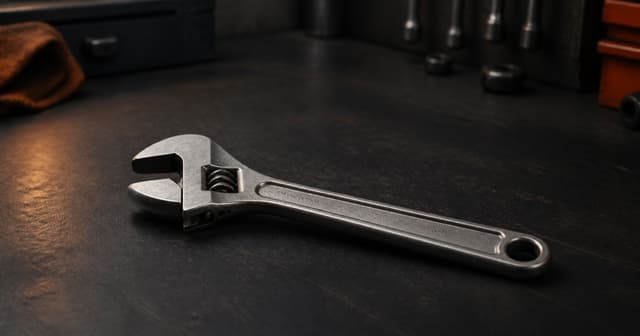
An adjustable wrench—also called a crescent wrench—is one of the most indispensable tools in any home repair kit.
Current recommendations are research-backed. Each article identifies its evidence, sources, update date, and limitations. No current guide is presented as hands-on tested. As an Amazon Associate, ToolShed Tested earns from qualifying purchases. When you buy through our links we may earn a commission -- at no extra cost to you. Product links and article details last reviewed August 11, 2026. Full disclosure.
An adjustable wrench—also called a crescent wrench—is one of the most indispensable tools in any home repair kit. Whether you're tightening a leaky faucet, assembling furniture, or working on your car, a reliable adjustable wrench adapts to dozens of fastener sizes without requiring you to carry a full set of fixed wrenches. But not all adjustable wrenches are created equal. Quality, durability, comfort, and jaw precision vary significantly across brands and price points, and choosing the right one can make the difference between smooth repairs and stripped bolts, sore hands, and frustration.
This guide walks you through what makes an adjustable wrench worth buying, how to evaluate key features, and which models work best for different home repair scenarios. We'll help you avoid common pitfalls and identify the tools that deliver reliable performance without premium pricing.
What Makes a Quality Adjustable Wrench
Before comparing specific models, it's important to understand what separates a well-engineered adjustable wrench from a mediocre one.
Jaw accuracy and mechanism: The worm gear—the fine-threaded screw that adjusts the jaw—should move smoothly without excessive play or grinding. Poor-quality wrenches have sloppy mechanisms that drift out of adjustment mid-task, stripping fasteners and wasting time. The movable jaw should stay parallel to the fixed jaw across the entire adjustment range. Cheap tools often develop binding or misalignment, especially as they age.
Materials and finish: Chrome-plated steel is the standard for adjustable wrenches, but the underlying steel quality matters enormously. High-carbon steel resists bending under load and maintains sharp edges longer than softer alloys. A good chrome finish prevents rust and corrosion, particularly important in damp basements, garages, or bathrooms where home repair work often happens. Matte finishes sometimes indicate lower-grade plating.
Comfort and grip: A textured or knurled handle reduces hand fatigue and improves safety, especially when applying torque. Ergonomic shaping can mean the difference between a quick repair and a cramped, exhausting job. Many home repairers overlook this until their hands ache after a long session.
Size range and leverage: Adjustable wrenches come in standard sizes: 6, 8, 10, 12, and 15 inches. A 10-inch wrench covers most home repair jobs—it's versatile enough to handle fasteners from roughly 0–1.375 inches, yet not so large that it's unwieldy in tight spaces. Larger wrenches provide more mechanical advantage but sacrifice accessibility in confined areas like under a sink.
Sizing Your Adjustable Wrench Collection
Most home repairers don't need a wrench in every size, but having the right mix prevents frustration and ensures you can tackle repairs without improvisation.
The 10-inch workhorse: This is the go-to for approximately 80% of household repairs. It adjusts from about 0 to 1⅜ inches, covering most common fastener sizes found on plumbing fixtures, door hardware, appliance connections, and automotive work. If you own just one adjustable wrench, it should be 10 inches.
The 8-inch compact: Perfect for tight spaces—under sinks, inside cabinet frames, or anywhere access is limited. An 8-inch wrench adjusts to roughly 1 inch and is small enough to slip into a tool belt or emergency kit. Many home repairers keep both a 10-inch and 8-inch as a basic pair.
The 12-inch heavy-duty option: Useful if you regularly work on larger bolts, garden equipment, or automotive projects. The extra length provides mechanical advantage when breaking loose stubborn or corroded fasteners. For casual home repair, a 12-inch is often overkill, but it earns its place in a more complete workshop.
Having one quality 10-inch wrench beats owning several cheap ones in every size. Durability and usability matter far more than quantity for casual home repairers.
Key Features to Evaluate
When comparing adjustable wrenches online or in stores, focus on these practical attributes:
Jaw alignment: Tilt the wrench so you're looking straight at the jaws from the side. They should be perfectly parallel and flush with no visible gaps. Misalignment causes the tool to slip off fasteners, risking stripped bolts and skinned knuckles. Many budget wrenches develop this problem within months.
Worm gear smoothness: Turn the adjustment dial. It should rotate without grinding noises, catching, or sudden resistance. Smooth adjustment lets you seat the jaw precisely on the fastener without over-tightening, which prevents rounding and damage.
Handle texture and shape: Run your fingers across the grip. A good wrench has pronounced knurling or texturing that resists slipping even when your hands are oily or damp. Smooth, polished handles are attractive but dangerous during heavy-duty work.
Chrome plating quality: Look for an even, lustrous finish without pitting, discoloration, or rough spots. A quality chrome job indicates the manufacturer invested in proper plating processes. Dull or uneven plating often means corrosion will appear quickly.
Head design: Some wrenches feature open heads (traditional), while others have partially enclosed designs that reduce the chance of the jaw spreading under extreme load. Semi-open designs are particularly valuable for home repairers who may not apply fasteners with professional precision.
Best Adjustable Wrenches for Home Repairs
The Precision Leader: Bahco Adjustable Wrench
Bahco wrenches, manufactured by Snap-on's parent company, are renowned for exceptional jaw accuracy and smooth worm gears. The Bahco adjustable wrench maintains parallel jaws across its entire adjustment range, reducing slippage and bolt damage. The finish is corrosion-resistant, and the handles are knurled for secure grip.
For home repairers prioritizing precision and longevity, Bahco represents excellent value, though it costs more than budget alternatives. A 10-inch Bahco will likely outlast several cheap wrenches, making it a sound investment for anyone who repairs homes regularly.
The Value Champion: Crescent Adjustable Wrench
Crescent—the brand that essentially invented the adjustable wrench—still produces solid mid-range tools. The Crescent adjustable wrench delivers dependable performance at a moderate price. Jaw alignment is generally good, and the worm gear mechanism works smoothly across most models. The brand has been refining its design for over a century, and that experience shows in reliability.
Crescent wrenches suit homeowners who want reliable performance without premium pricing. They're available at virtually every hardware store, making replacement or expansion easy.
The Budget-Conscious Pick: Stanley Adjustable Wrench
Stanley produces accessible, affordable adjustable wrenches that work well for occasional home repair. The Stanley adjustable wrench costs significantly less than premium brands while maintaining acceptable jaw alignment and mechanism smoothness in most cases. The chrome finish is adequate for typical home use, and the knurled handles provide decent grip.
For a homeowner tackling sporadic repairs and willing to replace tools periodically, Stanley offers good bang-for-buck. However, builders and regular repairers often find Stanley's precision and durability inferior to mid-range alternatives.
The Professional-Grade Option: Snap-on Adjustable Wrench
Snap-on wrenches represent the absolute highest standard in adjustable wrench manufacturing. With perfectly parallel jaws, buttery-smooth worm gears, and premium materials throughout, Snap-on tools are practically indestructible. The Snap-on adjustable wrench commands premium pricing but rarely requires replacement.
For dedicated home workshops, regular repairers, or anyone who uses tools professionally, Snap-on delivers uncompromising reliability. Casual home repairers rarely justify the investment, but those who do rarely regret it.
The Specialty Choice: Wera Adjustable Wrench
Wera, a German manufacturer known for precision tools, produces adjustable wrenches with innovative designs. Their worm gear mechanisms are exceptionally smooth, and jaw alignment is excellent. Wera adjustable wrenches often feature ergonomic handle shapes and distinctive finishes.
Wera tools appeal to dedicated home repairers and DIY enthusiasts who appreciate engineering excellence and are willing to pay for specialized design.
Adjustable Wrench Maintenance and Care
Extending your wrench's lifespan requires minimal but consistent care:
Keep it clean: After use, wipe away dirt, grease, and moisture. Grit in the worm gear accelerates wear and creates grinding that damages the mechanism.
Occasional lubrication: A drop of light machine oil on the worm gear keeps the adjustment smooth. Annual oiling prevents rust accumulation and binding.
Store properly: Keep your wrench in a dry location, ideally hanging or in a toolbox rather than loose in a garage where moisture and salt air degrade chrome plating.
Avoid impact use: Adjustable wrenches are designed for turning fasteners, not striking or prying. Impact force can bend the jaw or damage the mechanism.
Replace when worn: When jaw alignment deteriorates, the worm gear grinds, or the mechanism becomes unreliable, replacement beats repair. A damaged wrench risks tool failure during repairs and potential injury.
Common Mistakes to Avoid
Buying only by price: The cheapest wrench rarely delivers the lowest total cost. Inaccurate jaws strip fasteners, requiring replacement bolts and wasted time. Mid-range quality usually provides the best value.
Neglecting size variety: A single wrench is better than none, but having both a 10-inch and 8-inch dramatically expands your capability for tight-space repairs.
Using as a hammer or pry bar: Adjustable wrenches break easily under impact stress. Keep a hammer and pry bar in your kit instead.
Ignoring handle comfort: An uncomfortable grip leads to hand fatigue and reduced control. Test the feel before buying if possible.
Overlooking corrosion resistance: For bathrooms, kitchens, or damp garages, quality chrome plating and stainless alternatives prevent rust that damages the mechanism.
Building Your Home Repair Wrench Kit
For a well-rounded home repair toolkit, consider this foundation:
- One quality 10-inch adjustable wrench (primary workhorse)
- One 8-inch adjustable wrench (tight spaces and compact storage)
- One 12-inch adjustable wrench (if you work on larger equipment or cars)
Invest in mid-range quality—Bahco, Crescent, or equivalent—for the primary wrench. Budget brands work fine for secondary sizes you use occasionally. This balanced approach provides versatility, reliability, and affordability without unnecessary spending.
Conclusion: Choosing the Best Adjustable Wrench for Your Needs
The best adjustable wrench for home repairs balances precision, durability, comfort, and price. For most homeowners, a quality 10-inch wrench from brands like Bahco or Crescent delivers excellent value—precise enough for reliable fastening, durable enough to last years, and reasonably priced. Those prioritizing budget should choose Stanley, while dedicated repairers justify the investment in professional-grade options like Snap-on.
Rather than buying the cheapest option or the most expensive, identify your repair frequency and choose accordingly. A casual home repairer doing occasional fixes benefits from mid-range quality and a versatile 10-inch size. More active DIYers should invest in precision and consider keeping multiple sizes accessible.
By understanding jaw alignment, worm gear quality, materials, and intended use, you'll confidently select an adjustable wrench that handles your home repairs reliably for years. The right tool transforms frustrating repairs into manageable tasks—and a quality adjustable wrench is often the foundation of an effective workshop.