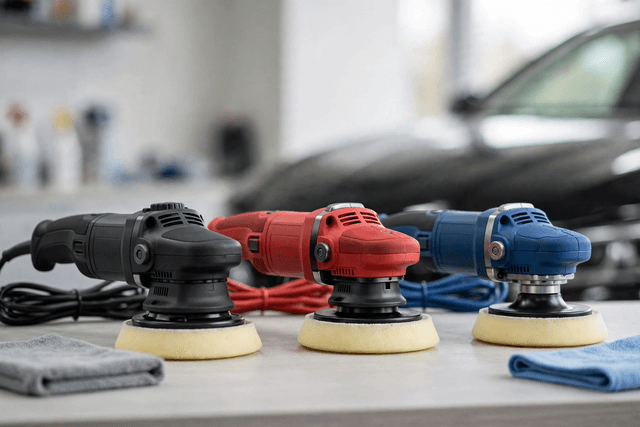
Swirls and oxidation? These five dual-action polishers correct paint safely for beginners and pros. Compare throw, power, and ergonomics.
Current recommendations are research-backed. Each article identifies its evidence, sources, update date, and limitations. No current guide is presented as hands-on tested. As an Amazon Associate, ToolShed Tested earns from qualifying purchases. When you buy through our links we may earn a commission -- at no extra cost to you. Product links and article details last reviewed October 6, 2026. Full disclosure.
Quick answer: The Chemical Guys TORQX suits beginners who want a safe, lightweight first machine for swirls and oxidation. The Griot's Garage G9 suits buyers who want the most motor power, with 1,000 watts and a 6,400 OPM ceiling for stubborn defects. The Adam's SK Pro 15mm suits serious hobbyists who want long-throw coverage for full-vehicle correction.
Research comparison, checked October 6, 2026: Recommendations use manufacturer pages, retailer listings, and Amazon listing data linked below. They are editorial judgments about documented features, without measured paint-correction results. Amazon sellers, bundles, condition, price, and availability can change; confirm the exact listing matches the described version before buying.
What to Look for in a Dual-Action Polisher
Throw length is the diameter of the pad's orbit, and it decides how much ground each pass covers. Longer throws like 15mm cover more area per pass, while shorter 8mm throws give more control on curves and edges. Motor power, stated in watts or amps, decides whether the pad keeps spinning under pressure instead of stalling. Ergonomics and vibration control matter because paint correction takes hours, and a machine that vibrates or forces an awkward grip will slow you down. Pad size should match the panels: 5-inch setups are the all-around standard, while 6-inch plates cover hoods and doors faster.
Compare Throw, Power, and Pad Size
1. Chemical Guys TORQX: Best Overall
The TORQX is a 700-watt dual-action polisher with an 8mm orbit throw and a speed range of 1,200 to 4,200 OPM. Chemical Guys balances the motor and counterweight for the stock 5-inch backing plate, and the 4.7-pound body keeps fatigue down during a full correction. Built-in mechanical safety features stop the pad from spinning on sensitive areas like edges and sharp contours, which is why it is positioned as the beginner-friendly option.
Choose it when you are new to machine polishing and want the lowest risk of damaging paint while you learn pad pressure and arm speed. The polisher-only listing keeps the entry cost down, but it also means pads and compounds are separate purchases, so budget for at least a cutting pad, a polishing pad, and a compatible compound. Confirm the listing shows model BUF503 before buying, since Chemical Guys also sells a 9-piece kit under BUF503X at a different price.
2. Griot's Garage G9: Most Powerful
The G9 runs a 1,000-watt, 8.5-amp motor with a 9mm throw and six speed settings from 2,000 to 6,400 OPM. Griot's lists a fan-cooled counterbalance, premium bearing construction, and constant speed control that resists bogging down under pressure. It ships with a 6-inch vented backing plate and a 10-foot quick-connect power cord, and it can convert to a 5-inch pad system with an optional plate.
Choose it when defect removal matters more than light weight, such as oxidized daily drivers or correction work across multiple vehicles. The 6-inch plate covers large flat panels quickly, but the 5.3-pound weight and bigger footprint are less nimble on tight curves than the smaller machines here. Confirm the listing is model 10901, the G9 polisher, before buying.
3. Meguiar's MT300: Best Ergonomics
The MT300 is a 4.5-amp dual-action polisher with a 3,000 to 7,500 OPM speed range, the highest stated ceiling in this comparison. Meguiar's Digital Torque Management electronically adjusts torque to hold speed under load, and the billet counterweight with a multi-bearing design is built to minimize vibration. A multi-position D-handle and soft-start technology round out the comfort-focused design.
Choose it when you will polish for long sessions and want vibration control and handle flexibility over the highest stated wattage. Its universal-throw design works with 3, 5, and 6-inch discs, which gives flexibility but puts more of the setup decision on you. Confirm the listing is model MT300, since Meguiar's older G110v2 looks similar in older listings.
4. Adam's SK Pro 15mm: Long-Throw Pick
The SK Pro 15mm is Adam's long-throw polisher with a 15mm orbit, a 1,000-watt motor, and speeds up to 5,000 OPM. It pairs a 5-inch backing plate with 5.5-inch pads, and Adam's lists a 25-foot detachable cord, an integrated polishing light, raised rubber touch-points for vibration control, and a progressive trigger. The long throw covers more paint per pass, which is the main reason detailers step up to this class of machine.
Choose it for full-vehicle correction where covering panels quickly matters and you already know how to keep a long-throw pad flat. Long-throw machines are less forgiving of tilted technique on curves and edges than 8mm machines, so they suit intermediate and experienced users. Confirm the listing is the 15mm SK Pro kit and not the 9mm or 12mm Adam's polishers, which appear in similar packaging.
5. SPTA 5-Inch: Best Budget
The SPTA is a 780-watt, 8mm-throw dual-action polisher with a 2,000 to 5,500 OPM speed range and a 5-inch backing plate. The kit version includes three foam pads, two microfiber towels, a wash glove, a spanner, and a user manual, so a beginner can start without buying accessories separately. SPTA lists constant power, a smooth start, and both a side handle and a D-handle.
Choose it when you want the lowest entry cost to try paint correction and prefer everything in one box. The stated specs are competitive with the bigger names on paper, but parts availability and long-term support are less established, so buy from a seller with a clear return policy. Confirm the listing matches the described 780W 8mm kit bundle before buying.
Match the Polisher to the Job
- Beginner swirl removal: the TORQX is the safest documented starting point, with built-in safety behavior and a lightweight body that forgives learning mistakes.
- Full paint correction on oxidized paint: the G9's 1,000-watt motor and high OPM ceiling give the most stated power headroom, while the SK Pro 15mm covers panels fastest per pass.
- Spot polishing and maintenance: the MT300's speed control and D-handle suit controlled, comfortable touch-up work without fatigue.
- Tight areas and first-time budget buys: the SPTA kit includes pads and towels in one box, and its 5-inch setup reaches smaller panels without a big investment.
Frequently Asked Questions
Will a dual-action polisher burn my paint?
Dual-action polishers are designed to resist burning paint because the pad both spins and oscillates, spreading heat and cutting action. The TORQX even lists mechanical safety features that stop the pad on sensitive areas. Risk rises with heavy cutting pads, aggressive compounds, and extended time on one spot, so keep the pad moving and work in small sections.
What pads and compounds should I start with?
Start with a medium-cutting foam pad and a finishing pad, plus a light polish and, if needed, a cutting compound. A one-step polish with a medium pad handles light swirls on most clear coats. Pair the pad to the backing plate size, for example 5.5-inch pads on a 5-inch plate, and change pads when they load up with residue.
Should I buy corded or cordless?
Every polisher in this comparison is corded, which suits paint correction because the job takes hours and cordless runtime would interrupt the work. Corded machines also avoid battery weight on an already heavy tool. Cordless polishers suit quick spot work away from an outlet, not full correction sessions.
For vehicle inflation, compare portable rechargeable tire inflators or cordless tire inflators. Read the site's research methodology for the distinction between source checking and measured performance.