The Complete Garage Workshop Setup Guide 2026: $500, $1,500, and $5,000 Build Tiers
Our room-by-room plan for building a garage workshop in 2026, in three honest budget tiers: a $500 starter shop, a $1,500 serious DIY shop, and a $5,000 dream garage, with the exact order to buy a bench, storage, lighting, cleanup, dust collection, air, and heat.
★ Tier 1 Pick
WORKPRO 48-Inch Adjustable Workbench
The foundation of a starter shop. A genuine hardwood bench with adjustable height at a price that leaves budget for the tools that go on it.
Research rank #1Amazon paid link; price & availability change.
Current recommendations are research-backed. Each article identifies its evidence, sources, update date, and limitations. No current guide is presented as hands-on tested. As an Amazon Associate, ToolShed Tested earns from qualifying purchases. When you buy through our links we may earn a commission -- at no extra cost to you. Product links and article details last reviewed June 14, 2026. Full disclosure.
Quick Answer
Our room-by-room plan for building a garage workshop in 2026, in three honest budget tiers: a $500 starter shop, a $1,500 serious DIY shop, and a $5,000 dream garage, with the exact order to buy a bench, storage, lighting, cleanup, dust collection, air, and heat.
#1
WORKPRO 48-Inch Adjustable WorkbenchTier 1 PickWhy: The foundation of a starter shop. A genuine hardwood bench with adjustable height at a price that leaves budget for the tools that go on it.Watch for: Not as rock-solid as a welded fixed bench
Wall Control 4-Foot Metal Pegboard Tool Storage KitTier 1 PickWhy: The smartest small investment in a starter shop. Vertical metal storage instantly doubles your usable bench space and keeps tools where you can see them.Watch for: Hooks beyond the starter set are an added cost
Stanley 6-Gallon 4-Peak-HP Wet/Dry Shop Vacuum (SL18116P)Tier 1 PickWhy: The cleanup workhorse of a starter shop. Small, cheap, and capable enough for general garage messes and tool-side pickup.Watch for: 6 gallons fills fast on big jobs
Tier 1 PickWall Control 4-Foot Metal Pegboard Tool Storage Kit
The smartest small investment in a starter shop. Vertical metal storage instantly doubles your usable bench space and keeps tools where you can see them.
Best Budget Wall Storage
Kit / verify included batteries
Buy if: The smartest small investment in a starter shop. Vertical metal storage instantly doubles your usable bench space and keeps tools where you can see them.
Skip if: Hooks beyond the starter set are an added cost
Wall Control 4-Foot Metal Pegboard Tool Storage Kit
The smartest small investment in a starter shop. Vertical metal storage instantly doubles your usable bench space and keeps tools where you can see them.
Best for
Best Budget Wall Storage
Rating
4.8/5
Price
Check current
Package
Kit / verify included batteries
Skip if: Hooks beyond the starter set are an added cost
A garage workshop is built in the wrong order more often than any other room in the house. People buy the exciting power tools first, then have nowhere to put them, no surface to work on, no light to see by, and no way to clean up the mess. The right approach is the opposite: build the room before the gadgets. This guide does exactly that, in three honest budget tiers, $500, $1,500, and $5,000, each a complete shop at its level, each a stepping stone to the next. Pick the tier that matches your budget and your ambition, buy in the order shown, and you end up with a garage that actually works instead of a pile of tools you cannot find.
The 30-Second Answer
$500 starter shop: A real workbench, metal pegboard storage, basic lighting, a small shop vac, and a plug-in heater. Everything you need to start working, nothing you do not.
$1,500 serious DIY shop: A heavy bench, a rolling tool chest, a vise, full LED lighting, a big shop vac, and an entry dust collector. The shop where real projects happen comfortably.
$5,000 dream garage: The serious shop plus an air compressor, a hardwired 240V heater, premium storage, and the big stationary tools. The garage you stop wishing for.
That is the map. The rule that runs through all three tiers: spend on the room first, the foundation, storage, light, and air, then add the tools that need that foundation to be useful. A table saw with nowhere to stand and nothing to plug into is a $600 paperweight. Below, each tier is a complete shopping list in buy-order, with honest tradeoffs and the deeper guides for every category.
Where This Guidance Comes From
This is a research-backed, spec-verified planning guide, not a research-backed build log of one specific garage. The tier lists come from comparing capacity, build quality, footprint, power requirements, and current street pricing across the core categories every shop needs, cross-checked against the deeper category guides we link throughout. Where a number is a manufacturer spec, we say so. Prices shift, so treat the tier totals as planning targets, not invoices. What this guide gives you that a single product review cannot is the order to buy in and the logic for why each tier stops where it does.
Quick Comparison: The Three Tiers at a Glance
Tier
Investment level
What it is
Anchor purchases
Tier 1: Starter
Entry
A working shop, minimum viable
Bench, pegboard, light, shop vac, plug-in heat
Tier 2: Serious DIY
Mid-range
Real projects, comfortable
Heavy bench, rolling chest, vise, dust collector
Tier 3: Dream Garage
Premium
Year-round, fully equipped
Compressor, 240V heat, premium storage, big tools
Each tier is self-contained: a $500 shop is genuinely usable, not a half-finished $1,500 shop. And each upgrades cleanly into the next, the starter shop vac keeps working as a wet-pickup and car-cleanup tool even after a dust collector arrives. Buy the tier you can afford now, and nothing you buy becomes wasted when you level up.
Tier 1: The $500 Starter Shop
The goal here is a room you can actually work in, built cheaply and in the right order. Skip the power tools for a moment, they come once the foundation exists. Buy in this sequence:
1. A workbench first. Everything happens on a surface. The WORKPRO 48-inch adjustable workbench gives you a real hardwood top rated to roughly 2,000 lbs at a starter price, and height adjustment fits standing or seated work in a tight garage. The bench is the one thing you should never improvise.
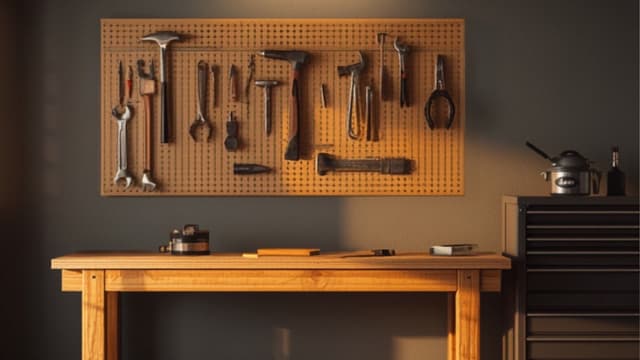
2. Vertical storage second. A Wall Control metal pegboard kit gets hand tools off the bench and onto the wall where you can see them. Metal holds heavy tools that snap hardboard pegboard, and it instantly doubles your usable bench space for very little money.
3. Light third. You cannot do good work you cannot see. A pair of LED shop lights transforms a dim garage, our LED work lights guide covers what to buy and how to mount it.
4. Cleanup fourth. The Stanley 6-gallon wet/dry shop vac handles sawdust, spills, and debris. Compact and cheap, it is the right cleanup tool before you need full dust collection.
5. Heat last, if you need it. The Dr. Infrared DR-968 1500W plug-in heater takes the edge off a cold garage in spring and fall without wiring anything into the wall.
That is a complete starter shop: a place to work, organized storage, light to see, a way to clean up, and warmth when you need it, all on a 120V outlet, all under roughly its current retailer price. From here you add the actual tools, and the smartest first tool purchase is a mechanics tool set for hand-tool coverage and a starter drill from our cordless platform buyer's guide, which makes sure your first battery decision does not box you in later.
Who Tier 1 is for
Renters, first-time homeowners, and anyone setting up their first garage who wants a genuinely usable shop without a big outlay. Build this, work in it for a season, and you will know exactly what to upgrade first.
Tier 2: The $1,500 Serious DIY Shop
This is the tier where a garage stops being a place you tolerate and becomes a place you want to be. You are not replacing the starter shop, you are upgrading its weak points and adding capability. Buy in this order:
1. Upgrade the bench. Step up to the Seville Classics UltraHD heavy-duty workbench, a steel-and-wood bench rated to roughly 1,000 lbs with leveling feet that stays dead steady under clamping and pounding. Move the starter bench to a secondary station or assembly area.
2. Add a vise. A bench without a vise is half a bench. A solid bench vise turns your surface into a third hand for metalwork, woodworking, and repair, the single most-used clamp in any serious shop.
3. Get real storage. The Husky 52-inch 9-drawer mobile workbench is both a rolling chest and a second work-top. Nine ball-bearing drawers organize the tools that were living in piles, and it rolls where you need it.
4. Light the whole shop. Move from a couple of work lights to full coverage. Even, bright LED lighting across the ceiling, again from our LED work lights guide, eliminates the shadows that hide mistakes.
5. Upgrade cleanup. The CRAFTSMAN 16-gallon shop vac triples your capacity and reach, so cleanup stops interrupting work.
6. Add dust collection. If you do any woodworking, the WEN 12-gallon dust collector captures chips and dust at the machine, where a shop vac cannot keep up. This is a health upgrade as much as a cleanup one.
A $1,500 shop is where most serious DIYers happily stop. It has a bench that does not move, storage that keeps tools findable, light that reveals everything, and air clean enough to breathe. With the room this dialed in, the tool budget can grow into a real cordless platform with a drill, impact driver, and circular saw, plus the mechanics tool set and torque wrench that make it a true working garage.
Who Tier 2 is for
Committed DIYers, weekend woodworkers, and home mechanics who use their garage every week and want it stable, organized, well-lit, and clean enough for real projects.
Tier 3: The $5,000 Dream Garage
This is the shop you stop wishing for. Tier 3 keeps everything from Tier 2 and adds the infrastructure and big tools that make a garage truly complete. The order matters less here because you are filling in a finished room, but the priorities are clear:
1. Add compressed air. An air compressor unlocks impact tools, nailers, spray finishing, tire inflation, and blow-off cleaning. Our portable air compressors guide covers sizing it to your tools, this is the single biggest capability jump in a dream shop.
2. Heat it properly. Replace the plug-in heater with the Dr. Infrared DR-988 240V 5600W industrial heater, wall or ceiling mounted, hardwired, thermostat-controlled. This is what turns a freezing winter garage into a year-round workspace. Budget for an electrician to run the 240V circuit.
3. Go premium on storage. Expand to a full rolling tool chest and cabinet combo from our tool chest guide, plus more wall and bin organization so every tool has a home.
4. Add the stationary tools. Now the exciting purchases earn their place: a table saw, miter saw, drill press, and more. Our workshop equipment guide sequences the big machines so you buy the ones your projects actually demand.
5. Plan for power and backup. A fully loaded shop draws serious current. A portable power station covers outages, off-grid corners of the garage, and outdoor projects without running extension cords from the house.
at the current retailer price you have a garage that does everything: a rock-solid bench, professional storage, full light, clean air, compressed air, real heat, and the stationary tools to tackle ambitious builds. If welding is on your list, the MIG welders guide covers the machine that makes a metal-capable shop, and it pairs naturally with the compressor and 240V circuit you have already installed.
Who Tier 3 is for
Serious hobbyists, side-hustle builders, and anyone for whom the garage is a genuine workspace, not just storage. If you spend real hours out here and want zero compromises, this is the build.
What Each Tier Actually Buys You
Budgets are abstract until you see what they put in the room. Here is the honest breakdown of what each tier delivers, and just as importantly, what it deliberately leaves out so the money lands where it counts.
Category
Starter
Serious DIY
Dream Garage
Workbench
Adjustable hardwood-top
Heavy steel-and-wood
Heavy bench plus a second station
Storage
Metal pegboard
Pegboard plus rolling chest
Full chest and cabinet plus wall systems
Clamping
Add later
Bench vise
Vise plus clamp wall
Lighting
Two work lights
Full ceiling LED coverage
Full coverage plus task lighting
Cleanup
6-gallon shop vac
16-gallon shop vac
Shop vac plus dust collection network
Dust collection
Not yet
Entry single-stage
Larger collector plus separator
Compressed air
Not yet
Optional small pancake
Real shop compressor
Heat
1500W plug-in
1500W plug-in
Hardwired 240V
Stationary tools
None yet
One or two key tools
Table saw, miter saw, drill press
The pattern is deliberate. Tier 1 spends every dollar on a usable foundation and nothing on power infrastructure. Tier 2 adds stability, organization, and clean air, the things that make daily work pleasant. Tier 3 is where infrastructure (240V power, real compressed air, hardwired heat) finally justifies the big stationary tools. Trying to skip to Tier 3's table saw on a Tier 1 budget is exactly the mistake that leaves a beautiful tool unusable in a half-built room.
How Long Does It Take to Build Each Tier?
A garage shop is rarely built in a weekend, and it should not be. The smartest builders stage purchases as projects demand them, which spreads the cost and teaches you what you actually need before you buy it.
The $500 starter shop can come together in a single weekend. Assemble the bench, mount the pegboard and lights, and you are working by Sunday afternoon. This is the one tier worth buying all at once, because every piece is foundational.
The $1,500 serious shop usually builds over two to four months. Upgrade the bench and add the vise first, then the rolling chest, then dust collection as your woodworking ramps up. Let each project tell you what to buy next.
The $5,000 dream garage is a year or more, and that is fine. The 240V circuit and compressed air are infrastructure milestones to plan around, and the stationary tools come one at a time as specific projects justify them. Rushing this tier wastes money on tools you have not yet learned to need.
The discipline that saves the most money is buying the next tool when a project requires it, not when it is on sale. A clamped-up workbench, organized storage, and clean air will serve every project; a stationary tool you bought for a build you never started just takes up the floor space you need.
The Build Order: Why Sequence Beats Budget
The most expensive mistake in garage building is not overspending, it is buying in the wrong order. A clear sequence saves money at every tier because each purchase makes the next one more useful instead of redundant.
Buy this
Before this
Because
Workbench
Any power tool
You need a stable surface to use tools safely
Storage and pegboard
More tools
Tools you cannot find are tools you do not use
Lighting
Precision tools
You cannot do accurate work you cannot see
Shop vac and dust collection
Heavy woodworking
Dust is a health and cleanup problem from day one
240V circuit and heat
Big stationary tools
Many large tools and heaters need the power first
Air compressor
Pneumatic tools
Air tools are useless without the air to run them
Follow the sequence and every dollar compounds. Ignore it and you end up with a beautiful table saw sitting on a wobbly folding table in a dark garage with no way to clean the sawdust, which is exactly the situation this guide exists to prevent.
Don't Forget the Hand Tools and Battery Platform
The room is the foundation, but the work gets done with hand tools and cordless tools, and two early decisions shape your whole shop. First, anchor your hand-tool coverage with a comprehensive mechanics tool set, sockets, ratchets, and wrenches cover the overwhelming majority of fasteners you will ever turn, and a torque wrench handles anything with a spec. Second, choose your cordless battery platform deliberately, because every future drill, saw, and impact wrench you buy will be locked to that ecosystem. Getting the platform decision right early is the difference between a shop where every battery fits every tool and a drawer full of incompatible chargers.
Five Garage Setup Mistakes That Waste Money
Buying power tools before the room. A table saw needs a stable surface, light, power, and dust control. Build the room first, then the tools have somewhere to live and work.
Cheaping out on the workbench. The bench is the foundation everything sits on. A wobbly surface ruins precise work and makes the shop frustrating. Buy a real workbench at every tier.
Ignoring dust and air quality. Sawdust is a cleanup and health problem from day one. A shop vac early and a dust collector once you do real woodworking are not optional.
Mixing cordless platforms. Buying tools across DeWalt, Milwaukee, and Ryobi leaves you with incompatible batteries and dead money. Pick one platform and stay in it.
Underbuilding the electrical. A serious shop needs more than one 15-amp circuit. Plan 240V and additional outlets before you buy big tools and heat, or you will pay an electrician twice.
Frequently Asked Questions
How much does it cost to set up a garage workshop?
A genuinely usable starter shop, bench, storage, light, cleanup, and plug-in heat, runs around its current retailer price. A serious DIY shop with heavy storage, a vise, dust collection, and full lighting lands near $1,500. A fully equipped dream garage with compressed air, hardwired heat, and stationary tools is around its current retailer price and up. Each tier in this guide is complete at its level.
What should I buy first for a garage workshop?
A workbench, then storage, then lighting, then cleanup. Build the room before the tools. A stable surface, organized storage, good light, and a way to manage dust make every tool you buy afterward more useful. Power tools and stationary machines come last, once the foundation is in place.
Do I need a 240V circuit in my garage?
Not for a starter or most serious DIY shops, which run fine on 120V outlets and a plug-in heater. You need 240V once you want a hardwired garage heater that can warm the space in real winter, or large stationary tools like a big table saw, welder, or air compressor. Plan it as part of a Tier 3 dream-garage build and budget for an electrician.
What is the difference between a shop vac and a dust collector?
A shop vac is for general cleanup, sawdust on the floor, spills, and wet messes, with high suction and low airflow. A dust collector moves high airflow to capture chips and fine dust at the woodworking machine as it is created, which a shop vac cannot keep up with. A serious woodworking shop wants both.
Can I build a workshop in a one-car or shared garage?
Yes. A Tier 1 build is designed for tight and shared spaces, an adjustable-height bench, vertical metal pegboard storage, and a compact shop vac all fit a one-car garage. Mobile storage like a rolling tool chest and folding or wall-mounted surfaces let you reclaim the floor for the car when needed. Plan vertically and choose mobile units, and even a small garage becomes a real shop.
The Verdict
Build the room before the gadgets, and build it in order. The $500 starter shop, a real workbench, metal pegboard storage, LED light, a shop vac, and a plug-in heater, is a genuinely usable garage that costs less than one premium power tool. The $1,500 serious DIY shop adds a heavy bench, a vise, a rolling tool chest, full lighting, and a dust collector, the level where real projects happen comfortably. The $5,000 dream garage layers on an air compressor, a hardwired 240V heater, premium storage, and the big stationary tools from our workshop equipment guide. Whichever tier you start with, buy in sequence so every purchase compounds, anchor your hand tools with a mechanics tool set, commit to one cordless platform early, and you will build a garage that works the first time instead of a collection of tools you cannot use. For keeping a fully loaded shop powered anywhere, finish with our portable power stations guide.
Package: verify current retailer listing before checkout
The foundation of a starter shop. A genuine hardwood bench with adjustable height at a price that leaves budget for the tools that go on it.
Key features
48-inch rubberwood top, height adjustable
Rated to roughly 2,000 lbs load capacity
Steel frame, assembles in under an hour
Compact footprint for a one-car or shared garage
Pros
A real hardwood-top bench at a starter price
Height adjustment fits standing or seated work
Holds far more than a homeowner will ever load it with
Small enough to fit a tight or shared garage
Cons
Not as rock-solid as a welded fixed bench
Top will mark up with heavy abuse, as any bench does
Who it's for: First-shop builders who need a sturdy, affordable work surface that fits a modest garage and supports everything from assembly to light repair.
Kit/package: verify included batteries before checkout
The smartest small investment in a starter shop. Vertical metal storage instantly doubles your usable bench space and keeps tools where you can see them.
Key features
Galvanized steel pegboard, far stronger than hardboard
Includes a starter set of hooks and brackets
Holds heavy tools that snap standard pegboard
Wall-mounted, frees up bench and floor space
Pros
Metal board holds heavy tools hardboard pegboard cannot
Gets hand tools off the bench and onto the wall, visible
Modular hooks reconfigure as your tools change
One of the best storage values in any shop tier
Cons
Hooks beyond the starter set are an added cost
Requires solid wall anchoring for heavy loads
Who it's for: Anyone whose tools are piling up on the bench or in a drawer and who wants visible, vertical, reconfigurable storage on a budget.
This guide is research-backed. It compares exact-model manufacturer sources, current market information, and recurring owner feedback; it does not claim direct physical testing. No paid placements influence our rankings.
Model identity (Primary)Exact model, kit contents, voltage platform, and current manufacturer documentation are matched before products are compared.
Use-case fit (Primary)Published capacity, controls, dimensions, compatibility, and limitations are evaluated against the jobs and buyers named in the guide.
Comparison consistency (Primary)Every option is assessed against the same category-relevant criteria, with unsupported performance assumptions excluded.
Warranty and support (Secondary)Current warranty terms, platform support, replacement options, and manufacturer documentation are reviewed for ownership risk.
Price and owner signals (Secondary)Current pricing and recurring verified-owner patterns inform value and reliability context without being presented as our own test results.
Morgan Hale checks exact model identities, manufacturer documentation, warranty terms, package contents, and current retailer listings. Research-backed recommendations are labeled as research and are not presented as physical tests.